
A household planning a move and a business planning a relocation may both search for a mover, but they can need different evidence and next steps. Commercial acquisition is not simply a residential campaign with a different keyword. Design each path around the people involved, the scope that must be assessed and the decision the customer is ready to make.
 View full-size graphic ↗
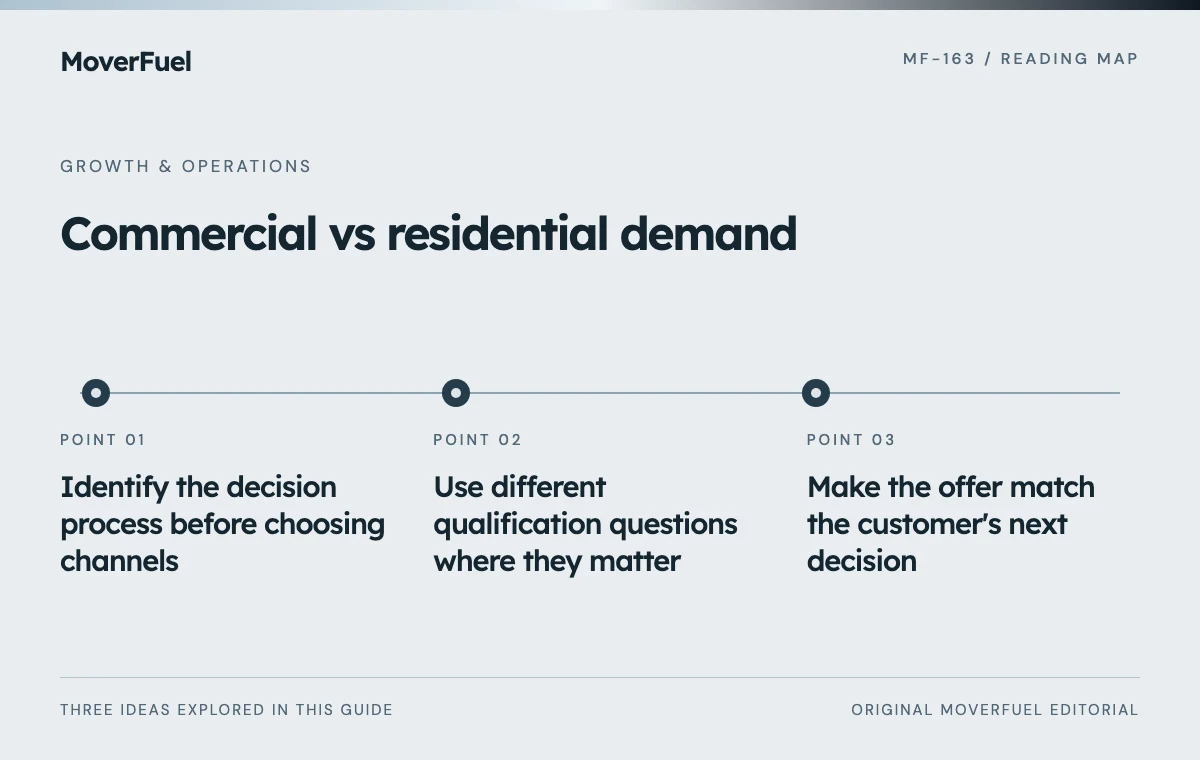
Identify the decision process before choosing channels
Scroll the table horizontally to compare all columns.
| Dimension | Residential inquiry | Commercial inquiry |
|---|---|---|
| People involved | Individual or household decision-makers | Potentially facilities, operations, procurement and leadership |
| Scope questions | Inventory, access, dates and requested help | Assets, access, continuity, phases and stakeholder requirements |
| Useful next step | Appropriate household estimate process | Scope discussion, site survey or project assessment |
| Decision evidence | Clear scope, trust and understandable terms | Delivery plan, relevant capability and documented requirements |
These are planning distinctions, not universal rules. A small office relocation may be straightforward, while a complex household move may require extensive coordination. Ask how the actual customer will decide rather than imposing a fixed sales-cycle assumption.
Record whether the person making the inquiry can approve the work or is gathering information for others. This helps the team provide useful material without treating an early researcher as a failed sales opportunity.
Use different qualification questions where they matter
Both paths need service fit, locations, timing and contact information. Beyond that common foundation, collect only details necessary to determine the next step. A household should not face a procurement questionnaire, and an office project should not be reduced to a bedroom count.
Clarify commercial constraints early
Ask about the premises, broad project scope, access restrictions, operating hours and any required coordination. If specialist assets or regulated activities are involved, route them for appropriate assessment rather than promising capabilities from a generic form.
For residential work, explain how the company obtains the information needed for an estimate. FMCSA's consumer guidance addresses written estimates and related requirements for interstate household-goods moves; do not generalize those rules into a claim about every commercial or intrastate job. [1]
Make the offer match the customer's next decision
A residential landing page might help a customer understand the move types supported and request an appropriate estimate. A commercial page may need to explain a project assessment, operational coordination and what information the team will review before proposing work.
Use relevant proof. A genuine household testimonial may demonstrate care, but it does not establish experience with a complex office relocation. When approved commercial work is unavailable, explain the process and verified capabilities without inventing client logos or case studies.
The CTA should name the next step honestly. Do not promise an instant final price when the work requires assessment. Equally, avoid a vague enterprise consultation label when the customer simply needs to discuss a small office move.
Explore the different needs of commercial movers and local moving companies before choosing page content.
Choose channels by reachable intent and evidence
Search campaigns can address explicit service needs, while content and relationship activity may support research before a project is ready. Do not assume one platform is inherently best for every commercial or residential market. Test whether it reaches appropriate inquiries at a sustainable cost.
Separate campaign messages when the service proposition and landing experience differ. Review search terms and inquiry reasons to identify mismatches. A campaign labeled commercial is not successful merely because it receives business-related clicks.
SBA marketing planning guidance recommends connecting goals, actions, budgets and measures. Apply that structure to each buying path instead of copying the same channel allocation across service categories. [2]
Maintain transparent partner relationships and truthful promotion. Commercial networking should not become undisclosed paid praise, and residential referral activity should not be confused with customer-review incentives.
Measure progress toward the correct commercial outcome
Scroll the table horizontally to compare all columns.
| Stage | Household example | Commercial example |
|---|---|---|
| Inquiry | Move request received | Relocation discussion requested |
| Qualified | Service, timing and geography fit | Project scope and capability fit |
| Assessment | Estimate information obtained | Survey or requirements review completed |
| Offer | Estimate provided | Scoped proposal provided |
| Outcome | Booked, completed or lost | Approved project, completed work or lost |
Define the terms in the CRM and keep the evidence behind each status. A survey is meaningful progress but not booked revenue. A signed project may still differ from completed work and recognized revenue. Report those distinctions explicitly.
Compare mature cohorts. A commercial project still awaiting a customer decision should not be counted as a loss simply because a residential estimate would usually have resolved earlier in that particular business. Use observed timing, not an invented industry standard.
Allocate effort using fit and contribution
Consider acquisition cost, assessment effort, delivery requirements and useful contribution together. A larger contract value does not automatically make a commercial campaign more attractive, and a smaller household job is not automatically less efficient.
Review the company's actual capabilities and appetite for each service. Marketing can generate demand, but the business still needs the people, planning and fulfillment process to serve it well. Document why the chosen mix fits the operating plan.
Use conversion optimization and lead tracking to improve the appropriate path rather than forcing both into one generic funnel.
Common questions
Do commercial moving leads always take longer to book?
No fixed timeline applies to every project. Stakeholders and assessment needs can add steps, but complexity varies. Use the company's observed decision cycles and label immature opportunities.
Should commercial and residential services share one form?
They can share basic contact fields, but the experience should route customers to relevant questions and next steps. Avoid making either audience complete irrelevant requirements.
Your next step
Build acquisition around the customer's decision process. Distinct qualification, assessment and measurement paths make both residential and commercial marketing more useful.
Sources & editorial notes
Platform claims cite the documents below. Operating frameworks and labeled examples are MoverFuel editorial analysis, not client results or industry benchmarks.
- FMCSA: avoiding unexpected moving costsFMCSA estimate guidance applies to interstate household-goods moves and should not be generalized to every moving service. Reviewed .
- SBA: marketing and salesMarketing planning connects objectives, actions, budgets and measurement; the two funnel maps are original editorial frameworks. Reviewed .