
Local and long-distance movers can share a brand while needing different acquisition plans. The important differences are not simply trip length or ticket value. They include who is searching, where the job starts and ends, what the customer needs to understand and how long an inquiry takes to become booked work. Build the journey around the actual service rather than assuming that one successful local campaign can be expanded nationally unchanged.
 View full-size graphic ↗
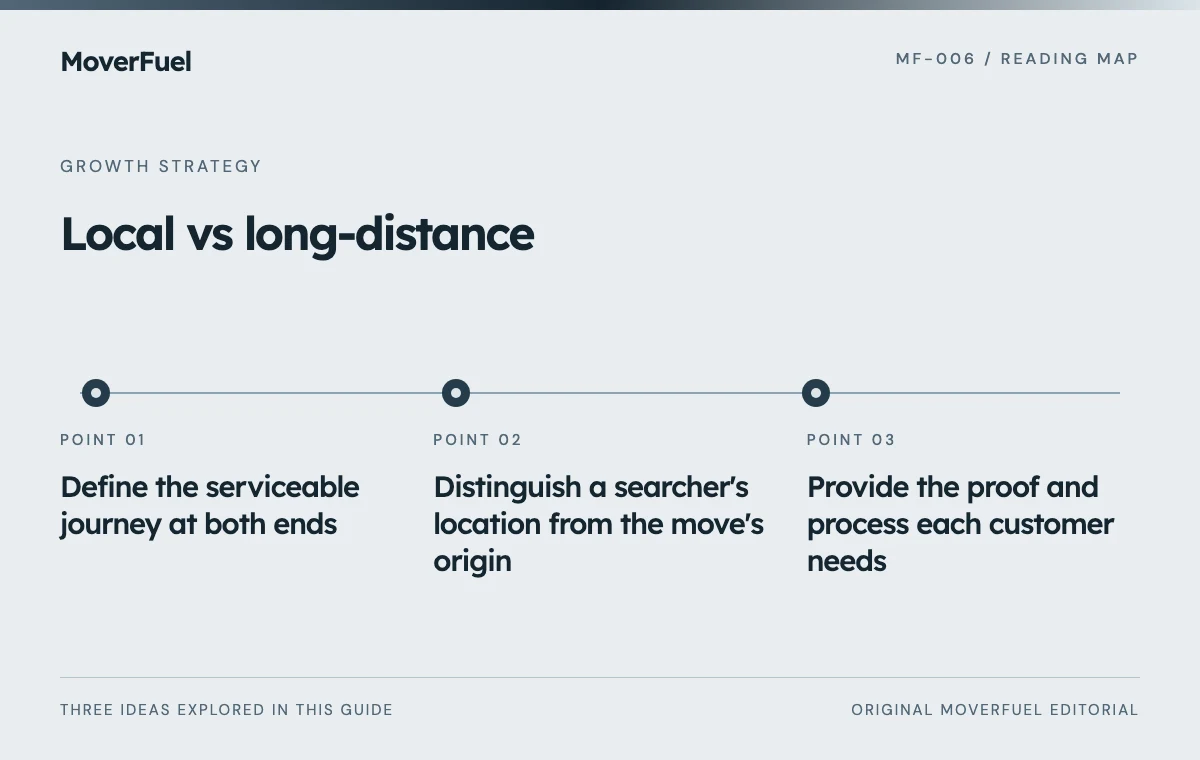
Define the serviceable journey at both ends
For local work, coverage may be expressed through familiar neighborhoods and a practical dispatch area. Long-distance work needs a clear origin-destination definition. A company may serve some origins broadly while accepting only certain routes, dates or service arrangements. The marketing brief should describe those limits before a campaign advertises wide coverage.
Keep long-distance and interstate terminology accurate. A long trip can stay within one state, while a shorter trip can cross state lines. Use the operator's approved service descriptions and applicable requirements instead of treating a distance label as a legal classification. FMCSA's interstate moving resources help customers understand the parties and process involved. [1]
Scroll the table horizontally to compare all columns.
| Question | Local household move | Long-distance inquiry |
|---|---|---|
| Where is the work? | Origin and destination within accepted coverage | Both ends of the route and any operational restrictions |
| When is it needed? | Preferred date and local crew availability | Pickup, delivery expectations and timing flexibility |
| What is the next step? | The appropriate local estimate conversation | Enough route and inventory context to choose the estimate process |
Distinguish a searcher's location from the move's origin
A customer can research a move while traveling, helping a relative or planning a relocation to a city they have not reached. Their current device location is not a complete description of the job. This matters when interpreting geographic reports and deciding which targeting settings fit the offer.
Google's advanced location options distinguish presence from interest in a place, using signals that are not perfectly accurate. A local campaign may intentionally focus on people in its service area. A route-oriented campaign may need to reach people researching an origin or destination from elsewhere. Check the operational use case before applying the same setting to both. [2]
Review the customer records behind apparent geographic waste. Some out-of-area users produce valid jobs; some local users request routes you cannot serve. The useful optimization signal is the move's fit, not a simplistic assumption that every device outside the target area is irrelevant.
Provide the proof and process each customer needs
Local customers may want to recognize the crew, understand neighborhood coverage and see how the company handles access, packing or scheduling. Long-distance customers may need more explanation of the parties involved, the estimate process and how the service is organized. Use approved facts rather than promising details the operator cannot confirm.
Make the provider's role clear
FMCSA distinguishes a household-goods mover from a broker. Marketing should identify the business accurately and avoid implying that a broker directly performs every move or that an operator offers services beyond its actual role. Have the operator review service and registration representations before publication. [1]
In both cases, trust should be inspectable. Use authentic reviews, approved photographs and relevant process explanations. A generic claim of being the best mover in every city does little to explain a complex relocation. A specific description of what happens after the inquiry can reduce uncertainty without promising an outcome.
Change the qualification path without overloading the first form
Use a common foundation of contact details, origin, destination and timing, then ask service-specific questions when they become necessary. Local moves may need access and home-size context. Long-distance moves may require route and inventory detail earlier. Commercial work needs its own project discussion rather than being forced into a household form.
- Explain why route and timing information is requested.
- Allow a reasonable clarification path when the customer does not yet know every detail.
- Distinguish a preferred date from confirmed availability.
- Route inquiries to the team qualified to handle the service.
- Keep the original request and later clarifications connected to one lead record.
The lead qualification guide provides a shared definition of fit while keeping unknown details and sales readiness separate.
Do not compare form completion rates without considering what the forms ask. A more detailed route inquiry may produce fewer submissions but more useful conversations. Conversely, a long form can create unnecessary friction. Judge the entire path to a suitable estimate, not the form metric alone.
Compare outcomes on timelines that fit the service
An imminent local move and a planned interstate relocation may progress on different schedules. Reporting only same-week bookings can favor the faster journey even when the other service produces valuable work later. Preserve inquiry cohorts and review them after an appropriate period for the actual sales process.
Scroll the table horizontally to compare all columns.
| Dimension | Why it matters |
|---|---|
| Service and route | Different jobs can have different fulfillment costs and operational limits |
| Inquiry, booking and service date | Activity in one week may concern different customer cohorts |
| Qualification definition | A valid local request and a valid interstate route need different checks |
| Cancellation and completion | A booking is not the same as delivered work |
| Attribution limits | Several discovery paths may influence the same customer |
Use actual job economics to evaluate acquisition cost. A larger invoice does not necessarily support a larger marketing allowance if fulfillment and sales costs also rise. Avoid importing an assumed industry margin into a route-expansion decision.
Expand from operational evidence
For local expansion, confirm that the company can serve the area and that any proposed business profile represents an eligible real operation. Google's profile guidelines do not treat a rented mailing address as a substitute for an operating location. Website coverage pages should explain genuine service availability rather than manufacture branches. [3]
For long-distance expansion, define the proposed lanes, dates, estimate capacity and service responsibilities. Start with a bounded test and review route-level qualification. If most inquiries cannot be fulfilled, wider reach has not established a growth opportunity; it has exposed a mismatch to resolve.
Keep successful elements that genuinely transfer, such as accurate tracking or a reliable response process. Rework the parts that depend on the customer journey: targeting, service explanation, qualification and reporting windows. Expansion should carry forward learning without assuming every market behaves the same way.
Common questions
Can local and long-distance services use the same website?
Yes, if the site clearly explains each service, its coverage and the next estimate step. Shared branding can coexist with separate service pages and qualification paths.
Is every out-of-area advertising click wasted?
No. The searcher may be planning a move from an origin you serve. Inspect the actual job route and the campaign's intended customer journey before deciding that device location proves a mismatch.
Should long-distance campaigns be judged by the same weekly booking rate?
Only when the comparison accounts for the actual sales cycle, service mix and cohort maturity. Otherwise, the faster journey can appear stronger simply because its outcomes arrive sooner.
Your next step
Make the route and operating promise explicit, ask the questions appropriate to the service and compare mature outcomes. Local and long-distance marketing can share infrastructure while using different acquisition and estimate decisions.
Sources & editorial notes
Platform claims cite the documents below. Operating frameworks and labeled examples are MoverFuel editorial analysis, not client results or industry benchmarks.
- FMCSA: tips for a successful moveInterstate moving context and the distinction between movers and brokers; no jurisdiction-specific legal conclusion is offered. Reviewed .
- Google: advanced location optionsLocation presence/interest settings and limitations of geographic signals. Reviewed .
- Google: representing your businessReal-location and service-area business representation requirements. Reviewed .