
A booked move can add revenue without leaving enough contribution to support the business. To evaluate what you can afford to spend acquiring work, start with the job's revenue and relevant variable costs, then deduct a clearly defined acquisition cost. The amount left still needs to support fixed costs and the business's profit requirements.
 View full-size graphic ↗
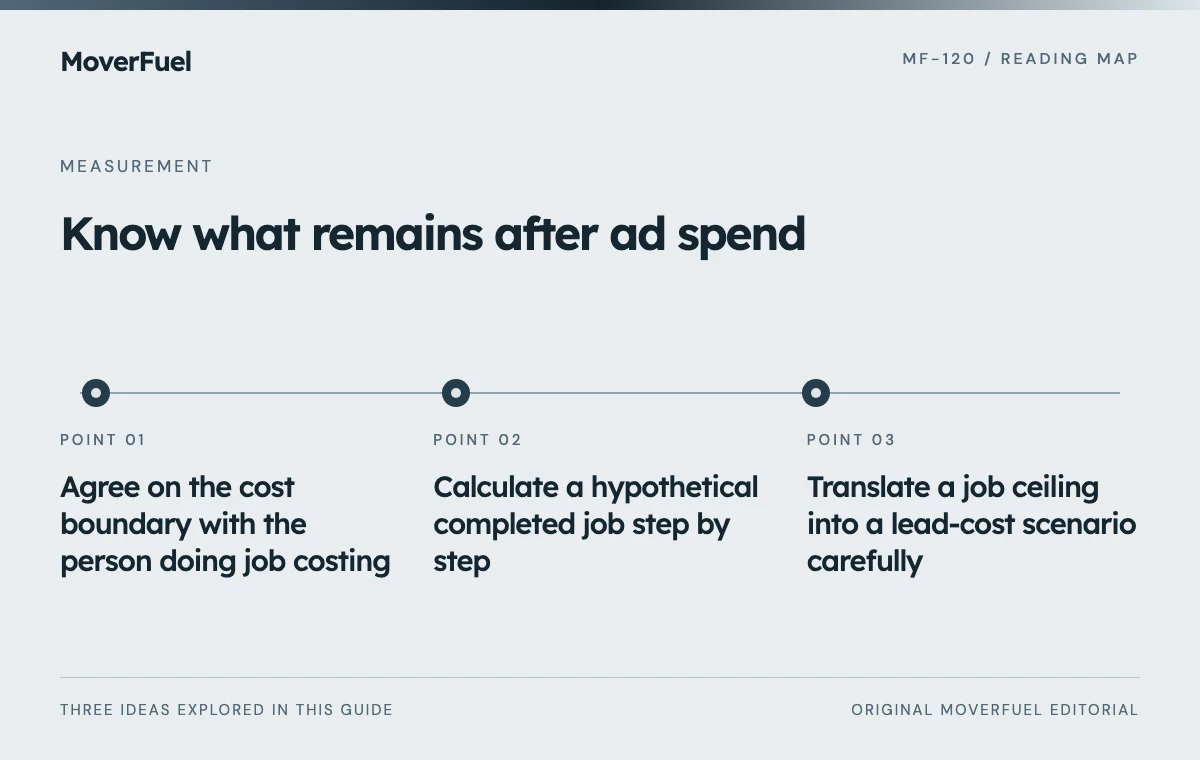
Agree on the cost boundary with the person doing job costing
Contribution margin is sales revenue less variable costs. It is available to cover fixed costs and then profit; it is not automatically net income. Cost behavior must be assessed within the relevant operating range. [1]
For moving work, review which labor, materials, fuel, travel and subcontracting costs change with the job. Do not assume that every payroll or vehicle expense is purely variable, or that every recurring bill is irrelevant to the decision. Use the company's actual cost structure.
Scroll the table horizontally to compare all columns.
| Cost | Question for the business | Reporting treatment |
|---|---|---|
| Crew labor | Which portion changes with this work? | Use the relevant incremental or variable amount |
| Packing materials | What is consumed by this job? | Assign supported job cost |
| Travel and fuel | What additional movement is required? | Include the relevant route cost |
| Equipment capacity | Does the job require additional capacity? | Model any step change separately |
| Acquisition | Media only or a broader defined cost? | Label the scope and avoid duplication |
Keep this management worksheet distinct from formal financial statements. It supports an acquisition decision under stated assumptions; it does not replace the accounting treatment required for the business's books.
Calculate a hypothetical completed job step by step
Scroll the table horizontally to compare all columns.
| Item | Amount |
|---|---|
| Completed-job revenue | $2,400 |
| Variable crew cost | $900 |
| Materials | $100 |
| Relevant travel and fuel | $150 |
| Other variable fulfillment | $50 |
| Total variable fulfillment | $1,200 |
| Contribution before acquisition | $1,200 |
| Assigned acquisition cost | $300 |
| Contribution after acquisition | $900 |
The job contributes $2,400 − $1,200 = $1,200 before acquisition. After the defined $300 acquisition cost, $900 remains. Relative to revenue, that remaining contribution is 37.5%. These are fictional inputs for explaining the calculation, not a typical moving margin.
The $900 is not net profit. Fixed overhead and other obligations remain. If management wants to reserve $600 per comparable job toward those requirements and its profit objective, this simplified scenario leaves a $600 acquisition ceiling before any further risk adjustment: $1,200 − $600.
Translate a job ceiling into a lead-cost scenario carefully
An acquisition limit per completed job can inform a lead-cost scenario only when the completion rate is defined. Multiply the job-level limit by the probability that a unique acquired inquiry becomes completed work, while ensuring the cost scopes match.
Scroll the table horizontally to compare all columns.
| Inquiry-to-completion rate | Maximum all-in cost per inquiry under these assumptions |
|---|---|
| 10% | $60 |
| 20% | $120 |
| 30% | $180 |
If the ceiling is all-in, media cannot consume the entire amount when management, creative or intake costs also belong in that scope. Deduct those costs consistently before deriving a media-only allowance. Use mature, comparable cohorts to estimate completion rates.
The cost-per-booked-move guide explains why bookings and completions need separate denominators.
Do not use an optimistic close rate from a few jobs to justify a large budget. Show a conservative range and update it as actual outcomes arrive. A lead-cost target is a conditional planning result, not a platform performance promise.
Recalculate when the next job changes capacity
A job that fits an idle crew can have different incremental economics from one that requires overtime, a rental vehicle or subcontracting. Conversely, accepting it may displace another profitable job. These effects can make the next acquired move different from the average completed move.
Keep average reporting separate from the next spending decision
Average contribution explains the historical mix. A budget increase asks what additional demand is likely to produce and what it costs to fulfill. Review available dates, service mix and branch capacity before assuming a past average remains valid at a larger volume.
Keep service categories separate when their cost behavior differs. Storage, long-distance and commercial work should not automatically inherit a local residential acquisition ceiling. Build an appropriate model for each material operating pattern.
Use a repeatable contribution review
Reconcile revenue and costs after completion, including material corrections or refunds. Compare actual contribution with the estimate and explain the largest differences. If route costs or labor requirements were understated, update the planning model before buying more of the same demand.
Report contribution after media separately from contribution after all defined acquisition costs when both are useful. Keep names precise so one team does not celebrate a media-only result while another assumes management and sales effort have already been deducted.
Review the reserve and working ceiling with finance and operations. The output should support a bounded marketing decision that the business can afford and fulfill, while preserving uncertainty where job costs or completion rates are not yet reliable.
Common questions
Is contribution after advertising the same as profit?
No. It remains available for fixed costs and other obligations. State which costs have been deducted before interpreting the result.
Can one acquisition ceiling apply to every move?
Only if the underlying economics are sufficiently comparable. Different services, routes and capacity conditions often require separate scenarios.
Your next step
Work from job contribution to a clearly scoped acquisition allowance. Keep cost behavior, completion rates and capacity visible so a revenue win does not conceal an uneconomic move.
Sources & editorial notes
Platform claims cite the documents below. Operating frameworks and labeled examples are MoverFuel editorial analysis, not client results or industry benchmarks.
- OpenStax: contribution margin and cost behaviorContribution-margin definition, fixed-cost coverage and relevant-range cost behavior. Job, reserve and lead-ceiling scenarios are original hypothetical calculations. Reviewed .