Creative testing becomes useful when each version tests an explanation of why a customer might choose the service. Changing a button color or swapping a truck photo can generate variation without producing a meaningful lesson. Start with a buying barrier, design a distinct concept and define the decision the results will inform.
 View full-size graphic ↗
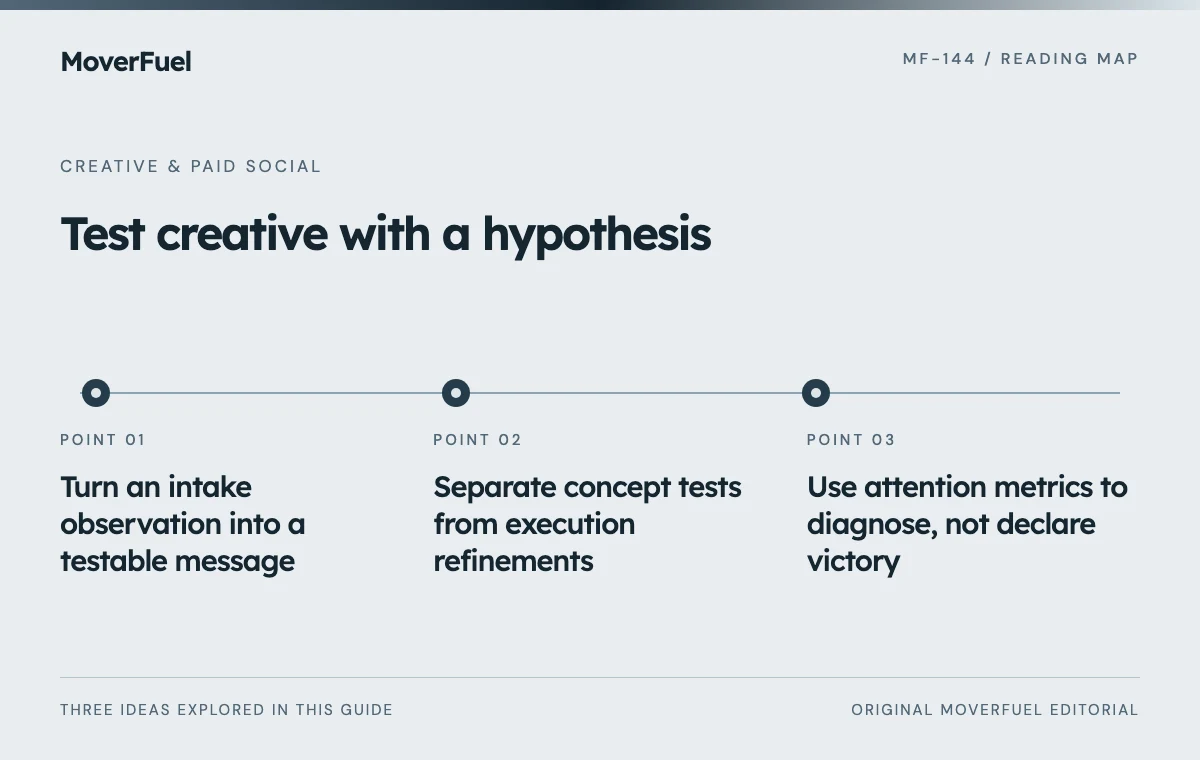
Turn an intake observation into a testable message
Read real, appropriately handled intake notes and customer questions. A recurring concern about packing scope suggests a different creative hypothesis from a concern about building access. Use those observations to choose the message rather than inventing a generic fear for the ad.
Scroll the table horizontally to compare all columns.
| Observed barrier | Hypothesis | Creative concept | Outcome to inspect |
|---|---|---|---|
| Packing inclusions unclear | A scope explanation improves fit | Show what the available packing service includes | Fewer scope mismatches among inquiries |
| Customer unsure of estimate process | A process preview reduces uncertainty | Explain the actual next steps | More qualified estimate completion |
| Office coordinator worries about disruption | Planning evidence supports a useful conversation | Show an approved project sequence | More suitable commercial survey requests |
A hypothesis should be falsifiable. ‘This creative will be better’ does not say what better means or why. Record what would count as evidence against the concept, including a misunderstanding that increases inquiries but reduces fit.
Separate concept tests from execution refinements
Decide whether the message or its expression is changing
A concept test compares different reasons to respond, such as scope clarity versus process confidence. An execution test might compare two openings for the same concept. Mixing a new offer, audience, format and destination into one comparison makes it difficult to identify the cause of a difference.
Use a common service, offer and qualification definition where practical. Record the versions, dates, budget boundary, placements and destination. If platform delivery is automated, recognize that the variants may not receive comparable exposure or audience mix.
Scroll the table horizontally to compare all columns.
| Field | Required decision |
|---|---|
| Primary hypothesis | What customer barrier is being addressed? |
| Changed element | Concept, opening, proof or call to action? |
| Held conditions | Which offer, audience and intake rules remain comparable? |
| Primary outcome | What business result determines the next action? |
| Diagnostics | What explains the result without replacing it? |
| Stop conditions | What error, cost or misleading message requires intervention? |
Use attention metrics to diagnose, not declare victory
Views, engagement and click-through can show whether people noticed or understood an opening. They cannot establish that the resulting inquiries fit the company's service areas, dates and capacity. Connect the test to unique qualified opportunities and mature business outcomes.
A fictional example: concept A attracts 60 forms, of which 12 qualify; concept B attracts 40 forms, of which 16 qualify. Without spend and downstream outcomes, neither is a proven winner. The example shows why form volume and qualification rate answer different questions.
Track staff handling effort and complaints as well. A provocative hook may create curiosity and confusion that cost the intake team time. A useful creative should bring an understandable offer to suitable customers, not simply maximize reactions.
Use lead tracking to retain the creative version and business outcome without exposing private customer information in campaign fields.
Make small-sample uncertainty visible
Display counts beside rates and keep the outcome observation window consistent. One extra booking can swing a small test dramatically. Do not stop a comparison the first time a preferred version appears ahead and then describe the result as reliable evidence.
NIST's guidance on comparing proportions distinguishes methods and assumptions, including the limitations of large-sample approximations. A statistical test needs an appropriate design and data; there is no universal sample size that makes every moving-ad experiment conclusive. [1]
For low-volume commercial work, qualitative evidence may guide the next iteration while quantitative outcome estimates remain uncertain. Label that as informed judgment, not a measured conversion lift.
Investigate deterioration before calling it creative fatigue
A decline can reflect audience saturation, seasonal demand, price changes, weaker intake coverage or tracking defects. Review those conditions alongside frequency, reach and response quality. Replacing the image will not fix a form that stopped delivering inquiries.
Compare the creative's original audience and offer with its current delivery. If the campaign expanded into different geography or services, the old result may no longer be comparable. Keep a change log so the team can distinguish a message problem from a campaign change.
Retire inaccurate or outdated creative immediately, regardless of historical performance. For truthful but weakening assets, test a specific new explanation or execution rather than endlessly producing cosmetic variations.
Write a decision that improves the next brief
Close each test with the hypothesis, observed counts, limitations, decision and next question. Save the actual asset and destination versions. A useful lesson might be that customers understood packing scope better, while booked-job evidence remains immature.
Share the lesson with sales and operations. They may identify whether the campaign attracted a different service mix or set an expectation the team could not fulfill. The next brief should incorporate that feedback, not only the platform's best-performing thumbnail.
Connect creative production and paid social management through the same experiment register.
Common questions
How many ad variations should a mover test at once?
Use a number the available budget and outcome volume can support meaningfully. A few distinct hypotheses are often easier to interpret than many underexposed variations, but there is no universal count.
Can click-through rate choose the best creative?
It can diagnose attention and message response. The business decision should also consider qualified inquiries, mature outcomes and handling effort under comparable conditions.
Your next step
A creative test should leave a usable lesson about the customer and offer. Define the hypothesis, preserve the comparison and report uncertainty before deciding what to scale.
Sources & editorial notes
Platform claims cite the documents below. Operating frameworks and labeled examples are MoverFuel editorial analysis, not client results or industry benchmarks.
- NIST: comparing two proportionsNIST guidance explains assumptions and methods for comparing proportions; it does not prescribe a universal advertising sample size. Reviewed .