
A shorter form produces more submissions. That sounds like a successful test until the estimating team discovers that many new inquiries lack a serviceable route. A useful landing-page experiment starts with a business question and a decision rule, then checks whether the change improves the kind of demand the moving company can actually serve.
 View full-size graphic ↗
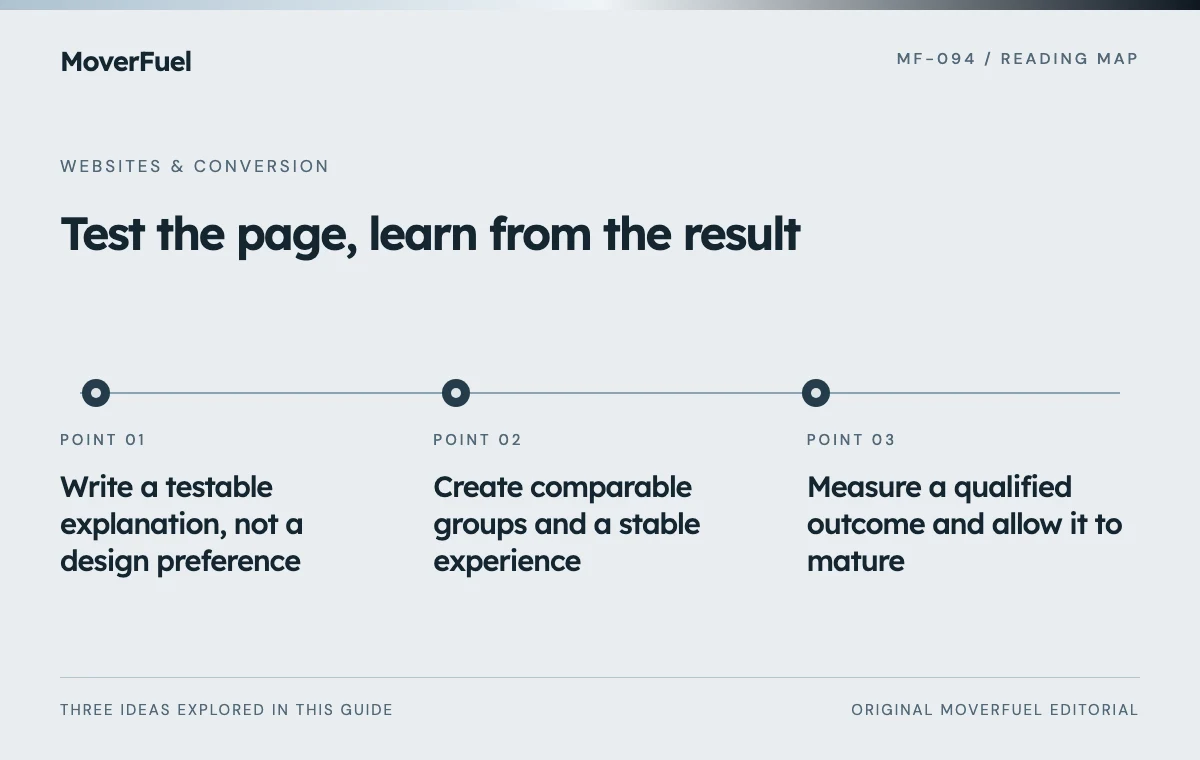
Write a testable explanation, not a design preference
State the observed problem, proposed change and expected mechanism. For example: customers may abandon a form because it requests a full inventory before they understand the estimate process; explaining the next step and moving detailed inventory collection later may improve qualified completion. That is more useful than ‘test a cleaner page.’
Scroll the table horizontally to compare all columns.
| Field | Example decision |
|---|---|
| Audience | Mobile visitors to the local-moving campaign page |
| Change | Explain the survey step before the contact form |
| Primary outcome | Qualified inquiries per eligible visitor |
| Guardrails | Spam, unserviceable routes and intake workload |
| Decision | Adopt only if the evidence supports useful improvement |
| Owner | One person responsible for data and release decisions |
Choose an improvement that addresses an observed obstacle. Session behavior, sales feedback and form errors can generate hypotheses, but none proves the proposed design will work. The experiment is how you test that explanation.
Create comparable groups and a stable experience
Randomly assign eligible visitors and keep a visitor's assigned version consistent during the experiment where your tooling permits. Avoid sending one campaign to version A and a different campaign to version B, then attributing the audience difference to design.
Document exclusions before launch: staff traffic, automated activity and known test submissions. Verify the expected allocation and investigate unexpected imbalances. If tracking fails on one version, pause the experiment and repair it rather than comparing incomplete records.
Run versions over comparable conditions
A before-and-after comparison can be distorted by seasonality, weather, promotions, staffing or campaign changes. Concurrent allocation helps reduce those timing differences, though it does not eliminate every source of bias. Record material operational changes and decide whether they invalidate the test.
Avoid changing several unrelated elements when the goal is to understand one mechanism. A complete page redesign can be tested as a package, but its result cannot tell you which individual component caused the difference.
Measure a qualified outcome and allow it to mature
Define qualification before reviewing results. For a local mover, that may include an offered service, serviceable origin and destination, plausible timing and valid contact information. Keep qualification consistent across versions so a subjective review does not favor the preferred design.
Bookings may take longer than form submissions. Use a defined observation window and compare cohorts with similar maturity. If the primary outcome is qualified inquiry rate, examine estimates and bookings as downstream evidence without pretending that early records are final.
Use the moving lead qualification framework to establish outcome definitions before the test starts.
Choose a sample and stopping plan appropriate to the question
Sample requirements depend on the baseline rate, the smallest improvement worth detecting, uncertainty tolerances and the method used. There is no universal visitor count that makes every moving-company test conclusive. A low-volume page may need more time than the business can reasonably wait.
NIST describes methods for comparing proportions, including a large-sample approximation and an exact approach for small samples. The choice depends on the data and assumptions; a percentage difference should not be treated as a statistical conclusion on its own. [1]
Set the analysis and stopping rule in advance with someone qualified to interpret it. Repeatedly checking a conventional fixed-sample test and stopping at the first favorable result can invalidate its intended error control. If using a sequential method, understand and follow that method's rules.
Report uncertainty and the practical size of the effect. A statistically detectable change may be too small to justify added maintenance or intake work. An inconclusive result means the evidence did not settle the question, not that the two experiences are identical.
Keep a decision log that survives the experiment
Scroll the table horizontally to compare all columns.
| Record | Why it matters |
|---|---|
| Versions and dates | Makes the tested change reproducible |
| Eligible sample and exclusions | Explains the comparison population |
| Primary outcome and uncertainty | Separates observation from confidence |
| Guardrail outcomes | Reveals quality or workload tradeoffs |
| Decision and limitations | Prevents an inconclusive test becoming a success story |
After adopting a version, verify its production implementation, form delivery and analytics. Remove obsolete experiment code when appropriate. Continue monitoring for unexpected effects, but do not rewrite the original result based on unrelated later changes.
When traffic is insufficient, use usability testing, technical repairs and customer interviews to improve known defects. Label those decisions accurately. Fixing a broken form does not require pretending you ran a statistically persuasive A/B test.
Common questions
How long should a moving landing-page test run?
Use a planned sample, outcome-maturation window and method-specific stopping rule. Calendar duration alone does not establish enough evidence.
Can more form submissions be a bad result?
Yes, if the additional submissions are unserviceable or create excessive work. Review qualified outcomes and operational guardrails alongside volume.
Your next step
Experiment to answer a defined business question. Comparable allocation, stable qualification rules and honest uncertainty matter more than a dramatic percentage lift.
Sources & editorial notes
Platform claims cite the documents below. Operating frameworks and labeled examples are MoverFuel editorial analysis, not client results or industry benchmarks.
- NIST: comparing two proportionsStatistical methods and assumptions for comparing proportions; no universal sample size or outcome guarantee is claimed. Reviewed .