Meta Ads can play a useful role when a moving company has a clear audience hypothesis, relevant creative and a reliable way to qualify inquiries. They should be evaluated by the work they help acquire, not by how cheaply a platform form can be submitted. Start by deciding which acquisition task the campaign is meant to perform.
 View full-size graphic ↗
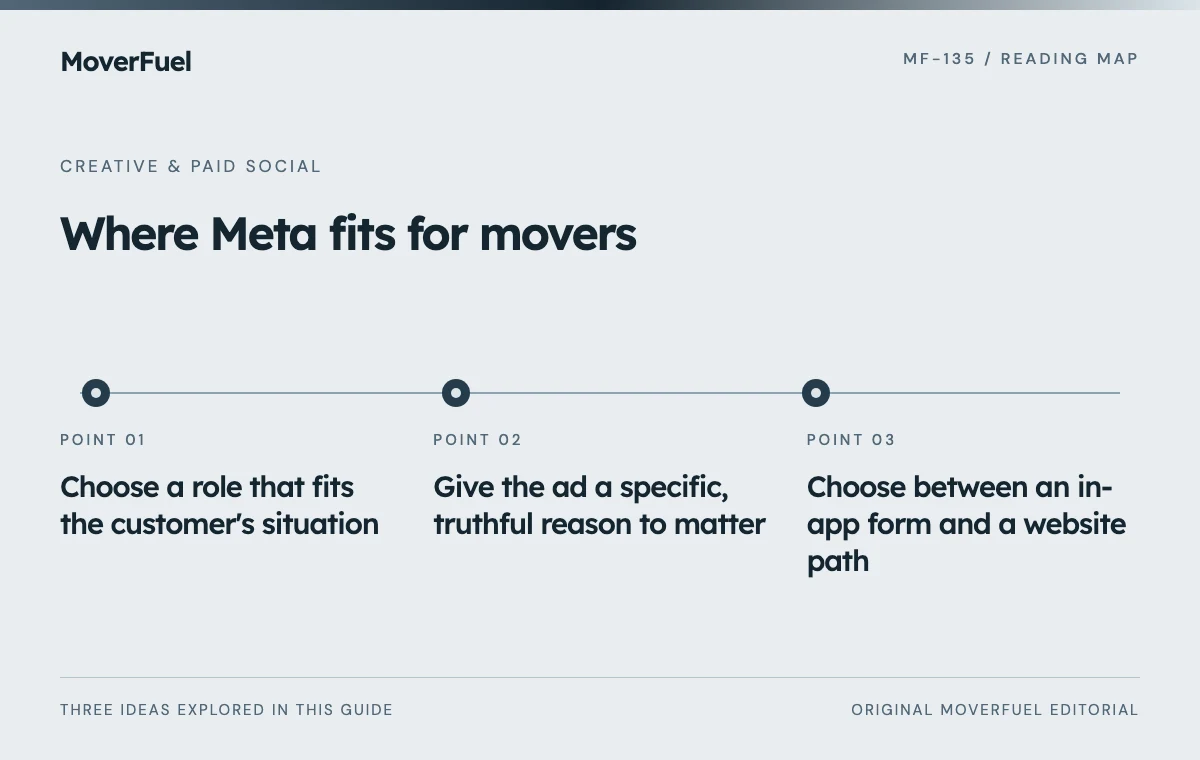
Choose a role that fits the customer's situation
Scroll the table horizontally to compare all columns.
| Role | Creative task | Business question |
|---|---|---|
| Local prospecting | Explain a recognizable moving situation and service | Do inquiries fit our routes, dates and scope? |
| Consideration reminder | Clarify a useful service or next step | Does permitted re-engagement help undecided customers? |
| Commercial awareness | Show an authentic office-relocation capability | Are relevant decision-makers reaching the right conversation? |
| Packing or storage education | Explain when an available service is useful | Does interest become qualified demand for that service? |
These are planning hypotheses, not guaranteed audience capabilities or performance claims. Verify current targeting options and policies in the account before building a campaign. Do not assume the platform can accurately identify everyone who is about to move.
Search advertising often serves an explicit query, while a social ad must establish relevance within a different browsing context. That distinction changes the creative task and the qualification burden. It does not prove that either channel is universally better for movers.
Compare the role with Google Ads for Moving Companies and the service's actual sales cycle before dividing a budget.
Give the ad a specific, truthful reason to matter
Use an actual service situation: coordinating apartment access, preparing for a home move or planning an office relocation. Explain what the company can help with and what the customer should do next. A vague promise of a stress-free move gives the viewer little information about fit.
Use approved evidence rather than invented social proof
Show authentic team, process or project material only when the business has permission to use it. Label illustrative concepts appropriately. FTC advertising guidance requires truthful, supported claims; do not invent ratings, before-and-after results, scarcity or customer endorsements. [2]
Match the ad to the destination. An ad about full-service packing should lead to a page or form that explains that service and its scope. A generic contact form can make it difficult to tell whether the customer understood the offer.
Plan several distinct creative hypotheses instead of changing only colors or headlines. For example, compare an explanation of the process with a service-scope demonstration. Keep the offer and qualification standard sufficiently consistent to interpret the difference.
Choose between an in-app form and a website path
Meta's public 2023 lead-generation guide describes in-app instant forms and website lead paths, including form information and the handoff after submission. It supports those basic mechanisms, not a claim that historical settings or performance studies describe the current account interface. [1]
Scroll the table horizontally to compare all columns.
| Path | Potential advantage | Question to verify |
|---|---|---|
| In-app form | Shorter path to submitting details | Does the customer understand the request and provide usable scope? |
| Website page | More room for service explanation and qualification | Does the mobile page remain clear and fast? |
| Service-specific page | Close match between ad and offer | Can the team track the resulting inquiry through booking? |
Ask for the information needed to establish service fit without turning the first contact into a complete inventory survey. Origin area, destination area, date window and requested service may be useful starting points. Test the actual form fields, delivery and follow-up process before spending.
Make intake capacity part of the campaign design
Assign an owner for new inquiries and confirm that the data reaches a monitored system. Staff should know which offer the customer saw and which details still need verification. A campaign cannot compensate for leads waiting in an export nobody checks.
Use a clear response expectation and respect contact preferences and applicable channel rules. If the customer did not understand the offer, clarify it rather than treating the form as proof of readiness to book. Record invalid details, route mismatch and timing mismatch separately.
The moving lead qualification guide helps define those distinctions, while lead tracking connects accepted inquiries to business outcomes.
Run a bounded test with a booked-outcome review
Set a budget the business can afford to test, a defined service area, an observation period and explicit creative hypotheses. Establish what would justify continuing, changing or stopping. Avoid prescribing a universal minimum spend without knowing the market and the sales economics.
Track unique inquiries, qualified opportunities, completed estimates, booked moves and completed work. Reconcile records across channels so a customer who also used search is not counted as two unique jobs. Report platform attribution separately from the deduplicated business total.
Review the reason for weak outcomes before scaling or abandoning the channel. Poor fit may reflect the offer, creative, geography, form or intake handling. Change one major hypothesis at a time where practical and allow enough time for the relevant decision cycle.
A viable result should fit contribution and operating capacity, not merely exceed a lead-volume target. If the team cannot fulfill the service profitably or respond reliably, acquiring more of the same inquiries is not the next step.
For help designing and running a test like this, see Facebook and Instagram ads for movers. We judge the channel by qualified estimates and booked moves.
Common questions
Are Meta Ads better than Google Ads for movers?
They serve different acquisition contexts. Compare their role, qualified inquiry mix and mature business outcomes within your own service model rather than choosing from platform lead cost alone.
Should movers use instant forms?
They are one option to test against a suitable website path. Verify customer understanding, usable qualification details, delivery and booked outcomes; ease of submission alone does not establish quality.
Your next step
Meta Ads are worth testing when the campaign has a defined role, credible creative and a dependable qualification process. Scale the combination that produces suitable, measurable work under the business's economics.
Sources & editorial notes
Platform claims cite the documents below. Operating frameworks and labeled examples are MoverFuel editorial analysis, not client results or industry benchmarks.
- Meta: lead generation guide (2023 public edition)Meta's historical 2023 public guide documents instant-form and website lead paths; current UI and study performance are not asserted. Reviewed .
- FTC: advertising and marketingFTC guidance requires advertising claims and endorsements to be truthful and substantiated. Reviewed .