A moving testimonial is most useful when a real customer explains a specific concern and what happened during their experience. It should not sound like an agency script assigned to a customer. Build the process around voluntary participation, factual context and editing that preserves what the speaker actually meant.
 View full-size graphic ↗
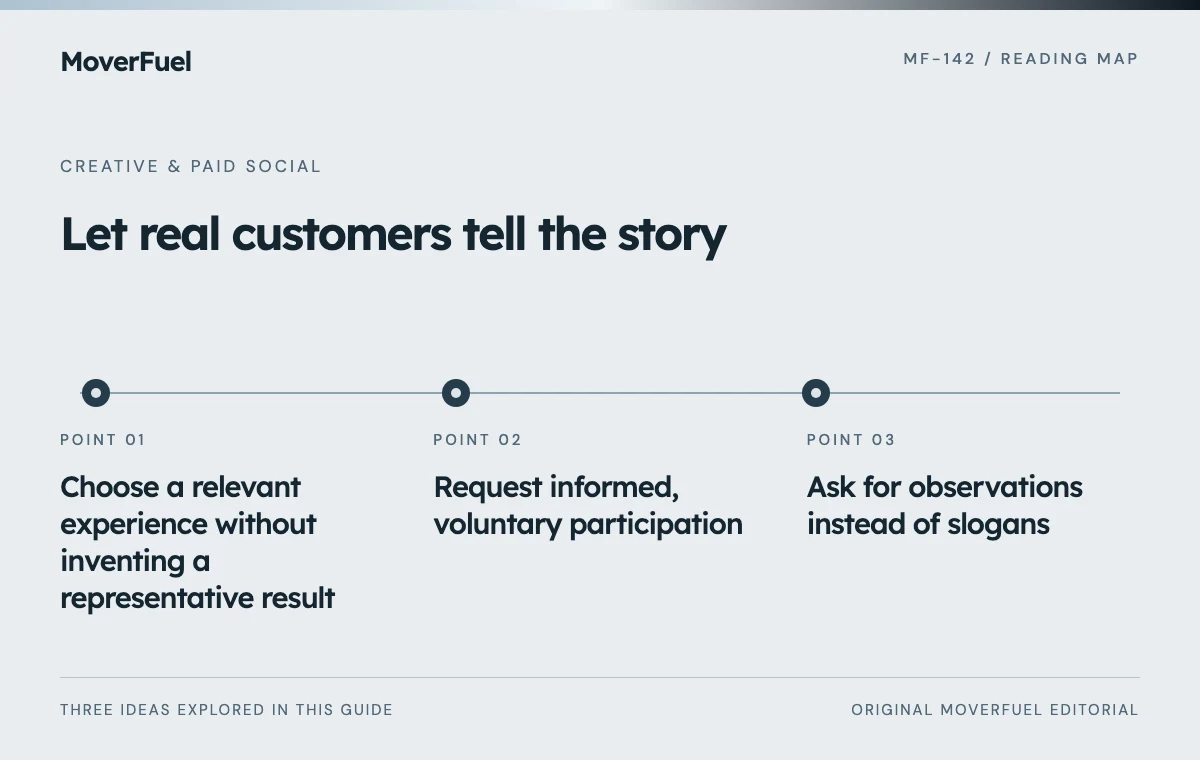
Choose a relevant experience without inventing a representative result
Identify the customer question the interview could help answer: communication before move day, packing scope, access coordination or a commercial handoff. Confirm that the person actually experienced the service they will discuss and that the business can accurately describe the project.
A single customer's positive experience is not a guarantee for every move. Avoid captions or introductions that convert a personal account into a universal outcome. Do not attach performance percentages, savings or damage claims that the underlying records cannot support.
Scroll the table horizontally to compare all columns.
| Item | What to verify |
|---|---|
| Speaker | Actual customer or authorized project participant |
| Service context | What work the company performed |
| Relevant concern | Question the story helps a prospect understand |
| Factual claims | Records or clarification needed before publication |
| Relationship | Any incentive, employment or other material connection |
| Permission | Intended channels, edits and usage scope |
Keep service recovery separate from promotional participation. A customer should not need to provide praise to receive an answer to a complaint or a service obligation. Do not use the interview request as pressure to change a public review.
Request informed, voluntary participation
Explain who is making the video, where it may appear, how the footage may be edited and whom the customer can contact with questions. Confirm the appropriate permission and release process for the intended use. Website publication and paid advertising may require different approvals in the actual agreement.
An original invitation: ‘We are creating a short video about how customers prepare for a move. If you would like to participate, we would ask about your own experience and the questions you had. Participation is optional, and we will explain the planned use before recording.’ Adapt it to the real project.
Do not promise complete customer control of every future use unless the agreement and workflow can honor that promise. Record any restrictions and ensure the editor and campaign manager can see them before making a cut or placement.
Ask for observations instead of slogans
Scroll the table horizontally to compare all columns.
| Question | Useful follow-up |
|---|---|
| What was most uncertain before your move? | What information helped you understand the next step? |
| What services did you actually use? | Which details mattered to your situation? |
| How did communication work? | Can you describe a specific interaction? |
| Was anything different from what you expected? | How was that handled? |
| What would you tell someone planning a similar move? | What should they prepare or ask about? |
Let the customer use their own words. Clarify ambiguous facts, but do not feed them an endorsement they would not otherwise give. If a response includes a claim that needs verification, flag it for review instead of assuming the customer's statement makes it safe to advertise.
Preserve the limits of the story
A customer may describe one crew, one route or a particular access problem. Keep enough context for the viewer to understand that scope. Avoid editing a qualified statement into an absolute promise or joining separate answers in a way that changes their meaning.
Review material relationships and the finished presentation
FTC endorsement guidance says endorsements should reflect honest opinions and that unexpected material connections may need clear disclosure. Its video guidance warns that a description alone may be insufficient; the disclosure must fit how the endorsement is presented. [1]
Have the actual incentive or relationship reviewed before filming and publishing. Do not hide a payment, gift or employment connection behind vague wording. Also verify the relevant platform's rules; a disclosure does not automatically make every incentive arrangement acceptable.
Review the final cut, caption text, thumbnail, headline and landing-page context together. An accurate interview can still become misleading when paired with an exaggerated title or an unrelated result claim.
Make the story accessible and useful in context
Provide accurate captions and ensure important visual context is available in an appropriate accessible form. W3C's media guidance covers captions, visual description and transcripts according to the content and delivery format. [2]
Place the video near information that helps the customer act on the story: service scope, estimate process or a relevant inquiry path. Do not let a testimonial replace essential facts about what the company offers. Maintain the original recording and approval records so later edits can be checked.
Evaluate whether viewers understand the service and whether the video helps qualified conversations. Views and watch time are useful diagnostics, but they do not prove that the testimonial caused bookings. Retire material when its permission expires or its context no longer accurately represents the business.
Connect testimonial production with creative and video services and a clear website conversion path.
Common questions
Can I give a customer a script to read?
Use open questions and let the customer describe their own experience. Do not put unsupported claims or opinions into their mouth; review factual statements and preserve meaning in the edit.
Is a disclosure in the video description always enough?
No. FTC guidance explains that viewers may miss descriptions. The appropriate disclosure depends on the endorsement and how it is delivered, including visual and audible presentation.
Your next step
A credible testimonial preserves a real customer's experience, context and choice to participate. Clear permissions, accurate editing and appropriate disclosures matter as much as production polish.
Sources & editorial notes
Platform claims cite the documents below. Operating frameworks and labeled examples are MoverFuel editorial analysis, not client results or industry benchmarks.
- FTC: Endorsement Guides questions and answersFTC guidance covers honest endorsements, disclosure of unexpected material connections and context-appropriate video disclosures. Reviewed .
- W3C WAI: Making Audio and Video Media AccessibleW3C media guidance describes captions, visual description and transcripts appropriate to the content. Reviewed .