
Trust is difficult to earn when a moving website asks customers to believe claims they cannot check. A row of badges is less useful than a clear explanation of who will handle the move, what the company actually does and where its credentials can be verified. Build the page from evidence your business can maintain.
 View full-size graphic ↗
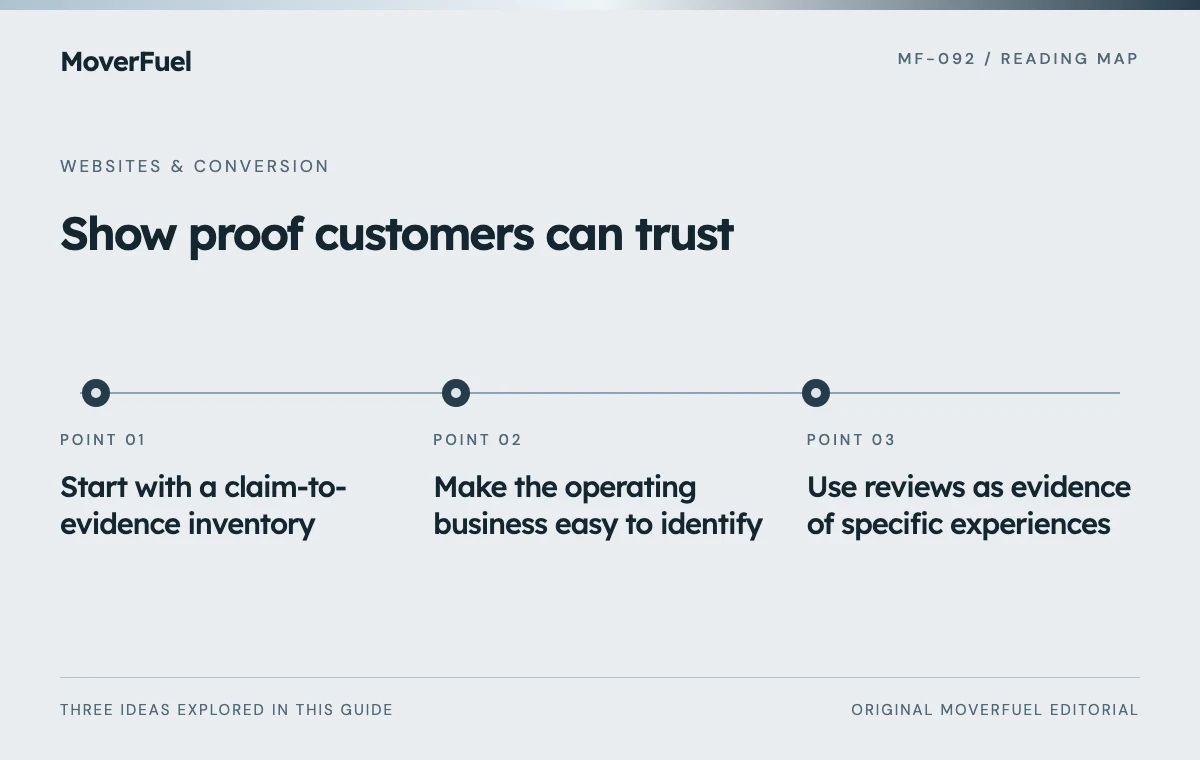
Start with a claim-to-evidence inventory
List every statement intended to reassure a prospect: years in business, customer ratings, insurance, operating authority, trained crews, specialist equipment and service coverage. For each claim, record its evidence, owner and review date. Remove or narrow statements that the business cannot substantiate.
Scroll the table horizontally to compare all columns.
| Claim or asset | Evidence required | Maintenance trigger |
|---|---|---|
| Review quotation | Authentic source and permission where needed | Source changes or withdrawal request |
| Registration detail | Current official record for the correct entity | Entity or authority change |
| Crew photograph | Original asset and appropriate permissions | Team or branding changes |
| Service promise | Operational process that delivers it | Policy or coverage change |
| Rating summary | Named platform, count and observation date | Rating refresh |
Keep the inventory separate from the public page. Customers need clear, relevant proof rather than an internal compliance spreadsheet. The inventory allows the team to publish concise claims confidently and retire them when the underlying facts change.
Make the operating business easy to identify
Use consistent business naming and contact details. Explain whether the company performs the move or arranges transportation through others. FMCSA distinguishes movers from brokers and provides registration guidance for interstate household-goods services; do not apply that federal framework indiscriminately to every intrastate operation. [1]
Link relevant identifiers to the correct official lookup where available. Confirm the legal entity behind the trading name before copying a number into the footer. A credential belonging to a related company, former owner or subcontractor should not be presented as though it automatically covers the advertised business.
Prefer precise explanations to broad reassurance
Replace vague wording such as ‘fully protected’ with an accurate explanation of the applicable coverage or valuation options, reviewed by the responsible business professional. Marketing should not turn a complex service agreement into a blanket promise. Link to the real policy or estimate information when additional detail is necessary.
Use reviews as evidence of specific experiences
Choose authentic reviews that help answer a customer's concern: communication, careful handling, arrival coordination or an office relocation. Preserve the meaning and identify the source. Do not combine several customer experiences into a fictional testimonial or make an ordinary review sound like a verified case study.
The FTC's review rule addresses fake or false reviews and other deceptive review practices. Its guidance also distinguishes prohibited sentiment-conditioned incentives from other situations; an authentic-review workflow must consider both the law and the platform's separate policies. [2]
If you show an aggregate rating, identify the platform and the date or update method. Avoid a permanent ‘five-star’ label that becomes inaccurate. A third-party widget still needs evaluation for accuracy, accessibility and performance; embedding it does not transfer responsibility for the surrounding claim.
Place a relevant review beside the service or process it supports. A residential packing review can be useful on a packing page, but it is weak evidence for an unsupported claim about complex industrial relocations.
Show the people and process customers will recognize
Original photographs can explain the real operation: branded vehicles, protective materials, packing procedures, office coordination and the people customers may meet. Ask what each image proves. A decorative skyline establishes atmosphere; it does not establish a staffed branch in that city.
Obtain appropriate permissions and avoid exposing customer addresses, documents, children or private possessions. Give photographers a shot list that shows useful operational details without turning a customer's home into unrestricted marketing material.
Scroll the table horizontally to compare all columns.
| Customer concern | Useful original image |
|---|---|
| How will my floors be protected? | Actual protection materials being used correctly |
| Who is arriving? | Current team and clearly branded vehicle |
| Can you handle office coordination? | Permitted commercial project preparation |
| Where will stored items go? | Accurate facility image with its role explained |
Write descriptive alternative text when the image communicates information, and provide captions when context matters. Label illustrative or concept imagery clearly. Never use generated people or trucks as documentary evidence of your actual team or fleet.
Put proof beside the decision and keep it current
Distribute evidence through the estimate journey: business identity near contact details, process proof beside service explanations and relevant customer experiences before the inquiry action. Repeating the same badge strip everywhere adds clutter without answering new questions.
Review proof alongside your moving website conversion plan. Clear contact options and realistic expectations must support the evidence.
Assign quarterly or event-triggered checks to a named owner. When a review disappears, a policy changes or a staff image becomes outdated, update the page and its underlying asset record. Trust signals are a maintained information system, not a one-time design decoration.
Common questions
Can we use stock photographs on a moving website?
Yes, as illustration when appropriate, but do not imply they document your actual people, equipment, facilities or completed work.
Should every credential appear beside the main CTA?
Prioritize evidence relevant to the decision. Give other credentials an accurate explanation and a sensible home rather than crowding the contact area.
Your next step
Publish fewer unsupported assurances and more checkable facts. A maintained proof inventory connects each trust claim to the real moving business behind it.
Sources & editorial notes
Platform claims cite the documents below. Operating frameworks and labeled examples are MoverFuel editorial analysis, not client results or industry benchmarks.
- FMCSA: movers versus brokersFederal distinction between interstate household-goods movers and brokers, with scope limits. Reviewed .
- FTC: reviews and testimonials rule FAQReview-rule guidance on fake or false reviews and sentiment-conditioned incentives. Proof-inventory method is original. Reviewed .