A Facebook lead form and a moving landing page can generate very different kinds of submissions. The form may make contact easier, while the page gives the customer more room to understand the service. A fair comparison holds the offer and qualification standard steady, then follows both paths through the same intake process.
 View full-size graphic ↗
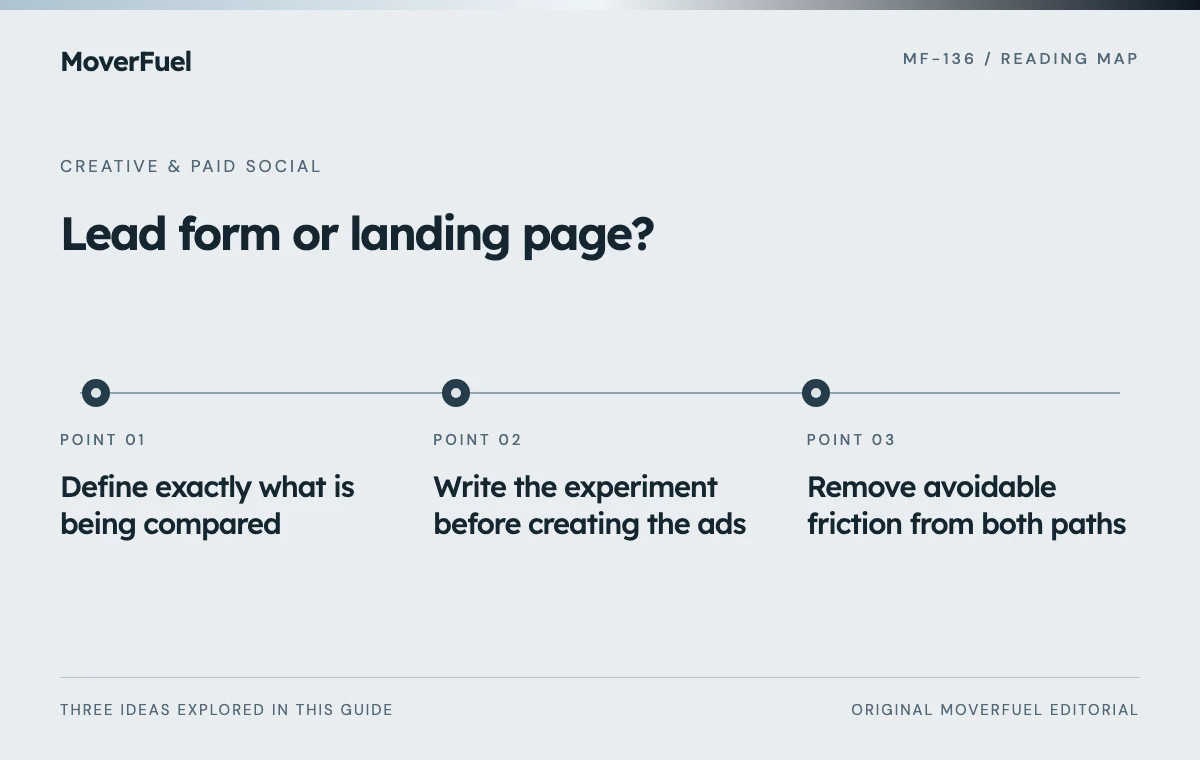
Define exactly what is being compared
Meta's public lead-generation guide describes instant forms within its apps and lead collection on an advertiser's website. The available account settings should be checked before launch; this comparison concerns the destination choice, not a claim about current interface defaults. [1]
Scroll the table horizontally to compare all columns.
| Question | Instant form | Landing page |
|---|---|---|
| Where does the customer respond? | Within the platform's form experience | On the company's website |
| How much explanation is needed? | Use the supported form information carefully | Can provide a fuller service and process explanation |
| Who controls the experience? | Platform format and current options apply | Company controls the page and form implementation |
| What must be tested? | Field quality, delivery and customer understanding | Mobile usability, speed, validation and delivery |
| What determines success? | Qualified outcomes under the same business definition | Qualified outcomes under the same business definition |
Avoid comparing a short local-move form with a long commercial-survey page and concluding that the destination alone caused the difference. The audience, service, information requested and decision burden all changed.
Write the experiment before creating the ads
Choose one service and a clearly defined offer, such as requesting an initial discussion about a local move. Use the same core creative proposition and geographic service scope. Establish what information staff need to call an inquiry usable and qualified.
Keep allocation and observation understandable
Use a supported experiment method when available and appropriate, or document the limitations of a simpler comparison. Automated delivery can allocate impressions unevenly, so equal budgets alone do not guarantee equivalent audiences. Record the actual delivery and major configuration differences.
Define the observation window from the sales process. A destination that produces more early forms should not automatically win before those inquiries have had time to qualify and book. Decide in advance how cancellations and unresolved records will be handled.
Remove avoidable friction from both paths
For the instant form, explain what the customer is requesting and what happens after submission. Verify the fields and contact details actually received. A customer should not be surprised that the request triggers a moving-company conversation.
For the landing page, match the ad's service and next step. Keep mobile form labels clear, identify errors accessibly and show honest submission feedback. W3C's form guidance emphasizes understandable controls and feedback; a failed form should not display success. [2] [3]
Ask for comparable qualification information where the two formats support it. If the page needs additional detail to explain the offer, document that difference rather than pretending the test isolates only a button click. Review privacy and contact requirements for both collection paths.
Use conversion optimization to repair an obviously broken experience before treating its poor results as evidence against the entire destination type.
Give both groups the same intake opportunity
Confirm that each source reaches a monitored queue with a stable inquiry ID and source label. Assign comparable staff coverage and follow-up expectations. A form that sits in a manual export for a day is being tested against a different sales process, not only a different destination.
Scroll the table horizontally to compare all columns.
| Metric | Why it belongs |
|---|---|
| Spend and accepted submissions | Establishes acquisition volume and cost |
| Unique usable inquiries | Removes supported duplicates and invalid records |
| Qualified opportunities | Applies the same route, date and service-fit standard |
| Completed estimates | Shows progression beyond contact |
| Mature bookings and completions | Connects to business outcomes |
| Staff time and complaints | Captures handling burden and customer experience |
Display counts as well as rates. Low-volume results may remain inconclusive. A lower cost per form can coexist with a higher cost per completed job, while a more demanding page may filter out some suitable customers as well as unsuitable ones.
Choose the next test from the reason for the difference
If instant forms produce wrong-area requests, inspect the offer, geography and qualification questions. If landing-page visitors abandon the form, inspect clarity, errors and mobile usability. Do not assume every weak result is inherent to the format.
A mixed approach can be reasonable when different services require different explanation. Keep its reporting separate enough to identify which combination works. Avoid sending the same customer into overlapping follow-up sequences because they used both paths.
Document the decision with the tested scope, unresolved uncertainty and a date for review. The conclusion should read ‘this path performed better for this offer under these conditions,’ not ‘all movers should always use this destination.’
See Facebook Ads for Moving Companies for the campaign role and lead tracking for the outcome connection.
Common questions
Do instant forms always produce lower-quality moving leads?
No. Quality depends on the offer, audience, customer understanding and intake process. Test usable and qualified outcomes rather than assuming the format determines intent.
Can I choose a winner from cost per lead alone?
Only if lead cost is the actual decision metric, which is usually too narrow for acquisition planning. Compare qualified estimates, mature bookings, contribution and handling effort as the evidence permits.
Your next step
Compare destinations as complete customer paths under a shared business definition. The strongest choice is the one that produces suitable work with acceptable economics and a clear customer experience.
Sources & editorial notes
Platform claims cite the documents below. Operating frameworks and labeled examples are MoverFuel editorial analysis, not client results or industry benchmarks.
- Meta: lead generation guide (2023 public edition)Meta's public 2023 guide describes in-app instant forms and website lead collection; current UI defaults are not asserted. Reviewed .
- W3C: accessible formsW3C form guidance supports understandable labeled controls. Reviewed .
- W3C WAI: form user notificationsW3C form notifications guidance supports accessible errors and honest success feedback. Reviewed .