
An office relocation request is not simply a larger household lead. The person researching may be a facilities manager gathering options, an owner with a firm date or an administrator preparing a shortlist. A useful campaign helps each suitable buyer reach the right project discussion. Its measurement must distinguish a credible opportunity from an early question and a submitted proposal from a signed project.
 View full-size graphic ↗
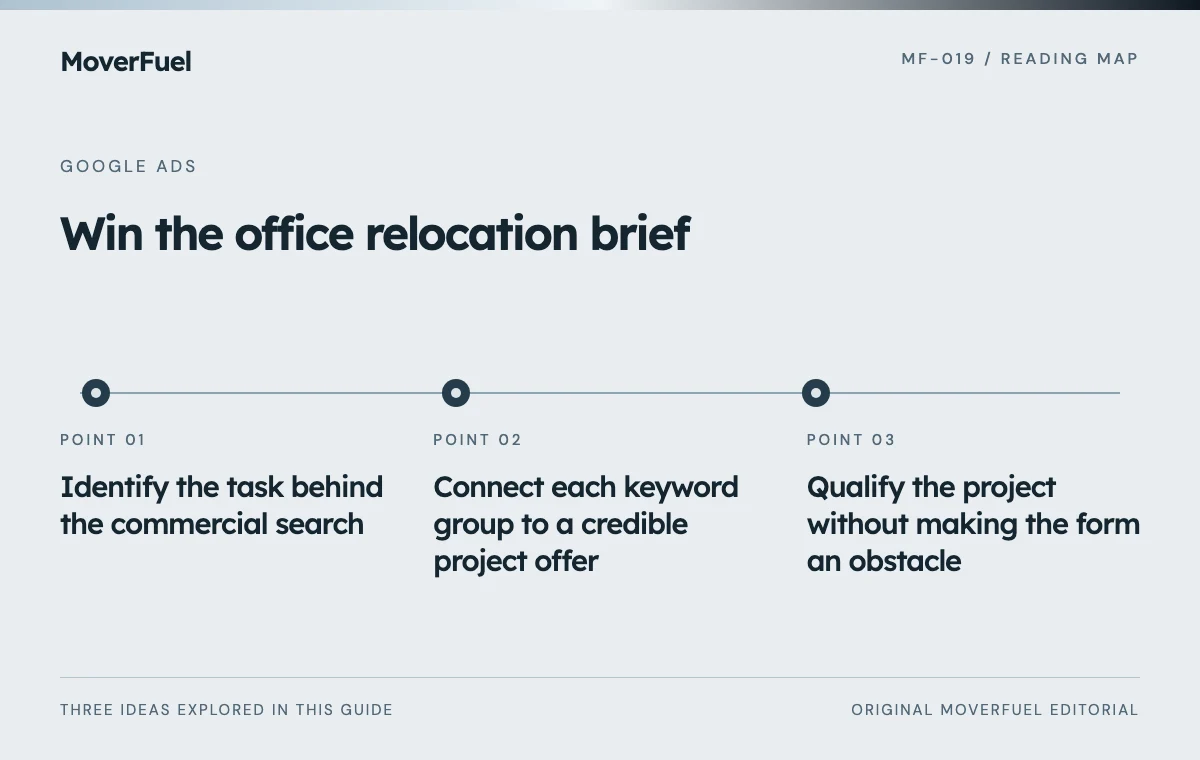
Identify the task behind the commercial search
Start with the work you can provide: office relocation, internal moves, warehouse relocation or another verified commercial service. Do not advertise specialist handling, disposal or installation simply because those terms occur near “office movers.” Confirm capabilities, insurance statements and subcontracted responsibilities with the business before writing the offer.
Scroll the table horizontally to compare all columns.
| Buyer task | Information needed | Suitable next step |
|---|---|---|
| Find relocation providers | Coverage and project capabilities | Project-fit conversation |
| Prepare a budget | Scope inputs and estimate method | Survey or structured discovery |
| Coordinate an approved move | Dates, access and responsibilities | Detailed planning discussion |
| Compare proposals | Included work and assumptions | Clarification with the project team |
The same person may move through several tasks. Avoid creating a separate campaign for every job title when searches and offers overlap. Use the distinction to write useful pages and qualification questions, then separate budgets only where the company needs independent control.
Draw a boundary around the service
A search about an office lease may signal relocation planning but may not be a moving-service request. A search for used office furniture may be unrelated unless the company provides that service. Decide whether such terms belong in a deliberate discovery test or outside the acquisition campaign.
Connect each keyword group to a credible project offer
Google’s Search campaign structure supports organizing a campaign into relevant ad groups, ads and destinations. Apply that structure to coherent commercial requests: office relocation should lead to an explanation of office work, not an apartment moving page with the heading changed. [1]
Describe how the first conversation works. A facilities manager may need to know whether a site survey is required, which locations are covered and who coordinates access. Explain the inputs your team actually needs instead of presenting a complex project as an instant fixed-price purchase.
Show approved evidence of relevant capabilities where available. If there are no permissioned client examples, explain the planning process, responsibilities and verification steps plainly. An invented enterprise logo or anonymous success statistic creates an evidence problem, not a stronger offer.
Qualify the project without making the form an obstacle
Use a short first request to establish contact and broad project fit. Follow with a structured discovery conversation. A prospect should not need to produce a complete inventory before learning whether the company covers the project, but sales needs enough information to avoid scheduling unsuitable surveys.
Scroll the table horizontally to compare all columns.
| Field | Decision supported |
|---|---|
| Origin and destination | Coverage and travel requirements |
| Approximate scope | Appropriate survey and estimating resource |
| Access restrictions | Loading, elevators and building coordination |
| Target schedule | Capacity and sequencing feasibility |
| Decision participants | Who approves scope, vendor and schedule |
| Procurement requirements | Documents or approvals needed before award |
Separate missing information from disqualification. “Inventory pending” may be a normal stage. “Project requires a service we do not offer” is a fit failure. Treating both as bad leads can cause marketing to exclude useful early-stage demand.
Name a project owner in the sales system. If multiple branches or specialists receive the inquiry, establish who acknowledges it and who follows up. A forwarded email is not a reliable transfer of responsibility without confirmation.
Measure the pipeline through distinct decisions
Use stages that represent meaningful work: inquiry received, project qualified, survey completed, proposal delivered and project awarded. Your exact stages can differ. The important rule is that each transition has an observable definition and a date.
Google’s lead measurement distinguishes initial interactions from qualified and converted outcomes. For commercial moving, qualification might mean that a real project meets service and schedule requirements; a later converted event might follow the company’s formal award rule. Do not let every proposal automatically count as a won job. [2]
Track reasons proposals remain open. A buyer awaiting lease approval is different from a buyer who rejected pricing. A project postponed indefinitely is different from one lost to another provider. These reasons inform whether to change targeting, clarify the offer or improve follow-up.
The qualified moving leads guide explains how to keep fit and follow-up outcomes separate. Commercial teams should adapt the fields to project decisions rather than importing a residential script unchanged.
Compare mature project cohorts and selling effort
Group opportunities by inquiry period and report how far each group has progressed. Recent inquiries may not have reached the procurement decision. Comparing their award rate with older completed cohorts creates a misleading decline even when the process is healthy.
Calculate media cost per qualified project and per awarded project using the same cohort. Show the number of opportunities beside the rate. Include estimating effort in the wider evaluation: repeated site surveys and complex proposals can create meaningful selling costs even when clicks are inexpensive.
Large project values also create volatility. One award can dominate a small sample, while one cancellation can reverse the apparent return. Report expected value and confirmed outcomes separately, then revise the record as scope changes. Do not present the total proposal pipeline as realized revenue.
Use the review to choose a specific repair
When many requests are residential, inspect search intent and page wording. When project fit is good but surveys stall, inspect scheduling and response ownership. When proposals are delivered but decisions remain unknown, improve follow-up records before assuming that the media source is failing.
Plan the next experiment around the largest observed obstacle. That might mean a clearer scope page, a simpler project form or a separate budget for a distinct commercial service. Record the hypothesis and which pipeline stage should change. A higher click-through rate alone does not establish that the campaign now generates better commercial opportunities.
Common questions
Should commercial campaigns use the same quote form as residential campaigns?
Only if it supports the commercial buyer’s task. A brief initial request can be shared, but project discovery needs fields such as access, stakeholders, scope and procurement requirements.
Should every proposal be a Google Ads conversion?
It can be an observed pipeline event, but it should not be confused with an awarded project. Choose bidding outcomes deliberately and define each stage before sending data.
Your next step
Design commercial acquisition around a project workflow. Clear scope, appropriate discovery and mature pipeline reporting reveal whether advertising is creating useful opportunities for the estimating team.
Sources & editorial notes
Platform claims cite the documents below. Operating frameworks and labeled examples are MoverFuel editorial analysis, not client results or industry benchmarks.
- Google: create a Search campaignSearch campaign organization and destination setup. Reviewed .
- Google: qualified and converted leadsDistinct qualified and converted lead stages; project-specific definitions are editorial recommendations. Reviewed .