“Qualified lead” should describe a decision the moving company made, not a reassuring name attached to every phone call. Before connecting a CRM to Google Ads, agree on the conditions, the person responsible and the record that proves the transition. This article designs that event. The later booking-import workflow has different fields and correction requirements.
 View full-size graphic ↗
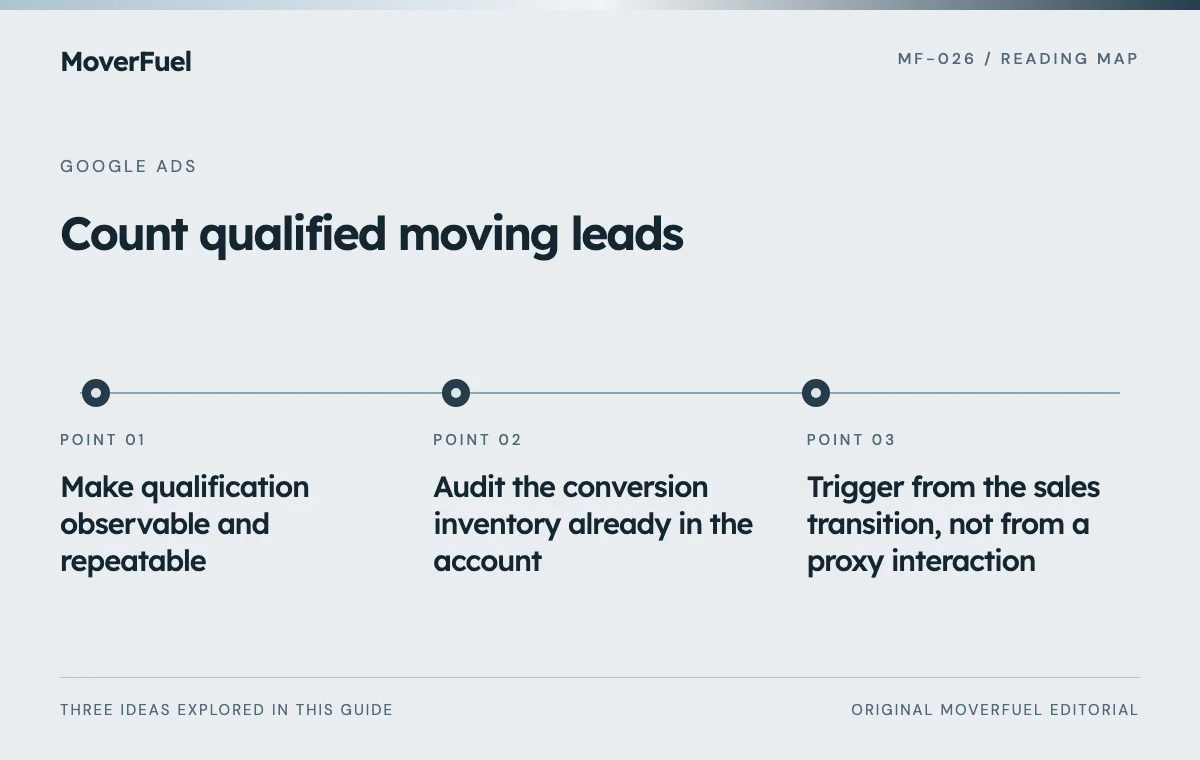
Make qualification observable and repeatable
A useful rule might require a real customer request, a contactable prospect, serviceable origin and destination, an offered service and workable timing. Adapt it to the business. Some teams can confirm all of these on the first call; others need a follow-up before the opportunity qualifies.
Google distinguishes qualified and converted leads as later stages of the lead journey. The platform does not supply your dispatch rules or decide whether a customer fits your service. Those conditions must come from the business and be applied consistently. [1]
Scroll the table horizontally to compare all columns.
| Event | Trigger | Evidence | Not sufficient |
|---|---|---|---|
| Inquiry received | New request enters the system | Unique lead record | A page view |
| Qualified opportunity | Defined fit checks are completed | Status transition with required fields | A call-duration threshold alone |
| Booked move | Company booking rule is satisfied | Confirmed job record | An estimate sent |
| Disqualified | Documented fit failure | Reason code and reviewable note | No response yet |
Keep “unknown” available when information is missing. Forcing every untouched record into qualified or disqualified categories produces false certainty and can teach the campaign about staff workload instead of customer fit.
Audit the conversion inventory already in the account
List existing form, call, analytics and CRM actions. Record their source, trigger, counting behavior and campaign use. Check whether the same inquiry arrives through more than one integration. Two names can describe the same business event, while one name can conceal several different events.
Under standard goals, primary actions used by the campaign support bidding and secondary actions normally provide observation. Custom goals can use included secondary actions for bidding. Review the campaign’s actual goal configuration rather than relying on the action label alone. [2]
Do not switch the campaign to an untested qualified event immediately. Validate the new path alongside the existing reporting, label the comparison clearly and decide when it is reliable enough for the intended role. Avoid double-counting the same stage as two independent successes.
Trigger from the sales transition, not from a proxy interaction
Use a documented status change or equivalent business event. Capture the event time, lead identifier, qualification rule version and system that produced it. If staff can repeatedly move a record into the same stage, design the integration to recognize the original event rather than creating a new qualification every time.
Separate a person, an inquiry and a job
One person can call several times about one move, and the same person can later request a genuinely different move. A phone number alone is not a complete event identity. Define how the CRM groups interactions into opportunities and how later jobs relate to those opportunities.
Select a supported data path and verify its requirements
Google’s offline conversion guidance currently recommends enhanced conversions for leads for new implementations and includes 2026 changes to supported upload paths. Use the current official instructions and the chosen vendor’s documentation. Do not build a new integration from an outdated Google Ads API example. [3]
Document which identifiers are collected, where they are stored, the permitted purpose and the handling required by the supported integration. Have the responsible privacy and technical owners review the configuration. Hashing a field does not by itself establish that every collection or sharing use is appropriate.
Keep this event contract independent of the vendor. A connector may rename fields, but it should not silently redefine qualification or replace the original event time with the time a batch happens to upload. The business should be able to change vendors without losing the meaning of its measurement.
Reconcile business records, accepted events and attributed outcomes
Use a sample with qualified, unqualified, repeated and incomplete inquiries. For each record, trace the CRM transition, integration processing result and advertising diagnostics. Count distinct business events before comparing totals.
An accepted upload is not proof that every event will appear as an attributed Google Ads conversion. Google documents discrepancies after successful upload as well as upload errors. Some business outcomes may not be attributable to Google Ads, so do not force the advertising total to equal every CRM qualification. [4]
Scroll the table horizontally to compare all columns.
| Total | Meaning |
|---|---|
| CRM qualified opportunities | Business outcomes recorded under the rule |
| Accepted integration events | Records that passed the upload process |
| Attributed advertising conversions | Outcomes credited under platform reporting and eligibility |
Compare compatible date bases and allow processing and conversion delay. Keep rejected records and reasons visible to the integration owner. A quiet dashboard with missing events is not a healthy system simply because no one received an alert.
Monitor definition drift after launch
Review a small sample whenever sales procedures, staffing or CRM fields change. A new employee may mark a record qualified earlier than the documented rule; a workflow update may remove a required field. Either change can alter campaign signals without any advertising edit.
Keep the human qualification process aligned with the qualified moving leads framework. Tracking should reflect that process, not create a competing definition hidden inside a connector.
Assign ownership for the rule, integration health and campaign goal selection. Record changes and their dates. A trustworthy qualified conversion is a maintained business measurement, not a one-time tag installation.
Common questions
Can call duration define a qualified lead?
It can be an operational clue, but it does not establish route, service or timing fit. Use an actual qualification decision for a sales-qualified event and keep call metrics separately labeled.
Should Google Ads match all qualified CRM leads?
Not necessarily. Business totals, upload acceptance and advertising attribution describe different populations and processes. Reconcile them without assuming every customer came from Google Ads.
Your next step
Define qualification once, record a unique transition and validate the full data path. Keep the rule and the integration under review as the sales operation changes.
Sources & editorial notes
Platform claims cite the documents below. Operating frameworks and labeled examples are MoverFuel editorial analysis, not client results or industry benchmarks.
- Google: qualified and converted leadsQualified and converted lead stage concepts. Reviewed .
- Google: primary and secondary conversion actionsPrimary/secondary and custom-goal behavior. Reviewed .
- Google: offline conversion importsCurrent offline/enhanced lead paths and 2026 migration context. Reviewed .
- Google: offline import errorsUpload acceptance does not guarantee attributed reporting. Reviewed .