
A moving company marketing plan should tell the team what to do next Monday. If it only lists Google Ads, SEO and social media, it has not resolved the hard questions: which jobs to pursue, where the operation has capacity, who will answer the inquiries, and what evidence would justify more spending. Build the plan around one business constraint, then give each action an owner and a decision date.
 View full-size graphic ↗
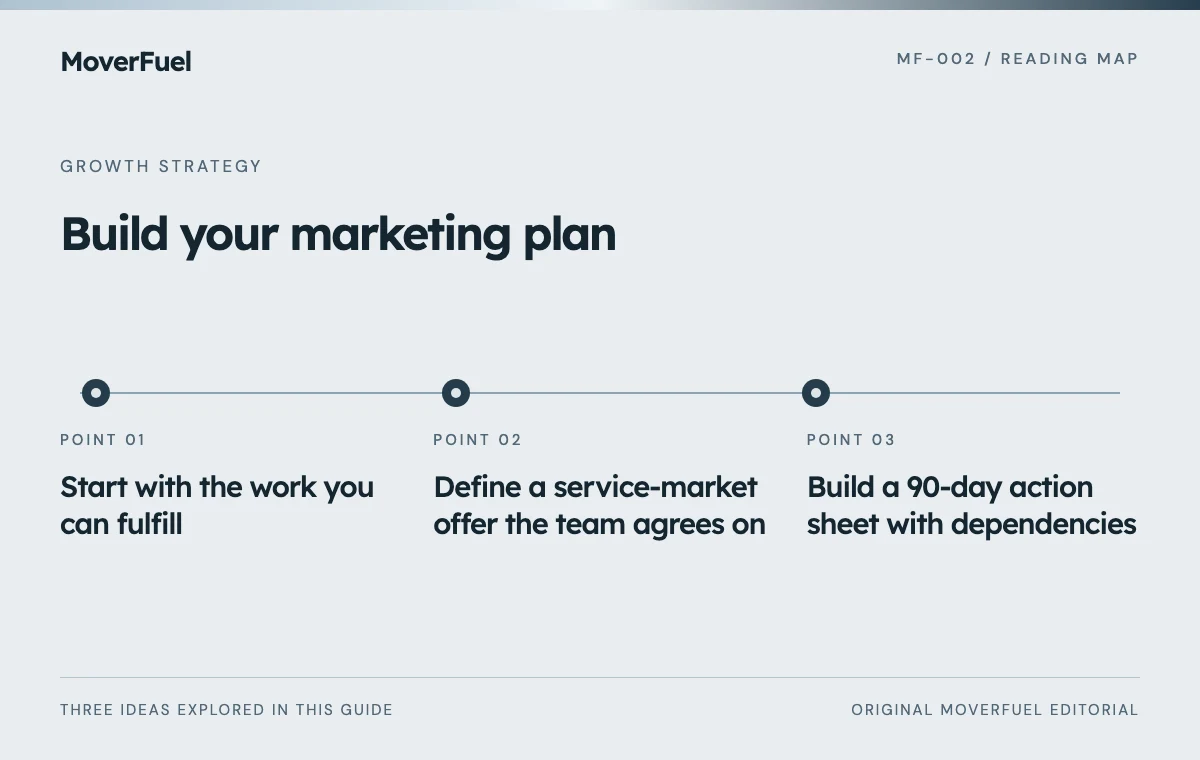
Start with the work you can fulfill
Look at the booking calendar before the advertising report. Unsold weekday crew capacity is a different problem from unanswered inquiries or fully booked weekends. A plan that buys more traffic for unavailable dates can increase sales workload without increasing completed moves. Write the constraint in operational language: ‘We can accept additional local residential jobs on Tuesdays through Thursdays in our established service area.’
Count saleable time, not just trucks
Truck count alone misses crew availability, travel, maintenance and the duration of different jobs. Ask dispatch for a usable capacity estimate by date and service. Then ask sales whether enough qualified inquiries currently reach those slots. When the calendar and inquiry records disagree, investigate before choosing a channel.
The SBA's marketing framework includes a target market, objectives, sales approach, budget and review process. For a mover, the operational constraint makes those components specific: the audience needs the kind of move you can actually deliver, on dates you can support. [1]
Define a service-market offer the team agrees on
Write a short acceptance brief with origin coverage, destination coverage, move types, timing and relevant exclusions. A local residential campaign should not quietly accept commercial relocation or interstate requests unless the business offers them. The brief also needs an exception path. A customer with a flexible date may be worth discussing even when their first preference is unavailable.
Scroll the table horizontally to compare all columns.
| Decision | Operating answer | Marketing implication |
|---|---|---|
| Service | Local household moves with optional packing | Explain both services and the estimate process |
| Coverage | Existing dispatch-approved service area | Check campaign geography and page wording |
| Capacity | Additional midweek slots | Mention scheduling options without promising availability |
| Next step | Estimator confirms scope and date | An inquiry begins an estimate; it is not a reservation |
Use this brief to review the website, ads and phone intake together. A campaign cannot repair a contradiction between an ad promising immediate availability and an estimator who has no open slots. Record who can approve changes to the offer as capacity shifts.
Build a 90-day action sheet with dependencies
Choose a small number of actions that remove the constraint. Sequence work by dependency: a working form and reliable call routing should precede a campaign that increases inquiry volume. A complicated redesign can wait if a focused service-page correction is enough to explain the offer accurately.
Scroll the table horizontally to compare all columns.
| Period | Action and owner | Evidence before moving on |
|---|---|---|
| Days 1–14 | Owner and dispatcher agree the offer; marketing traces existing inquiry paths | Acceptance brief, baseline counts and working routing |
| Days 15–30 | Web lead clarifies the local service page; sales lead assigns follow-up coverage | Mobile inquiry test and a complete sample record |
| Days 31–60 | Campaign manager runs a bounded service-market test | Qualified inquiries and mature estimate outcomes by source |
| Days 61–90 | Owner reviews economics and available capacity | A documented keep, change or stop decision |
Give every action an observable finish line
‘Improve tracking’ is too broad. ‘A test form reaches the assigned estimator and creates one record with its source’ can be checked. Similarly, ‘improve lead quality’ needs defined fit criteria and a way to inspect outcomes. Record the task owner, dependency, expected evidence and review date in the same sheet.
Budget implementation and staff time alongside media
Separate advertising spend from agency fees, creative production, website work, call tracking and intake labor. Those costs serve different purposes and arrive at different times. A campaign budget that leaves no time for an estimator to respond is not an executable plan.
Use a cash limit for the initial test and state what it is intended to learn. The question might be whether a particular service-market offer produces qualified estimates at an affordable cost. It should not be ‘Can we buy enough leads to fill the calendar?’ when the qualification and booking rates are unknown.
Model several outcomes using your own numbers in the marketing ROI calculator. Keep assumptions separate from observed results, and include cancellations or incomplete work when evaluating the eventual business outcome.
For example, if the owner can fund the media test but the team cannot complete the required landing page until next month, move the launch date. Do not treat the delay as permission to send traffic to an unsuitable page. A dependency register makes that tradeoff visible before money is spent.
Connect intake to the same plan
Define inquiry, qualified lead, estimate and booking separately. Google supports advertiser-defined qualified and converted lead stages; the moving business still has to determine what those stages mean operationally. A submitted form does not establish serviceability or an accepted move date. [2]
- Name the person responsible for each new inquiry and the backup when they are unavailable.
- Record service, geography, timing and contact outcome before labeling a request qualified.
- Keep ‘unable to reach’ separate from ‘outside coverage’ and ‘lost after estimate.’
- Return repeated mismatch patterns to the campaign and website owners.
Set a response expectation the team can actually meet during its staffed hours. Monitor missed calls and unresolved forms separately. If requests arrive outside coverage, define an honest acknowledgement and next staffed follow-up step. Automated messages should not imply that an estimator has personally reviewed the move when that has not happened.
Use the moving-lead qualification guide to agree the acceptance criteria before comparing channel results.
Hold a short weekly decision meeting
Review the same funnel each week: unique inquiries, contactable prospects, qualified opportunities, estimates, bookings and completed work. Segment when it changes a decision, such as local versus interstate service or a new versus established market. Avoid creating dozens of tiny segments that cannot support a useful comparison.
Allow enough time for an inquiry cohort to reach a realistic outcome. This week's spending and this week's completed jobs often describe different customers. Note the inquiry date, booking date and service date so a slow decision cycle is not mistaken for poor demand.
Scroll the table horizontally to compare all columns.
| Observation | Next investigation | Possible action |
|---|---|---|
| Many inquiries cannot be served | Compare their routes and services with the acceptance brief | Narrow messaging or targeting; preserve valid exceptions |
| Qualified requests do not receive estimates | Check routing, contact attempts and estimator workload | Repair the handoff before increasing demand |
| Suitable work books and capacity remains | Review contribution, cancellations and measurement reliability | Consider a bounded increase with a new review date |
Keep a change log. Record what changed, why, who approved it and when to review the effect. Without that record, a pricing change, seasonal shift and campaign edit can all be credited to whichever explanation sounds most persuasive. The 90-day plan should finish with a better decision, not merely a completed task list.
Common questions
Should a small moving company use every marketing channel?
No. Start with the service-market problem, available resources and measurement quality. Fund a manageable set of channels with defined roles. More channels can add complexity before they add useful demand.
What if we do not know our booking rate?
Make measurement part of the first phase. Preserve inquiry cohorts and record qualification, estimate and booking outcomes. Use labeled scenarios for planning until enough mature records exist to support a decision.
Does a 90-day plan mean SEO should produce results within 90 days?
No. Ninety days is a management interval for tasks, evidence and decisions. Different channels and technical changes have different timelines. Do not turn a planning window into a ranking or revenue promise.
Your next step
Write the acceptance brief, identify the first broken handoff, and assign a person to fix it. Then choose the smallest useful acquisition test that fits the operation. Review qualified work and completed outcomes before expanding the plan.
Sources & editorial notes
Platform claims cite the documents below. Operating frameworks and labeled examples are MoverFuel editorial analysis, not client results or industry benchmarks.
- SBA: marketing and salesMarketing-plan components and the need to review marketing and sales together. Reviewed .
- Google: qualified and converted leadsPlatform support for qualified and converted lead stages; the planning framework and examples are original editorial analysis. Reviewed .