
“White-glove” can mean unpacking a household, delivering one piece of furniture or handling a complicated relocation with specialist requirements. A premium campaign fails when the advertiser and customer attach different meanings to the same phrase. Define the actual work first, then build the ad, evidence and estimate process around it.
 View full-size graphic ↗
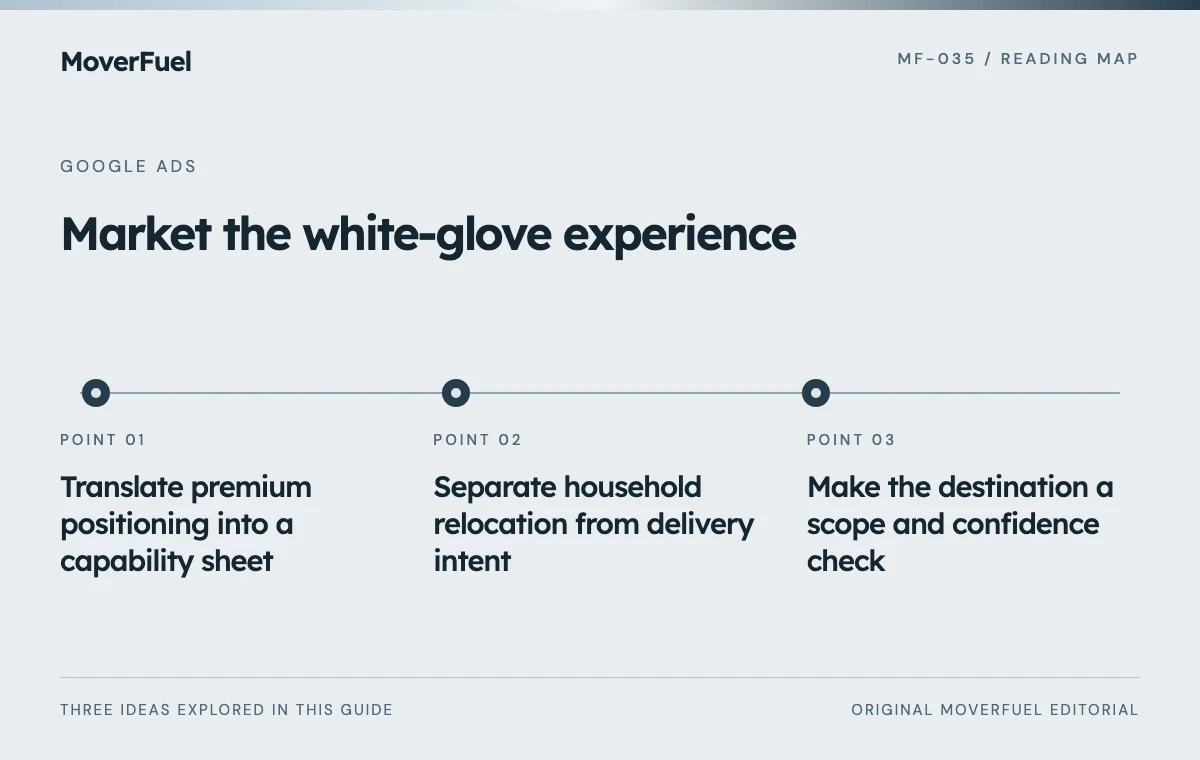
Translate premium positioning into a capability sheet
Ask operations which services are performed in-house, which require an approved specialist and which are not offered. Include packing, unpacking, furniture preparation, access planning, storage, installation boundaries and fragile-item requirements where relevant. Do not imply that every premium inquiry is suitable.
Describe process rather than relying on adjectives. “Inventory review before planning the crew” communicates something a customer can understand. “Flawless luxury relocation” offers little information and creates an expectation the company may be unable to support.
FTC advertising guidance requires truthful, non-misleading claims with appropriate support. Apply that principle to credentials, handling promises, coverage descriptions and price statements. Premium positioning does not make unsupported absolutes safer. [1]
Scroll the table horizontally to compare all columns.
| Customer concern | Useful evidence when genuine | Qualification needed |
|---|---|---|
| Fragile possessions | Approved explanation of packing and handling process | Inventory, condition and special requirements |
| Difficult access | Documented survey and access-planning workflow | Stairs, elevators, parking and building rules |
| Unpacking help | Clear list of included tasks | Rooms, scope and customer expectations |
| Storage between properties | Accurate collection and delivery process | Dates, access needs and storage arrangements |
Separate household relocation from delivery intent
A search for white-glove furniture delivery may come from a retailer or someone who bought a single item. A search for a full-service relocation can involve an entire household. Both may be valuable, but their staffing, pricing and qualification differ. Combine them only if the business can serve and measure both deliberately.
Build tightly related intent groups and inspect actual inquiries. Add exclusions for services the company does not provide, with a recorded reason. Do not exclude every delivery-related phrase automatically if delivery is a genuine, profitable offer.
Review the outcome behind the wording
Have the estimator classify a sample by requested scope. A vague query may produce an appropriate complex move; a precise premium phrase may produce an unsupported installation request. Use the customer conversation to improve the interpretation rather than treating a keyword as a complete brief.
The negative keyword strategy guide explains why exclusions need to be reviewed for both wasted spend and accidental loss of useful intent.
Make the destination a scope and confidence check
Lead with the specific service, coverage and next step. Show real, approved evidence of the process where available. If client photographs cannot be published, use an original explanatory diagram or a clearly labeled demonstration instead of implying that stock imagery is a completed customer project.
Explain what happens during the estimate: which details are reviewed, whether a survey may be needed and when the customer should expect a substantive response. Avoid an “instant final quote” promise if the team must inspect inventory and access first.
Use accurate descriptions of protection and liability arrangements supplied by the business and reviewed by the appropriate specialist. Do not casually substitute “fully insured” for an explanation of applicable terms. The campaign should direct customers to reliable information, not invent coverage.
Keep mobile calls and requests straightforward. Premium does not mean forcing a customer to complete a lengthy application before anyone will explain the offer. Ask enough to route the opportunity, then gather detailed inventory in the appropriate consultation.
Qualify complexity without making the inquiry exhausting
Scroll the table horizontally to compare all columns.
| Information | Why it matters | How to ask usefully |
|---|---|---|
| Origin and destination | Coverage and route feasibility | Locations or postal areas |
| Timing and flexibility | Crew and specialist availability | Preferred date and acceptable alternatives |
| Requested scope | Moving, packing, delivery or another service | Short selectable options plus a note |
| Special items or access | Survey and handling preparation | Invite a description; use a secure upload process if offered |
| Decision and contact details | A responsible next conversation | Who should coordinate the estimate |
Do not ask the marketing form to replace a professional survey. If a customer describes an unusual item, route it to the person who can confirm capability. Sales should not promise handling methods simply to keep an expensive lead interested.
Assign a named owner for the next action. A high-touch service loses credibility when a careful inquiry receives only a generic acknowledgment and no meaningful follow-up.
Measure suitable projects and the cost of serving them
Track service-fit inquiries, surveys, estimates, retained bookings and completed work. Split full relocations from small delivery jobs where they have different economics. Combining them into one average can conceal whether the campaign attracts the intended service mix.
Include the additional estimating effort in the commercial review. A complex opportunity may justify more consultation, but repeated surveys for unsupported work consume real capacity. Record why suitable estimates are lost before assuming the advertising needs a broader audience.
Assess acquisition cost against realistic contribution after the resources required to deliver the job. A high invoice is not proof of a profitable premium service. Improve the campaign when it brings work that the company can quote accurately, deliver competently and retain at a sustainable cost.
Common questions
Should I advertise art or antique moving to attract premium customers?
Only when the business has the actual capability and an approved description of its scope. A valuable search term does not justify offering unsupported specialist handling.
Is a higher cost per lead acceptable for premium work?
Possibly, if suitable jobs book and produce adequate contribution after delivery and sales costs. Evaluate the completed service mix rather than assuming a premium label guarantees better economics.
Your next step
A credible premium campaign explains specific work, proves genuine capability and routes complex inquiries to a competent estimate process.
Sources & editorial notes
Platform claims cite the documents below. Operating frameworks and labeled examples are MoverFuel editorial analysis, not client results or industry benchmarks.
- FTC: advertising and marketingTruthful, supported advertising claims. The capability and intake frameworks are original editorial recommendations. Reviewed .