
Cutting advertising spend can lower the bill and empty the estimate pipeline at the same time. Before reducing demand, identify where useful inquiries stop becoming booked moves. Preserving lead volume while lowering booked-job cost is a goal to test, not a result any campaign change can guarantee.
 View full-size graphic ↗
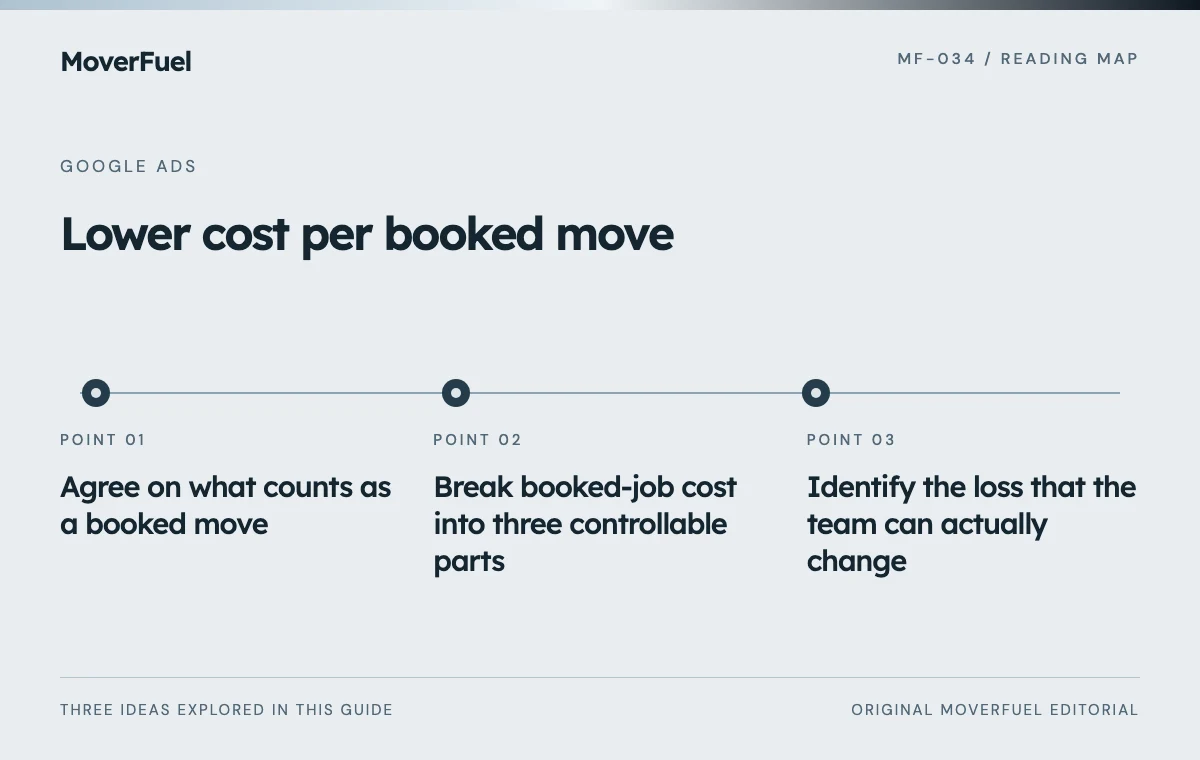
Agree on what counts as a booked move
Use a written booking definition that matches the company’s sales process. It might require an accepted estimate and the required reservation step. Keep inquiries, estimates, bookings, retained bookings and completed jobs separate. A tentative date request is not necessarily a reserved crew.
Match costs and outcomes to the same acquisition cohort. If October advertising produces an inquiry that books in November, an inquiry-cohort report should attribute the later outcome back to that October group. A calendar report of November bookings answers a different staffing question.
Set a review cutoff and show open opportunities. Otherwise, a recent group with many pending estimates can look less efficient than an older group whose customers have all decided. Do not solve an apparent performance decline that is really a difference in reporting maturity.
Break booked-job cost into three controllable parts
This is an accounting identity for the defined funnel, not a forecast of what a campaign will achieve. When a denominator is zero, report the rate as undefined rather than displaying a misleading zero cost. Keep duplicate calls and forms attached to the original opportunity.
Scroll the table horizontally to compare all columns.
| Measure | Starting scenario | After an improvement |
|---|---|---|
| Advertising spend | $6,000 | $6,000 |
| Unique inquiries | 120 | 120 |
| Qualified inquiries | 72 | 84 |
| Booked moves | 24 | 28 |
| Cost per inquiry | $50 | $50 |
| Qualified-to-booked rate | 33.3% | 33.3% |
| Cost per booked move | $250 | $214.29 |
In this illustration, better fit adds four bookings without increasing inquiry volume or changing the qualified-to-booked rate. Real interventions may change several variables, including volume. The example shows why a lead-cost-only report can miss an improvement; it does not promise that exclusions will preserve every inquiry.
Identify the loss that the team can actually change
Review a sample of rejected and lost opportunities with sales and operations. Separate service mismatch, route mismatch, unavailable dates, unreachable contacts, price objections, slow follow-up and customers who chose another provider. “Bad lead” is too broad to guide a repair.
Google’s qualified and converted lead concepts support distinguishing later business outcomes from initial contact. The company must still supply a consistent definition and dependable records; the label itself does not decide whether a job was suitable. [1]
Match the intervention to the reason
Scroll the table horizontally to compare all columns.
| Observed loss | Useful intervention | Tradeoff to watch |
|---|---|---|
| Wrong service requested | Clarify ads, queries and page scope | Some broad inquiry volume may fall |
| Suitable callers not reached | Repair routing and callback ownership | Additional staff effort |
| Estimates delayed | Improve survey scheduling and handoff | Estimator workload |
| Dates unavailable | Align budget and messaging with capacity | Reduced reach during full periods |
| Bookings cancel frequently | Review expectations and reservation process | More deliberate qualification |
Choose the largest credible, fixable loss rather than the easiest setting to change. If suitable callers wait days for an estimate, rewriting every keyword may not address the bottleneck.
Protect useful demand while testing the repair
Record total inquiries, qualified inquiries, retained bookings and spend before the test. Where practical, change one major cause at a time. Maintain a change log so a new ad message is not confused with a simultaneous staffing improvement or price increase.
Set a volume guardrail using your own operating needs. If crews require a minimum pipeline to sustain future work, monitor that pipeline while assessing cost. A lower average acquisition cost is not automatically preferable when total contribution falls because too many suitable opportunities disappear.
The PPC audit checklist can help separate broken tracking from genuine demand or conversion problems before the test begins.
If the first result is inconclusive, state what evidence is missing. Do not keep adjusting definitions until the intervention appears successful. A useful result may be that inquiry quality improved but volume dropped enough to require a different allocation.
Check retained work and contribution before scaling
Suppose the starting scenario’s 24 bookings includes four cancellations. Its cost per retained booking is $6,000 / 20 = $300. If the revised scenario produces 28 bookings but eight cancel, the retained count is still 20 and the apparent booked-cost improvement disappears. Keep both metrics visible.
Then consider delivery economics. Larger jobs may require additional crew hours, travel or specialist materials. Estimate contribution after variable delivery costs and acquisition expense, while keeping fixed overhead separate. An attractive revenue total does not automatically establish profit.
Scale the repair only when it improves the business objective under realistic capacity and cost assumptions. The strongest outcome is a repeatable process for converting more suitable demand—not a temporary reporting ratio that hides cancellations or service costs.
Common questions
Can I guarantee that lead volume stays unchanged?
No. Changes to targeting, messaging or bidding can alter volume. The practical goal is to test improvements with explicit demand guardrails and judge useful bookings as well as lead totals.
Should every campaign optimize to the cheapest lead?
No. Different lead groups can have different fit, booking and cancellation rates. Compare mature downstream outcomes before deciding which source is economically stronger.
Your next step
Decompose the cost, repair a specific loss and watch retained work. Lower acquisition cost matters when the business still receives enough suitable jobs to use its capacity well.
Sources & editorial notes
Platform claims cite the documents below. Operating frameworks and labeled examples are MoverFuel editorial analysis, not client results or industry benchmarks.
- Google: qualified and converted leadsDistinction between initial contact, qualified leads and converted leads. Numerical examples are original illustrative arithmetic. Reviewed .