
A low Quality Score can start a useful investigation, but raising the number is not the same as improving a moving company’s business. The practical question is which part of the search-to-estimate experience may be failing. Read the components, inspect the actual customer journey and choose a repair whose commercial effect you can evaluate.
 View full-size graphic ↗
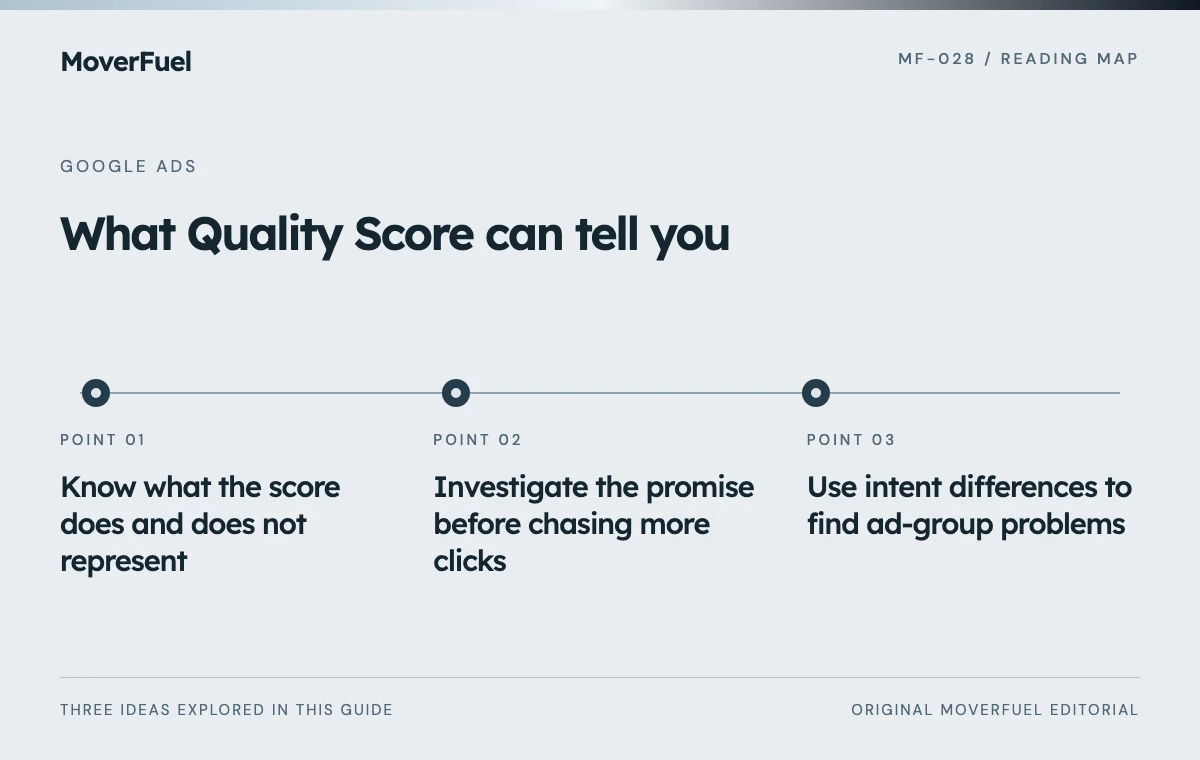
Know what the score does and does not represent
Google describes Quality Score as a keyword-level diagnostic on a 1–10 scale, based on expected click-through rate, ad relevance and landing-page experience. It is not a business KPI or a direct input in the ad auction. A missing score can reflect insufficient exact-search history rather than a proven quality defect. [1]
Do not average scores into an agency success claim or promise that moving every keyword to ten will produce profitable jobs. A campaign can have a relevant ad and still reach unsuitable routes, mishandle calls or sell work at poor margins. Those problems require other evidence.
Scroll the table horizontally to compare all columns.
| Component | Question to investigate | Possible repair |
|---|---|---|
| Expected click-through rate | Does the message clearly describe the service requested? | Rewrite vague or indistinguishable claims |
| Ad relevance | Does the ad answer the keyword’s intent? | Separate materially different service requests |
| Landing-page experience | Does the destination help this customer take the next step? | Clarify coverage, service details and estimate process |
Investigate the promise before chasing more clicks
Read the ad beside the intended query. A search for apartment moving should not receive a generic company slogan that leaves the service unclear. Identify the service, a verifiable reason to consider the company and the next step. Specificity should improve understanding, not manufacture a superlative.
Avoid using exaggerated availability or a misleading price simply to attract clicks. The customer still has to reach a suitable estimate. A message that increases response while producing more unserviceable requests can make the marketing report look busier and the sales operation worse.
Check whether the proof is real
If an ad relies on reviews, credentials or a service promise, verify the underlying evidence and its scope. A branch-specific claim should not silently become a company-wide one. When proof is unavailable, describe the actual process rather than substituting unsupported “best” language.
Use intent differences to find ad-group problems
Inspect whether an ad group combines requests that need different explanations. Household relocation, office projects and vehicle transport are not interchangeable simply because their keywords include “moving.” Remove incompatible services and separate coherent offers when necessary.
Do not respond by creating a separate campaign for every phrase. The useful unit is the customer task and destination. Several close themes may share a clear ad; materially different promises may need separate groups or pages.
Use the campaign structure framework to decide where a real budget or geography boundary belongs. A diagnostic observation alone does not justify rebuilding the entire account.
Review the destination on an ordinary phone
Open the actual final URL with its tracking parameters. Confirm that it loads, names the advertised service and shows how to request an estimate. Check whether an intrusive overlay, oversized media or confusing form prevents the customer from completing the task.
Scroll the table horizontally to compare all columns.
| Customer question | Page evidence |
|---|---|
| Can you handle this kind of move? | Accurate service description |
| Do you cover my locations? | Understandable coverage and route questions |
| What happens after I submit? | Clear estimate and response process |
| Why should I trust this business? | Verified identity and approved proof |
| Can I complete this on my phone? | Usable fields, buttons, errors and call link |
Fix factual mismatches before cosmetic details. A polished page advertising a service that is not offered is still the wrong destination. Likewise, adding keywords repeatedly does not help a customer whose actual question is whether the company can move an office after hours.
Choose one repair and keep a decision record
Record the affected keyword themes, component status, observed customer problem and proposed change. Give the repair an owner. For a page change, test the form and call path afterward so an improvement in copy does not introduce a submission failure.
Keep other material changes stable where possible. If pricing, targeting and the landing page all change together, describe the result as a combined change. Do not credit a better score with outcomes that could have come from several simultaneous interventions.
Some repairs are justified without waiting for a score response: a broken form, inaccurate service claim or unreadable mobile layout should be corrected because it prevents the customer’s task. The diagnostic can help discover the issue, but it need not be the reason the fix matters.
Evaluate the resulting work, not just the new score
Compare suitable inquiries, estimate progression and mature bookings alongside engagement. A clearer page may reduce inappropriate submissions while improving the sales team’s usable workload. A smaller raw lead total can therefore coexist with a better business result.
Review costs and contribution using consistent cohorts. Keep counts visible when samples are small. If diagnostic components improve but qualified bookings do not, investigate geography, response coverage, offer competitiveness and measurement rather than continuing to optimize a number in isolation.
Common questions
Is Quality Score used directly in the ad auction?
Google says the reported Quality Score is a diagnostic, not a direct auction input. Use it to identify experience issues rather than as a bidding or profit formula.
Should every keyword have a score of ten?
That is not a useful business objective. Prioritize accurate, relevant ads and usable pages, then evaluate qualified outcomes and acquisition economics.
Your next step
Use the three components to locate a customer-experience problem. Repair the cause, verify the journey and assess the business outcome without turning the score into the goal.
Sources & editorial notes
Platform claims cite the documents below. Operating frameworks and labeled examples are MoverFuel editorial analysis, not client results or industry benchmarks.
- Google: Quality ScoreDiagnostic definition, scale, components, missing-score interpretation and limits. The moving-company repair framework is original editorial guidance. Reviewed .