
A complicated account is not necessarily a controlled account. Campaigns should separate decisions that the company needs to make independently: budgets, service coverage, goals or operational ownership. Ad groups should organize coherent customer requests within those boundaries. Start with a decision map and choose the simplest structure that can enforce it.
 View full-size graphic ↗
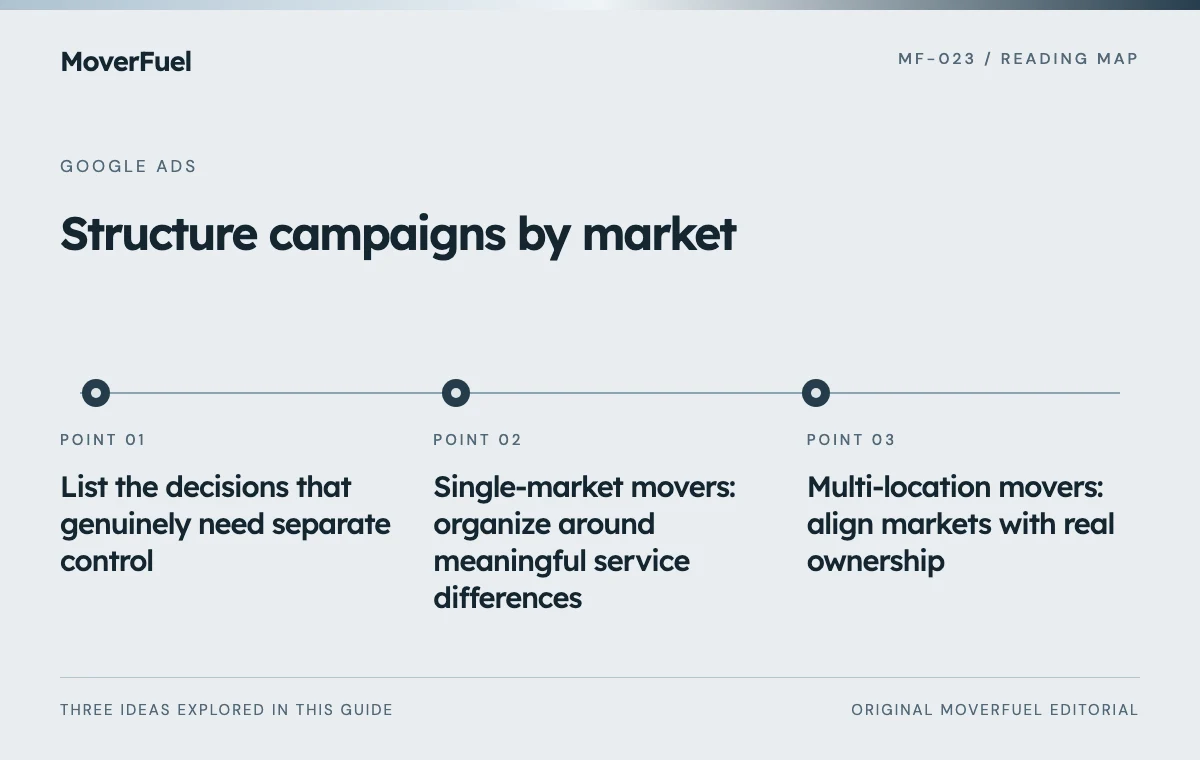
List the decisions that genuinely need separate control
Ask which budgets can move independently, which branches answer their own inquiries, which services require distinct geography and which outcomes count as success. Write down who owns each decision. If two proposed campaigns have identical answers, their separation needs another practical justification.
Google’s Search setup distinguishes campaigns and ad groups and lets advertisers configure campaign settings and relevant ads. Use those controls to express business requirements rather than copying an agency naming convention that obscures how the company operates. [1]
Scroll the table horizontally to compare all columns.
| Question | Possible structural consequence |
|---|---|
| Can a branch approve a separate spending ceiling? | Market-level campaign boundary |
| Does interstate targeting differ from local pickup coverage? | Service or route boundary |
| Do several keyword themes share one offer and page? | Coherent ad group rather than many campaigns |
| Does a commercial inquiry need a different outcome goal? | Separate goal configuration and possibly campaign |
| Does only the keyword spelling differ? | Usually insufficient reason for a new campaign |
Single-market movers: organize around meaningful service differences
A single-market business may start with one local campaign containing a small number of service-oriented ad groups. Apartment and household requests can share a campaign when budget, coverage and sales ownership align. Separate an offering when its actual controls differ, not merely because a keyword list has another heading.
Recognize the cost of unnecessary fragmentation
Every extra campaign creates another budget, setting set and review obligation. Very small segments can also make results harder to interpret because each contains few observations. A tidy spreadsheet with dozens of rows may leave the operator less able to explain which decisions matter.
Consolidation should still preserve useful reporting. Use consistent service themes and naming so you can identify apartment requests or packing demand without giving each theme an independent budget that no one needs.
Multi-location movers: align markets with real ownership
When branches have separate budgets, capacity and response teams, market-level campaigns can make accountability clearer. Keep service names and outcome definitions consistent across markets, while allowing geography, pages and available services to reflect actual differences.
Scroll the table horizontally to compare all columns.
| Layer | Example purpose |
|---|---|
| Campaign | Market A local moving budget and coverage |
| Ad group | Apartment moving intent within Market A |
| Destination | Accurate Market A service and estimate page |
| Lead routing | Market A sales owner with documented overflow |
| Reporting | Comparable qualification definition across markets |
Resolve overlap explicitly. A customer near a branch boundary should reach a capable team, not become a contest between campaigns. Document which branch handles the request and how transfers are recorded. Geographic exclusions can help enforce a plan, but they do not replace the plan.
Google’s location settings include presence and interest options and rely on imperfect signals. Audit actual job origins alongside platform location reports; the name of a market campaign is not proof that every inquiry belongs to that market. [2]
Interstate movers: separate routes only when decisions differ
A route-based business may need different controls for origin groups, destination groups or services. Avoid a campaign for every possible city pair unless the company needs that level of independent control and can maintain it. Many lanes can share a campaign when the offer, economics and operational rules are comparable.
Build the operational matrix first using the interstate campaign guide. It explains why searcher location, move origin and destination should not be treated as the same field.
If a route temporarily loses capacity, decide whether to adjust targeting, messaging or the overall service availability. Keep the change traceable. A hidden exclusion added during a busy week can continue suppressing demand long after the operation is ready to accept it again.
Keep naming, goals and exclusions understandable
Use names that tell the analyst the market, service and campaign purpose. Avoid encoding so many changing settings into the name that it becomes inaccurate after an ordinary edit. Store detailed configuration in a change record rather than relying on a long name as documentation.
Review conversion goals across campaigns. A market optimizing for raw forms should not be compared directly with one optimizing for sales-qualified opportunities under the same “cost per lead” label. The dashboard needs clear definitions and comparable cohorts.
Document shared negative lists and campaign-specific exceptions. When the company introduces a new service, audit both the positive coverage and inherited exclusions. A previously reasonable account-wide block can quietly prevent the new offer from reaching customers.
Restructure with a measurable reason and a migration record
Good reasons include independent branch budgets, materially different targeting, unclear routing or persistent maintenance problems. “The account looks messy” is a starting observation, not a complete business case. Identify what the new structure will let the team control or understand better.
Record old-to-new campaign mappings, destination changes, goal settings and launch dates. Preserve historical reporting rather than deleting context. Verify tracking and lead routing after the move, then interpret performance with the transition and sales delay in mind.
Do not change structure, offer, pricing and measurement simultaneously unless the business requires it. If several things must change, describe the review as a combined relaunch. That is more accurate than attributing every improvement to the new campaign hierarchy.
Common questions
Should every city have its own campaign?
Only when separate control is useful and maintainable. A city spelling alone does not justify another budget. Group markets according to operational coverage, ownership and the decisions you need to make.
When should two campaigns be consolidated?
Consider consolidation when their settings and business purpose align, fragmentation creates maintenance cost, or results are too sparse to interpret separately. Preserve meaningful reporting and historical mappings.
Your next step
The right structure makes ownership and decisions visible. Separate meaningful controls, group coherent intent and keep the account understandable enough to maintain as the business changes.
Sources & editorial notes
Platform claims cite the documents below. Operating frameworks and labeled examples are MoverFuel editorial analysis, not client results or industry benchmarks.
- Google: create a Search campaignCampaign and ad-group setup concepts. Reviewed .
- Google: advanced location optionsPresence/interest options and location signal limitations. Reviewed .