A person watching a packing demonstration may appreciate it without needing a mover this month. That is the central planning problem for Demand Gen: attention and moving intent are not the same thing. Use visual campaigns to answer a specific customer question, then measure whether the attention develops into suitable work.
 View full-size graphic ↗
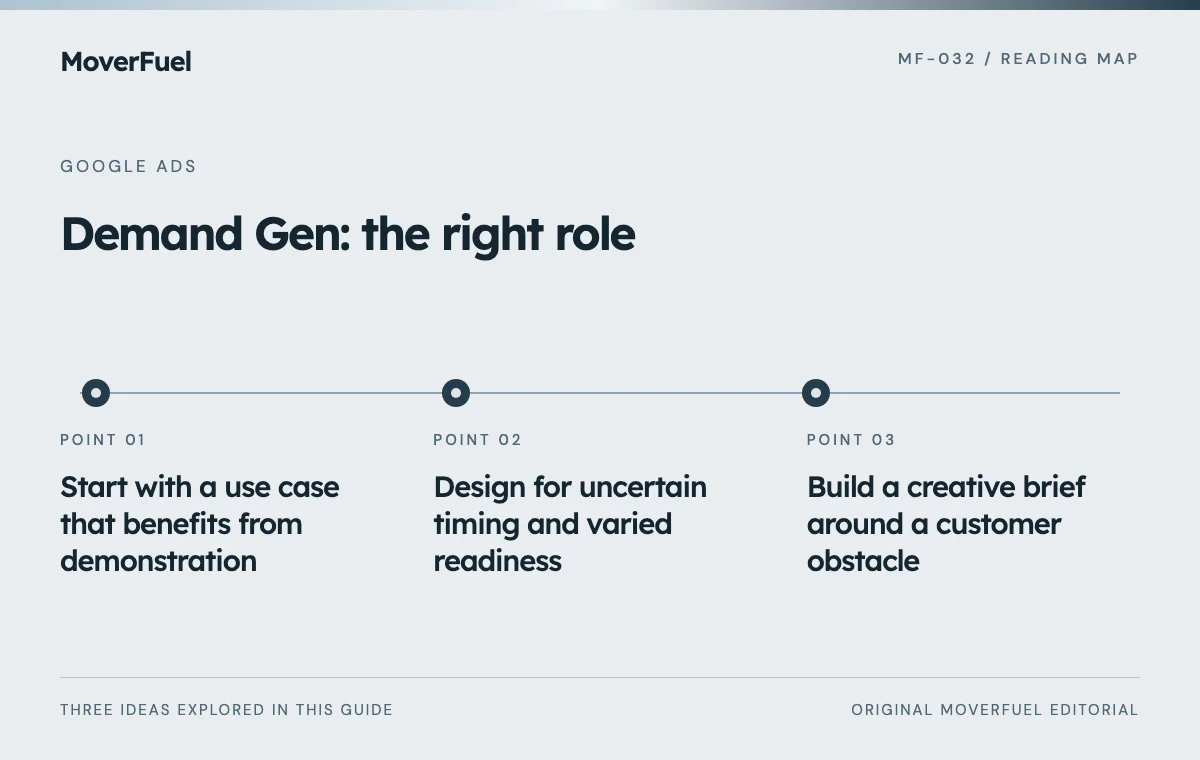
Start with a use case that benefits from demonstration
Demand Gen supports visual advertising across Google inventory including YouTube, Discover and Gmail. Google documents creative previews and measurement options, but inventory and controls evolve. Confirm the available options in the account used for the test. [1]
A mover has useful things to show: how a crew prepares an apartment elevator, what an inventory survey needs to capture, or how packing and temporary storage fit together. These ideas explain a buying decision. A truck photo with an unsupported “best movers” claim provides much less information.
Scroll the table horizontally to compare all columns.
| Use case | Useful creative | Appropriate next step |
|---|---|---|
| Packing add-on | Demonstrate preparation for fragile household items | Read what the packing service includes |
| Office relocation planning | Show a phased move checklist and responsible roles | Request a planning conversation |
| Storage between homes | Explain pickup, storage and later delivery stages | Review availability and request an estimate |
| Re-engagement where permitted | Answer a common unanswered estimate question | Return to the relevant service page |
Select one concept with a real operational offer behind it. Do not advertise specialist handling that the crew cannot provide or use customer property in creative without permission.
Design for uncertain timing and varied readiness
Moving dates are not known simply because someone interacts with content. A future relocator may be comparing options long before an address is confirmed. A business viewer may be an employee rather than the person who commissions office relocation. Keep those possibilities in the message and follow-up plan.
Write an audience-to-action plan
For each audience hypothesis, record why the content is useful, what evidence would indicate a real opportunity and how the next step will capture it. A commercial planning guide might lead to a conversation about locations, timetable and decision ownership. A packing video might lead to a service explanation before an estimate request.
Have the responsible privacy and account owners review the data used for audience creation and re-engagement. Do not assume possession of an email address automatically permits every advertising use. Keep the implementation within the applicable platform requirements and the company’s actual permissions.
Build a creative brief around a customer obstacle
Start the video or image sequence with the problem the service solves. For example, a household facing a gap between closing dates needs to understand the storage handoff. Show the sequence clearly: inventory review, collection, storage arrangements and delivery planning. State limitations that affect the decision.
Use real staff or clearly presented demonstrations, approved locations and accurate process details. Avoid presenting stock footage as evidence of your own equipment or customer work. A testimonial requires a real source and appropriate permission; a fictional quote is not a shortcut to credibility.
Prepare a review sheet for each format. Small text that works on a desktop preview may be unreadable in a vertical mobile placement. Confirm that the main service and next step are understandable without relying on tiny disclaimers or audio alone.
Match the page to the promise and level of commitment
A detailed planning video can lead to an equally useful planning page with an optional inquiry. Sending every viewer directly into a long estimate form may ask for information they do not have yet. Conversely, a clear ready-to-book service message should not force a motivated customer through an unrelated download.
Scroll the table horizontally to compare all columns.
| Question | Practical check |
|---|---|
| Does the page continue the advertised topic? | Compare the opening message and service scope |
| Can a ready customer act? | Test the estimate and call paths on mobile |
| Can an early researcher learn something? | Include a concrete explanation, not only sales copy |
| Can the team identify fit? | Capture service, route and timing when an inquiry is made |
The moving website conversion guide explains how to reduce friction without removing information the estimator genuinely needs.
Separate attention, attributed response and additional business
Review three layers. First, determine whether people engage with the material. Second, match resulting inquiries to qualification and booking stages. Third, assess whether the business gained work beyond the demand it would otherwise have received. Those layers answer different questions and should not be blended into one success number.
For an initial test, record spend, unique inquiries, service-fit rate, mature bookings and cancellations alongside engagement measures. Preserve the attribution settings used in the report. A change in how credit is assigned can change reported conversions without changing customer behavior.
Where a credible holdout or experiment is feasible, use it to investigate incremental effects. If volume is too small, state that limitation. Do not turn a handful of assisted conversions into a claim that the campaign generated every associated booking.
Set a capped learning budget and a review date tied to the likely buying cycle. If the creative attracts attention but the company cannot connect it to suitable opportunities, decide whether the audience, offer or next step needs repair before increasing spend. Educational value is useful, but it does not remove the need for a commercial decision.
Common questions
Is Demand Gen a substitute for Search campaigns?
It can serve a different role. Search responds to expressed queries; a visual campaign may introduce or explain a service earlier. Allocate budget according to the demand question and evidence rather than treating the formats as interchangeable.
Should success be measured only by immediate bookings?
No, particularly for longer planning cycles. Track intermediate response and later bookings, but keep attention separate from business outcomes and be explicit about attribution limits.
Your next step
Choose a visual explanation worth seeing, give the viewer a fitting next step and test whether the resulting attention produces useful moving opportunities.
Sources & editorial notes
Platform claims cite the documents below. Operating frameworks and labeled examples are MoverFuel editorial analysis, not client results or industry benchmarks.
- Google: About Demand Gen campaignsDemand Gen visual inventory, creative previews and measurement options; account availability remains subject to change. Reviewed .