The useful question is not whether Performance Max can produce conversions. It is whether it can add suitable moving jobs at a cost your business can support. A campaign that takes credit for existing demand can look successful without making the calendar any fuller. Treat the first launch as a bounded experiment with a written decision rule.
 View full-size graphic ↗
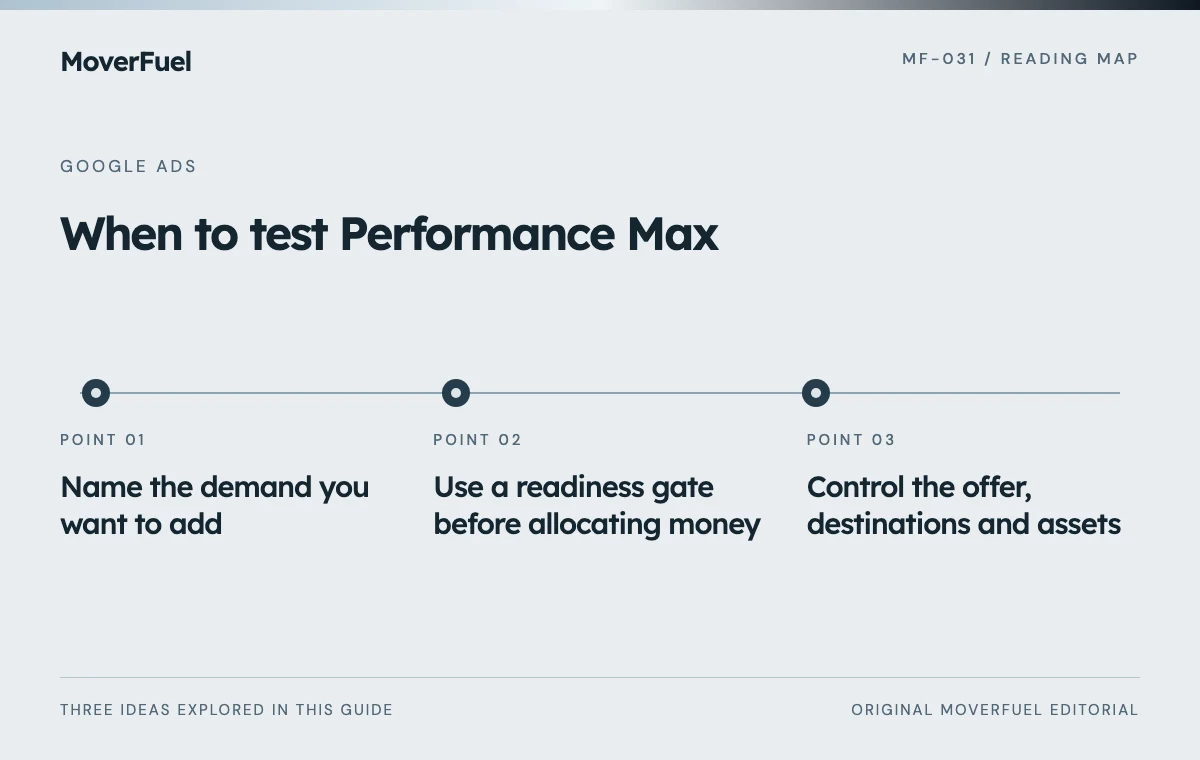
Name the demand you want to add
Choose one business question before choosing campaign settings. Perhaps your local Search campaigns reach the available high-intent queries, while crews still have weekday capacity. Or you want to introduce a packing-and-storage offer that requires more explanation than a short text ad. Those are different experiments with different creative and sales requirements.
Google describes Performance Max as automation across bidding, targeting and creative on multiple Google channels. Its lead-generation guidance emphasizes accurate conversion data and useful business inputs. Automation does not independently know whether an inquiry fits your routes, inventory requirements or available dates. [1]
Write the hypothesis in operational terms: “Additional qualified apartment-moving inquiries that become retained weekday bookings.” Do not use “more conversions” without defining the event. Also specify what would disprove the hypothesis, such as a rise in total spend with no credible improvement in combined bookings.
Use a readiness gate before allocating money
Scroll the table horizontally to compare all columns.
| Requirement | Evidence to collect | If missing |
|---|---|---|
| Outcome data | Recent inquiries matched to qualified and booked stages | Repair measurement first |
| Operational room | Available crews and estimator capacity in the test market | Resolve the capacity constraint |
| Creative proof | Approved images, video and accurate service claims | Prepare assets and permissions |
| Destination quality | Working mobile forms and service-specific pages | Fix the customer journey |
| Financial boundary | Maximum test loss and review dates agreed in writing | Do not launch an open-ended test |
A large inquiry count does not compensate for unreliable classification. If the sales team changes its qualification definition halfway through the test, the campaign receives an inconsistent signal and the analyst loses a fair comparison. Define service fit once, train the reviewers and log any later changes.
Use the qualified conversion guide to establish the signal before adding a new campaign type.
Control the offer, destinations and assets
Organize the experiment around a coherent service. A commercial relocation requires a different conversation from a small residential move. Review whether each asset and destination accurately describes the service that the receiving team can sell.
Current Google guidance includes campaign/account negative keywords, brand exclusions and controls around final URL expansion. Review the settings available in your account rather than assuming older limitations still apply. Inspect automatically generated creative as well as material your team supplied. [1]
Make every eligible destination earn its place
Open candidate pages as a customer would. Exclude an irrelevant careers page or informational page from a conversion journey where appropriate controls permit it. Check that the advertised location, phone routing and requested information agree. A correct tracking tag cannot rescue a page that routes customers to the wrong branch.
Compare the business before comparing campaign columns
Keep a baseline covering total paid spend, unique qualified opportunities, retained bookings and service mix. Separate branded demand where reporting permits. If Performance Max bookings rise while Search bookings fall by a similar amount, investigate reassigned credit before describing the increase as new demand.
A matched market or controlled experiment may provide stronger evidence than a simple before-and-after comparison when it is feasible. Markets rarely match perfectly: seasonality, capacity, prices and local competition can differ. Record those differences and avoid treating a weak comparison as proof of incremental revenue.
Allow enough time for the normal estimate-to-booking cycle, not just the advertising platform to accumulate events. Compare equally mature inquiry cohorts. A week of new commercial inquiries should not be judged against residential inquiries that have already had a month to close.
Choose continue, repair or stop from a written review
Scroll the table horizontally to compare all columns.
| Observed result | Interpretation to investigate | Next action |
|---|---|---|
| More forms, fewer suitable jobs | Signal quality or service mismatch | Repair goals and intake; avoid scaling raw leads |
| Campaign bookings grow, total bookings do not | Attribution overlap or substitution | Review combined results and comparison design |
| Suitable bookings grow within the agreed cost boundary | Potential useful expansion | Increase cautiously with capacity checks |
| Spend reaches the agreed loss limit without usable evidence | Test has not earned more investment | Pause and document what remains unknown |
Keep the test budget separate from money needed to sustain proven demand. Review marginal results as you expand: the next increment of spend can behave differently from the initial allocation. Preserve the ability to stop without losing access to assets, customer records or the original account baseline.
The final memo should explain what changed in the business, what the data cannot establish and what the next test would resolve. A disappointing experiment can still prevent a larger mistake when its boundaries and lessons are recorded honestly.
Common questions
Should every mover add Performance Max?
No. It is a testable channel option, not a required growth stage. Reliable outcome tracking, suitable assets, operating capacity and an affordable experiment matter more than copying another account.
Can campaign-reported bookings prove incremental growth?
They show attributed outcomes under the reporting rules. Incremental growth requires a credible comparison with what would likely have happened without the campaign.
Your next step
Launch only when the experiment has a clear demand question, dependable outcome data and a financial stopping point. Judge the combined business result before rewarding a campaign for reported conversions.
Sources & editorial notes
Platform claims cite the documents below. Operating frameworks and labeled examples are MoverFuel editorial analysis, not client results or industry benchmarks.
- Google: Performance Max lead generation best practicesCurrent Performance Max lead-generation inputs, multichannel automation and campaign controls; no guaranteed mover results. Reviewed .