
A housing headline can explain part of a moving company's environment, but it cannot tell you how many suitable jobs will arrive next month. Read the indicator's definition, geography and timing before connecting it to your own inquiries. The useful output is a conditional plan, not a confident prediction from a single chart.
 View full-size graphic ↗
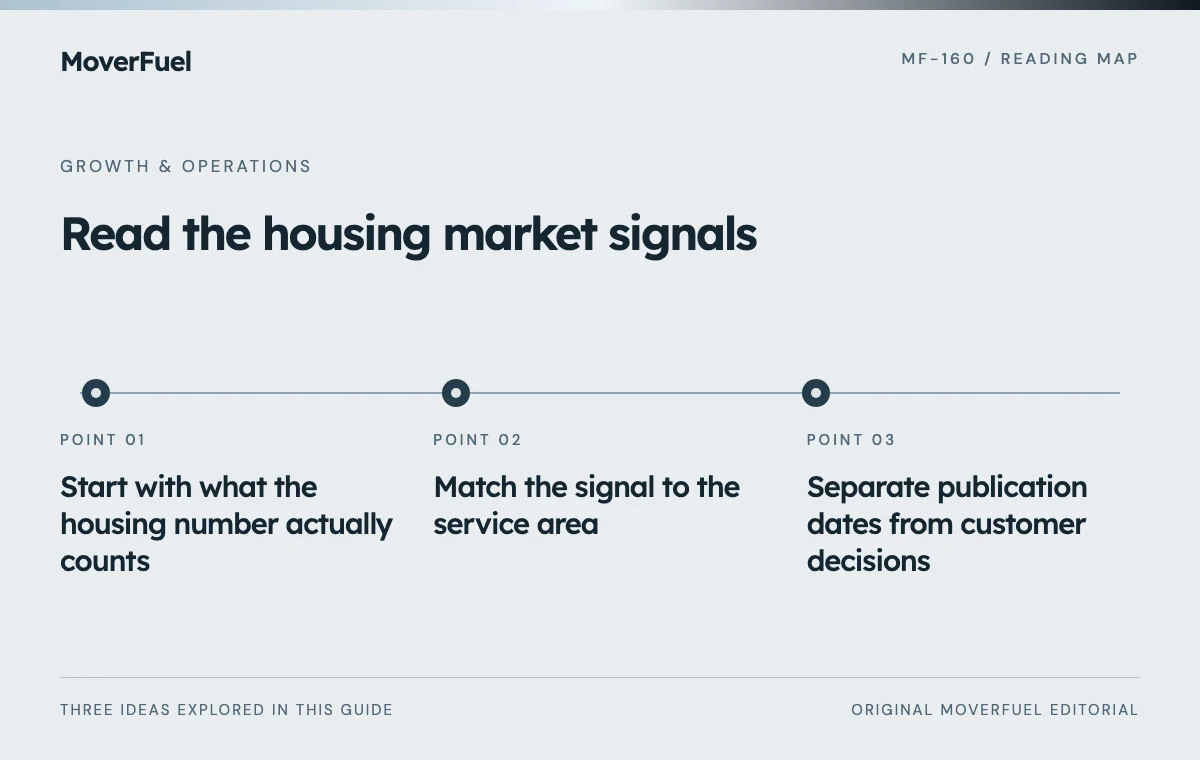
Start with what the housing number actually counts
Census new residential sales concern new single-family houses sold when a contract is signed or a deposit accepted. That is different from a closing, a household's moving date or a paid moving job. A sale may be recorded before construction has begun. [1]
Migration data answer another question. The ACS asks where a person lived one year earlier. Those responses help describe population movement; they do not identify which households hired a mover, their service needs or their acquisition channel. [2]
Scroll the table horizontally to compare all columns.
| Signal | Potential use | What it does not establish |
|---|---|---|
| New home sales | Understand one part of housing activity | All home transactions or moving jobs |
| Residence one year ago | Understand patterns of population movement | Paid mover demand or a prospect list |
| Company qualified inquiries | Observe current demand reaching this business | The entire local market |
| Booked and completed jobs | Measure actual company outcomes | Future demand without further assumptions |
Keep these definitions alongside the chart in the management report. A familiar label such as sales can conceal a materially different event from the one operations needs to plan around.
Match the signal to the service area
The Census Survey of Construction produces national and regional estimates for its main housing series. Its methodology explains the limits of the sample for local estimates. A national trend should not be relabeled as a count for the company's city or operating territory. [3]
Add local evidence without inventing precision
Use properly defined local records where available, and record their publisher, coverage and revision policy. Building permits, listings, sales and population changes describe different events. Do not combine them into a single demand score unless the weighting has a defensible purpose and clear limitations.
A mover serving one metro and a mover handling several interstate lanes may react differently to the same national release. Identify the origins, destinations and service categories that actually contribute to the company's work before choosing an indicator.
Separate publication dates from customer decisions
A published release describes a period that has already occurred. Some housing estimates are preliminary and later revised. Save the release date and the version used in a decision so the team can explain why its assumptions changed. [3]
Within the company, distinguish inquiry creation, estimate completion, booking and job date. A customer can request an estimate in one month and move in another. Comparing a housing contract series with completed jobs in the same calendar month may conceal that timing difference.
Compare market context with your own funnel
Break inquiry trends into service type, geography and source where the data is reliable. Review whether campaign delivery, tracking, answer coverage, availability or pricing changed. A decline in reported leads could reflect measurement failure rather than lower demand.
If inquiries hold steady but fewer are suitable, inspect the requests themselves. A change in origin, destination or timing may matter more than the headline total. If suitable inquiries remain stable but bookings fall, investigate estimate handling and operational fit.
The marketing funnel audit provides a way to isolate the stage that changed before adjusting acquisition spend.
Record disconfirming evidence. A market explanation should become less persuasive when comparable competitors, your other channels or another branch show a different pattern. Avoid selecting only the figures that support the preferred narrative.
Build responses around conditions you can observe
Scroll the table horizontally to compare all columns.
| Condition | Possible response | Check before acting |
|---|---|---|
| Suitable inquiries decline across reliable sources | Test demand and visibility assumptions | Tracking and campaign delivery are intact |
| Interest shifts to different service areas | Review serviceable geographic opportunities | Operations can fulfill the work |
| Estimate conversion weakens | Investigate objections and follow-up | The cohort has had time to decide |
| Demand exceeds a constrained schedule | Adjust promises and acquisition priorities | Capacity information is current |
These are management prompts, not automatic rules. Define a limited action, an owner and a review date. A small experiment can help distinguish competing explanations without committing the entire marketing budget to an uncertain market forecast.
Keep the company's financial decision-makers involved when scenarios affect cash commitments. Marketing evidence informs the discussion but does not establish the business's ability to absorb a prolonged downturn.
Maintain a short market evidence log
For each indicator, save its definition, source URL, geography, observation period, publication date and revision status. Add the company metric being compared and the reason the relationship might matter. This makes the interpretation reviewable rather than dependent on memory.
At the next review, record what happened and whether the planned action was useful. Preserve uncertainty where the evidence remains mixed. Over time, the log can reveal which signals deserve attention and which mainly produce distracting headlines.
Connect the findings to your Google Ads strategy and tracking system using actual customer and job outcomes.
Common questions
Does a decline in home sales mean moving leads will decline by the same percentage?
No. Housing transactions, residence changes and purchases of moving services are different measures. The effect depends on geography, service mix, timing and the business's own visibility and conversion.
Can national housing data guide a local campaign?
It can provide context, but it should not be presented as a local demand count. Combine it with properly defined local evidence and reliable company inquiry and job records.
Your next step
Use housing data to ask better questions. Check definitions and timing, compare the evidence with your own funnel, and make conditional decisions that can be revised.
Sources & editorial notes
Platform claims cite the documents below. Operating frameworks and labeled examples are MoverFuel editorial analysis, not client results or industry benchmarks.
- Census Bureau: Survey of Construction definitionsNew residential sales definitions distinguish signed contracts or deposits from closings and moving jobs. Reviewed .
- Census Bureau: ACS residence one year agoACS residence-one-year-ago questions describe population mobility, not purchases of moving services. Reviewed .
- Census Bureau: Survey of Construction methodologySurvey of Construction methodology describes national/regional estimation, sample limitations and revisions. Reviewed .