
When housing activity weakens, the instinct may be to cut every campaign or chase any job available. Neither response starts with the company's actual exposure. Identify which services and markets are affected, distinguish external pressure from internal conversion problems and agree on what the business can responsibly test.
 View full-size graphic ↗
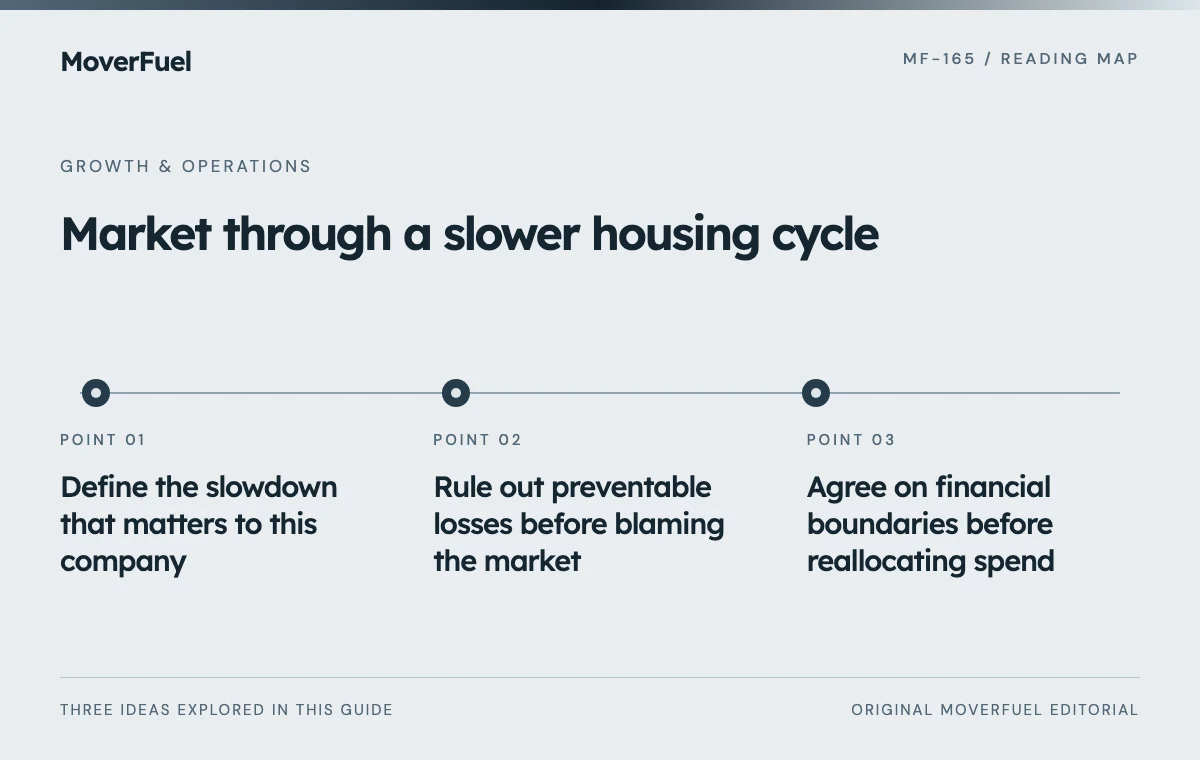
Define the slowdown that matters to this company
A national housing statistic is not a direct measure of local paid moving demand. Census new-home sales measure contracts or deposits for new single-family homes, while residence-change data describe a different population event. Neither is a count of this company's potential customers. [1] [2]
Map the revenue and inquiry mix by service and geography using reliable internal records. Determine where the company depends on the activity thought to be slowing. Avoid assuming that every residential, commercial, packing or storage service will move in the same direction.
Scroll the table horizontally to compare all columns.
| Question | Evidence | Decision supported |
|---|---|---|
| Which services are changing? | Comparable inquiry and job cohorts | Where to focus diagnosis |
| Which markets are affected? | Defined geography and service coverage | Whether a response should be local |
| What stage is weakening? | Qualified inquiries, estimates and bookings | Demand versus conversion work |
| What can operations fulfill? | Current capacity and capability | Which alternatives are realistic |
Keep external indicators in context, including publication dates and revisions. A preliminary release may change. The company should be able to explain the evidence available when it made a decision. [3]
Rule out preventable losses before blaming the market
Check whether calls are answered, forms reach the correct team, campaign delivery is normal and source tracking still works. Review recent website or account changes. A broken conversion path can look like a demand collapse in a dashboard.
Compare opportunities that have had time to resolve
Separate a decline in suitable inquiries from a decline in estimate-to-booking conversion. Recent estimates may still be open. Record the cohort date and the outcome definition before concluding that customers stopped buying.
Listen to documented loss reasons without treating every comment as a market survey. Price, timing, trust, service fit and slow responses require different remedies. Use the record to form a testable explanation, then look for confirming and contradicting evidence.
Start with the funnel audit and the housing indicator guide to keep operational and market explanations separate.
Agree on financial boundaries before reallocating spend
Ask the people responsible for finance and operations to define the available budget, acceptable test exposure and commitments the business must protect. A marketing report cannot determine the company's cash capacity on its own.
Evaluate activities by their purpose and evidence. Some produce near-term inquiries, others repair conversion or maintain useful assets. A blanket cut can remove productive demand; a blanket increase can deepen waste. Document the reasoning for each material change.
Use a dated decision record: what changed, why, expected effect, maximum exposure and review point. This prevents reactive weekly changes from becoming an untraceable strategy.
Test adjacent demand only where capabilities fit
Scroll the table horizontally to compare all columns.
| Opportunity | Validate first | Avoid |
|---|---|---|
| Different supported geography | Travel and service economics | Assuming another market is unaffected |
| Commercial work | Capability and project assessment process | Claiming experience the company lacks |
| Packing or storage | Actual offer, costs and fulfillment | Promoting an unavailable add-on |
| Past legitimate opportunities | Current need and appropriate contact basis | Indiscriminate stale-record blasts |
Choose one or two well-defined questions rather than launching every possible alternative. A bounded test should produce a decision about a real service opportunity, even if the result is that the company should not pursue it.
SBA marketing guidance emphasizes a plan that connects objectives, actions, spending and measurement. Apply that discipline to a downturn response so each activity has an owner and a reason to continue or stop. [4]
Do not use unsupported discounts as the default differentiator. Confirm the contribution effect and make terms clear. A lower price cannot compensate for an unsuitable service or an estimate process customers do not trust.
Preserve useful acquisition assets and repair weak points
Keep business information accurate, essential service pages useful and conversion paths functional. These tasks remain important even when campaign budgets change. Neglected pages and outdated availability claims can make recovery harder when demand improves.
Prioritize improvements tied to observed friction: an unclear service scope, difficult mobile form, weak estimate handoff or missing source-to-job connection. Avoid using the downturn to justify a large redesign without a specific customer or measurement problem.
The off-season strategy guide offers an action portfolio. A housing downturn may last across seasons, so reassess assumptions rather than treating it as a normal calendar dip.
Use scenarios that can change with the evidence
Create conservative, expected and stronger-demand scenarios from explicit company assumptions. State the inquiry, conversion and capacity conditions behind each. Do not attach false probabilities or describe the middle scenario as a forecast guaranteed to occur.
Review actual outcomes against those assumptions and decide what to change. If service fit improves but inquiry volume remains weak, the next action may differ from a case where demand is stable and booking conversion is falling. Preserve that distinction in the management discussion.
Connect paid acquisition, conversion improvements and measurement to the constraint the evidence actually supports.
Common questions
Should moving companies stop advertising during a housing downturn?
There is no universal answer. Review cash boundaries, service exposure and mature campaign outcomes. Reduce waste and test carefully rather than assuming all advertising is either essential or expendable.
Can commercial moving replace lost residential demand?
Only if the company has suitable capabilities and can reach real commercial opportunities. It is a separate acquisition and fulfillment path, not a guaranteed substitute.
Your next step
Respond to the company's measured exposure, not a headline alone. Protect useful acquisition infrastructure, set financial boundaries and test realistic alternatives with clear review decisions.
Sources & editorial notes
Platform claims cite the documents below. Operating frameworks and labeled examples are MoverFuel editorial analysis, not client results or industry benchmarks.
- Census Bureau: Survey of Construction definitionsNew residential sales count defined new-home contracts/deposits, not all moving demand. Reviewed .
- Census Bureau: ACS residence one year agoResidence-one-year-ago data concern population movement rather than paid mover purchases. Reviewed .
- Census Bureau: Survey of Construction methodologyHousing estimates have geographic and revision limitations. Reviewed .
- SBA: marketing and salesMarketing plans connect goals, actions, budgets and measurement; downturn responses remain conditional company decisions. Reviewed .