
A marketing audit should explain where suitable work is being lost and how to verify the cause. A list of missing tags or low scores is not enough. Trace the customer's path from discovery to inquiry, qualification, estimate and completed move. At each handoff, separate an observed defect from a hypothesis, then assign the next check to someone who can act on it.
 View full-size graphic ↗
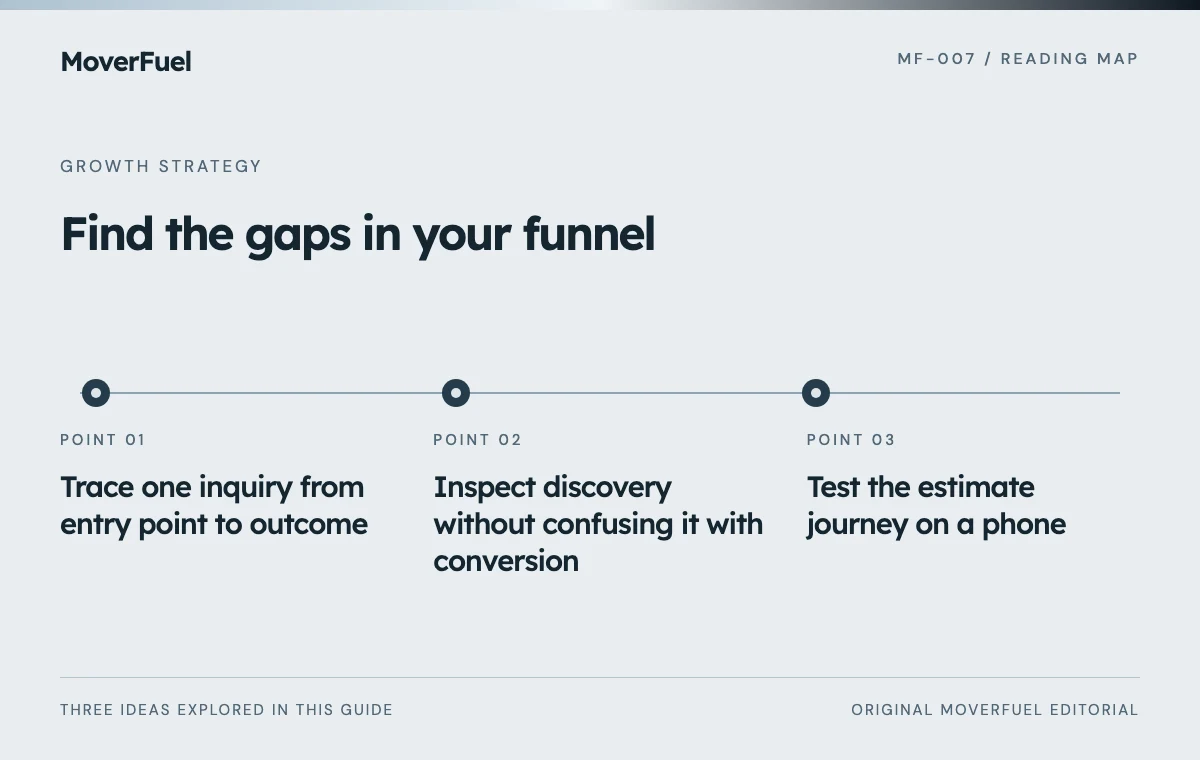
Trace one inquiry from entry point to outcome
Choose a representative recent record for each important service or inquiry path. Identify the landing page or call entry point, the record created, the person assigned and the eventual outcome. Work with authorized access and avoid copying customer information into unrelated audit documents.
Use a controlled test for functionality where appropriate, clearly marking it as a test so it does not become a real sales opportunity or advertising conversion. Verify the confirmation and routing as well as the page interaction. A form that displays success but never reaches the estimator is a more urgent problem than a cosmetic improvement.
Scroll the table horizontally to compare all columns.
| Handoff | Check | Useful evidence |
|---|---|---|
| Page to inquiry | Can the customer complete the intended action? | Device, steps, validation and confirmation |
| Inquiry to sales | Does the correct person receive one usable record? | Record ID, routing and notification outcome |
| Sales to estimate | Is fit established and the next step recorded? | Disposition, assigned owner and estimate status |
| Estimate to outcome | Is booking, loss or completion distinguishable? | Dated outcome and a meaningful reason |
Inspect discovery without confusing it with conversion
Review whether important service pages are accessible, internally linked and understandable. Check for unintended indexing restrictions, broken destinations and misleading coverage claims. Google's helpful-content guidance emphasizes useful information for the intended audience; a page can be technically accessible while still failing to answer a moving customer's practical question. [1]
Review the local information customers actually see
Compare the business profile, website and operating facts. Check name, contact details, services and genuine location information. Google's local-ranking guidance identifies relevance, distance and prominence, so a visibility issue should not automatically be attributed to one missing keyword or a low score from an unrelated tool. [2]
Record the scope of every observation. Seeing a result for one query in one location does not establish visibility across the service area. Likewise, an audit tool's score is a diagnostic aid, not evidence that a business will receive more booked moves after every suggested fix.
Test the estimate journey on a phone
Read the page as a customer with a specific move in mind. Can they tell whether the company provides the service, whether the route is plausible and what happens next? Check the primary contact options without relying on knowledge that only the office team has.
- Submit the form with an omitted required field and confirm the error is understandable.
- Check date and location inputs with the device's actual keyboard.
- Confirm that click-to-call uses the intended number and the call reaches the right path.
- Review any success message for accurate expectations about estimates and availability.
- Check that the customer can recover from an error without re-entering unnecessary information.
W3C's forms guidance supports clear labels, instructions and validation. Use these principles to identify specific friction rather than merely reporting that the form is ‘not optimized.’ Capture the failed step and the expected behavior so the developer can reproduce the issue. [3]
Review qualification and response coverage together
Sample records labeled unqualified, unreachable and lost after estimate. Ask whether the labels reflect the conversation and the current service policy. A request for an unavailable Saturday may become suitable if the customer is flexible; an apparently distant searcher may be planning a move from a serviceable origin.
Then inspect response ownership. Identify unassigned inquiries, missed calls, delayed handoffs and records without a documented next step. The audit should distinguish a source that generates unsuitable requests from a process that fails to handle suitable requests.
Use a consistent qualification definition before comparing the quality of different channels.
Reconcile the reports with business records
Pick a small set of known inquiries and follow their identifiers through the reporting systems. Check whether a form, call and CRM-created event are being counted as separate acquisitions when they concern one customer. Compare the event dates and outcome definitions before treating different platform totals as contradictory.
For example, CallRail's Google Ads integration has implementation prerequisites and distinct conversion paths. Its existence does not mean a raw call is automatically a qualified moving opportunity. Audit what the actual integration sends and how the receiving conversion action is used. [4]
Keep unresolved attribution visible. Some records will lack a reliable original source or include several touchpoints. Do not fill the gap with a confident channel assignment simply to make the dashboard reconcile. An honest unknown can be more useful than a precise but invented answer.
Prioritize by business consequence and confidence
Give each finding an observed condition, evidence, likely consequence, owner and next verification step. Separate confirmed failures from improvements worth testing. A reproducible broken form deserves different treatment from an uncertain hypothesis about headline wording.
Scroll the table horizontally to compare all columns.
| Finding | Evidence level | Next action |
|---|---|---|
| Form confirms success but no record arrives | Reproduced functional failure | Repair delivery and retest before adding traffic |
| Many sampled requests concern an unsupported service | Observed pattern requiring broader review | Check terms, page language and intake coding |
| Estimate rate falls after a staff change | Correlation, cause not established | Review ownership, timing and service mix |
| A page could explain packing options more clearly | Content improvement hypothesis | Clarify the offer and evaluate the inquiry journey |
Finish with a short ordered work list and a date to verify the fixes. The audit is useful when the team can reproduce the problem, understand its importance and confirm whether the action worked. A long document without ownership simply moves the uncertainty into another file.
Common questions
Does a technical SEO audit cover the entire marketing funnel?
No. Technical access and indexing are one part. A funnel audit also examines the offer, inquiry handling, qualification, estimates and outcome measurement.
How many lead records should an audit review?
Choose a sample appropriate to the services and questions being investigated, and state its limits. A small diagnostic sample can reveal a reproducible defect without establishing a statistically representative rate.
Should every audit recommendation be implemented immediately?
No. Prioritize confirmed failures and material operating constraints, then test lower-confidence improvements. Each item should have an owner, a reason and a verification step.
Your next step
Trace the real customer journey, classify the evidence and turn the highest-impact findings into owned tasks. Verify repairs with the same checks that revealed the problem. An audit should reduce uncertainty about the next action, not merely produce more scores.
Sources & editorial notes
Platform claims cite the documents below. Operating frameworks and labeled examples are MoverFuel editorial analysis, not client results or industry benchmarks.
- Google: helpful people-first contentUseful, audience-focused content as a search foundation. Reviewed .
- Google: local rankingLocal-ranking factors and diagnostic limits. Reviewed .
- W3C: accessible formsForm labels, instructions and validation. Reviewed .
- CallRail: Google Ads integrationIntegration prerequisites and conversion-path distinctions; the audit procedure is original editorial analysis. Reviewed .