
A seasonal marketing calendar should connect when customers inquire with when the moving company can perform the work. It should also allow time to prepare pages, creative and intake coverage before demand arrives. Start with your own history and service mix; a generic calendar cannot tell every market when to increase spend.
 View full-size graphic ↗
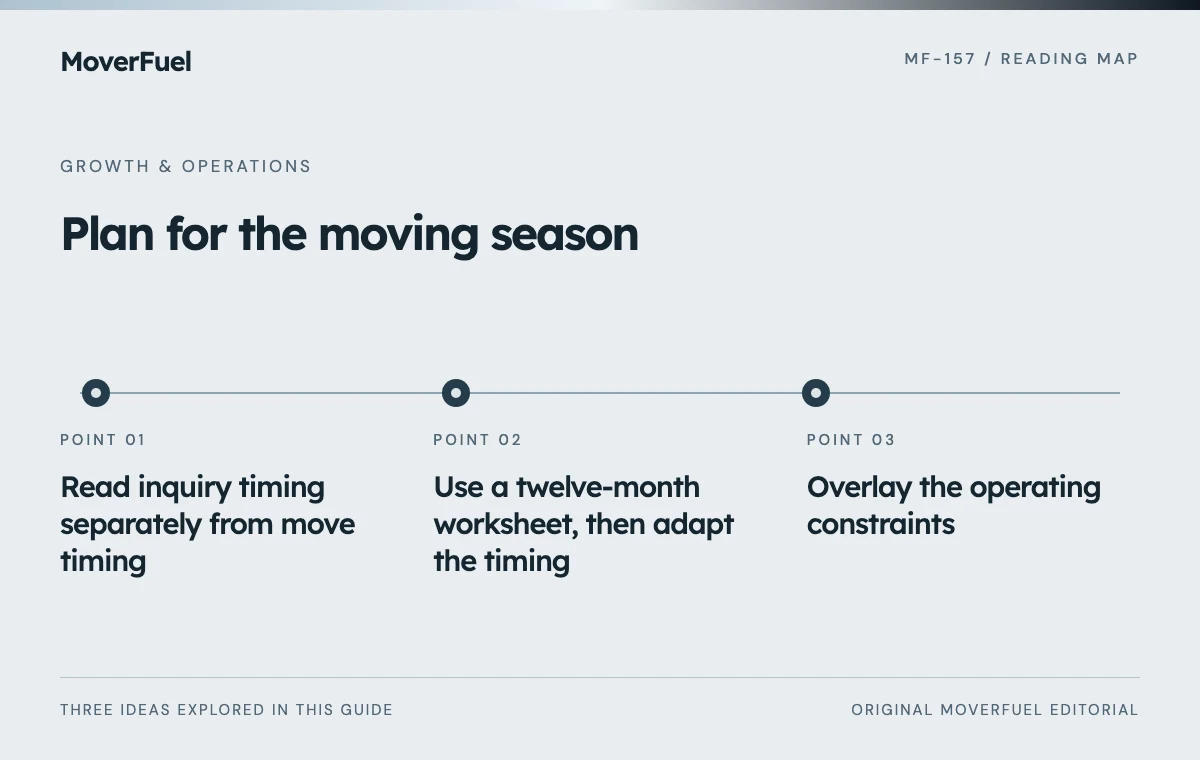
Read inquiry timing separately from move timing
Compare inquiry creation, estimate completion, booking and service dates across prior periods. A move performed in one month may have been acquired earlier. If the calendar follows only completed-job revenue, campaign preparation can arrive after the relevant decision window.
Separate services and markets when their patterns differ. Commercial relocations, local households and storage needs may not follow the same rhythm. Note unusual promotions, weather disruptions, staffing changes and tracking gaps before treating a historical peak as a repeatable pattern.
Scroll the table horizontally to compare all columns.
| Input | Question |
|---|---|
| Inquiry volume by service | When does suitable demand enter the business? |
| Inquiry-to-booking time | How early must marketing and intake be ready? |
| Booked workload by date | Where is capacity already committed? |
| Cancellations and reschedules | How uncertain is the schedule? |
| Contribution by service | Which work supports the business economically? |
| Production lead times | When must pages, assets and approvals begin? |
SBA marketing guidance connects goals, actions, budgets and measurement. Use that planning structure while deriving timing from the moving company's actual operating evidence. [1]
Use a twelve-month worksheet, then adapt the timing
The following is an illustrative annual review cadence, not a claim that every mover has the same busy season. Add your market's expected demand, available capacity, campaign action, production deadline and owner to each row. Shift preparation ahead of the relevant inquiry period.
Scroll the table horizontally to compare all columns.
| Month | Review focus | Decision to record |
|---|---|---|
| January | Prior-year evidence and current commitments | Which assumptions need updating? |
| February | Service-page and tracking readiness | What must be repaired before the next demand increase? |
| March | Creative and intake preparation | Which assets and staffing need lead time? |
| April | Forward booking coverage | Where can suitable demand still fit? |
| May | Campaign and service-mix fit | Which offers match current availability? |
| June | Customer expectations and response coverage | What promises or handoffs need correction? |
| July | Capacity and contribution review | Should demand be shifted, capped or maintained? |
| August | Later-date inquiry pipeline | What work is developing beyond current commitments? |
| September | Upcoming service opportunities | Which bounded tests are justified? |
| October | Owned-content and conversion maintenance | What can be improved before the next cycle? |
| November | Scenario and resource planning | What changes would alter next year's plan? |
| December | Learning and handoff documentation | What should the next cycle preserve or change? |
These prompts are useful even when the calendar is rephased. A branch with a different demand pattern should not increase spend merely because a row is labeled with a traditionally busy month elsewhere.
Overlay the operating constraints
Add crew availability, equipment constraints, estimator capacity and the response team's coverage. A campaign can create inquiries that the company has no practical ability to assess or fulfill. Mark dates and services where additional demand would create pressure instead of useful growth.
Work backward from the customer decision
If a service requires a survey and proposal before booking, schedule the marketing and estimate capacity accordingly. Include time for creative review, technical QA and staff training. Publishing a page the day the schedule needs filling may be too late for the actual decision cycle.
Plan flexible spending phases with review triggers
Use phases such as prepare, test, expand, maintain and reduce based on evidence. Define the trigger for moving between them: qualified inquiry availability, mature contribution, response reliability and forward workload. Do not make every budget change automatic on a date alone.
Keep service offers and availability messages current across ads, pages and intake scripts. If capacity tightens, adjust the acquisition plan before the team begins making promises it cannot keep. If demand weakens, diagnose whether the cause is market conditions or execution before increasing spend.
The peak-season capacity guide provides the shorter operating review used when conditions change quickly.
Review variance and carry the lesson forward
Each month, compare the plan with actual suitable inquiries, estimate progression, bookings and workload. Explain the largest differences and assign one or two adjustments. Keep a record of what changed so next year's calendar does not repeat unsupported assumptions.
Distinguish activities completed from outcomes achieved. Publishing the planned articles is an execution measure; helping suitable customers find and understand the service is a different result. Use both to identify whether the plan or its delivery needs work.
Coordinate content marketing, Google Ads and lead tracking through the same calendar and operating review.
Common questions
Should every mover spend more in the same months?
No. Use local demand history, service mix, booking lead times and available capacity. A generic seasonal pattern is a starting hypothesis, not a budget rule.
How far ahead should seasonal content be prepared?
Work backward from the relevant inquiry period using the real time needed for research, production, review and the customer's decision. There is no universal lead time for every asset and channel.
Your next step
A seasonal calendar should connect customer timing, preparation work and sellable capacity. Keep the plan flexible and update it with observed outcomes instead of repeating a fixed annual spending pattern.
Sources & editorial notes
Platform claims cite the documents below. Operating frameworks and labeled examples are MoverFuel editorial analysis, not client results or industry benchmarks.
- SBA: marketing and salesSBA marketing guidance links goals, actions, budgets and measurement; company-specific timing is editorial planning. Reviewed .