
Recent moving reviews may help a prospective customer judge whether public feedback reflects the company's current service. That is a reasonable customer-confidence question, not proof of a fixed ranking formula or a guaranteed conversion increase. Evaluate the freshness, relevance and context of the evidence together instead of chasing a universal review-age target.
 View full-size graphic ↗
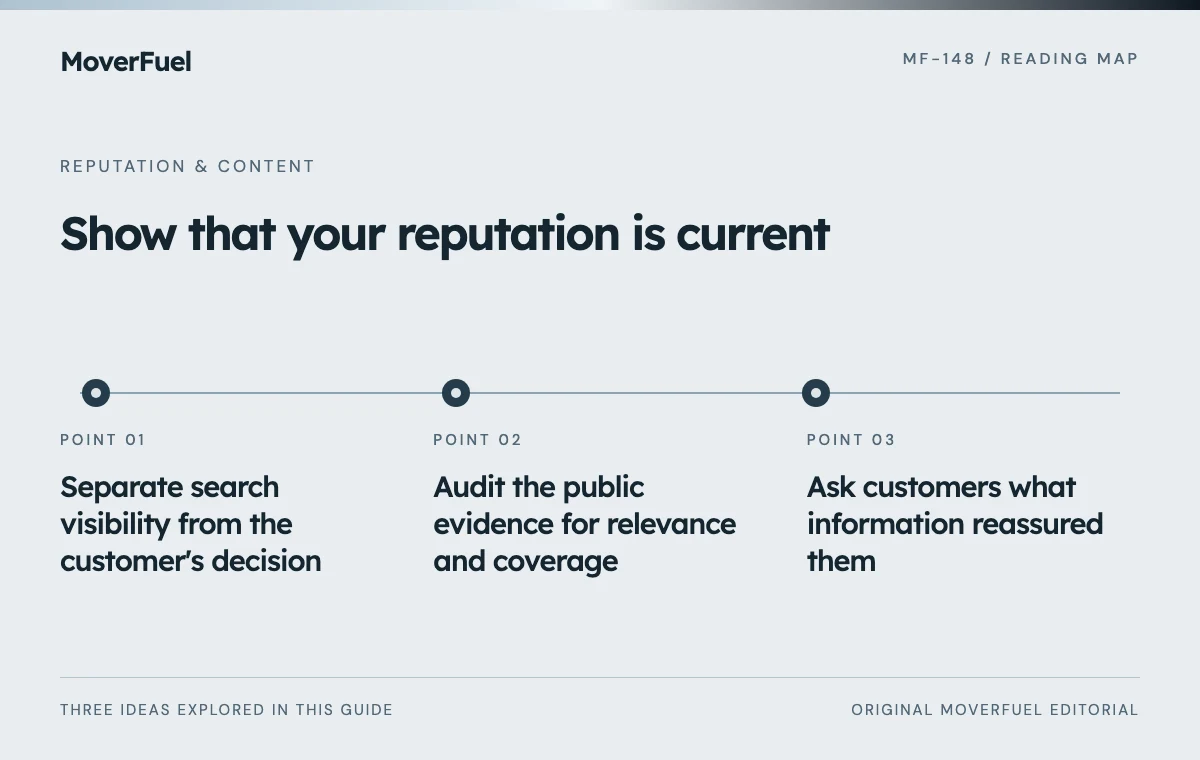
Separate search visibility from the customer's decision
Google describes local ranking in terms of relevance, distance and prominence, and says review quantity and positive ratings can help local ranking. That guidance does not establish a universal recency threshold or a promise that a newer review profile will outrank an older one. [1]
A customer may independently care whether a review describes the current team, service or location. Treat that as a hypothesis to investigate through customer research and observed behavior. Do not turn a plausible explanation into an unsupported ranking factor or percentage uplift.
Scroll the table horizontally to compare all columns.
| Question | Evidence to examine | Unsupported shortcut |
|---|---|---|
| Does the business appear for relevant searches? | Search/profile visibility with market context | A fixed number of new reviews guarantees a rank |
| Does the public proof help customers choose? | Customer feedback and conversion research | Every customer rejects reviews older than a set age |
| Does feedback reflect current operations? | Service, location and time context | A recent date makes every review representative |
Keep these questions separate in reporting. A profile can gain reviews while visibility changes for unrelated reasons, and conversion can change because staffing, price or availability changed.
Audit the public evidence for relevance and coverage
Scroll the table horizontally to compare all columns.
| Dimension | What to inspect |
|---|---|
| Timing | Whether feedback spans recent and older service periods |
| Service match | Local, long-distance, packing, storage or commercial context |
| Location match | Whether the profile and feedback concern the correct operation |
| Specificity | Useful details rather than only a rating |
| Response quality | Accurate, respectful handling of concerns |
| Operational changes | Whether old feedback describes a materially different service |
Record what is visible without inventing a completeness score. A small branch may have fewer reviews because it serves fewer jobs; a commercial business may have a different feedback pattern from high-volume residential work. Counts need an operating denominator before they become a process diagnosis.
Look for gaps that marketing can address truthfully. If current packing services have little public context, explain the service clearly on the website and maintain a neutral review opportunity. Do not manufacture a testimonial to fill the perceived gap.
Ask customers what information reassured them
Use a voluntary, neutral question during appropriate customer research: ‘What information helped you decide whether to contact us?’ If reviews are mentioned, ask what about them was useful. Let the customer identify timing, detail, rating, response or another factor rather than leading them toward recency.
Use a careful usability comparison when appropriate
A moderated research exercise can explore how people interpret clearly identified sample review layouts. Do not publish fictional reviews as real proof or place them into a live sales page. The purpose is to understand interpretation, not to deceive prospects into an experiment.
Record sample size, recruitment and limitations. A few interviews can reveal questions worth addressing, but they do not establish how all moving customers behave. Keep quotes anonymous or obtain permission before using them publicly.
Improve feedback coverage without manipulating sentiment
Use a consistent service-based request process rather than asking only customers expected to be positive. Google Maps policy prohibits selective positive solicitation and incentives. The aim is a genuine opportunity for feedback, not a manufactured stream of favorable dates. [2]
Investigate delivery failures, duplicate suppression and wrong-profile links if recent completed jobs are not receiving the intended neutral request. Fixing those issues can improve coverage without pressuring customers to post.
The review-request workflow provides a technical checklist for consistent delivery and exceptions.
Report findings with the right level of confidence
A useful finding might be that interviewed commercial prospects wanted reviews describing similar projects, while recent residential reviews did not answer their questions. The response could be clearer commercial service content and approved evidence, not simply a higher review-request frequency.
If conversion changes after improving public proof, record other changes in traffic mix, offer, price, season and intake coverage. A before-and-after chart alone does not isolate the effect of review recency. Use a suitable design before claiming causation.
Review the evidence periodically and update misleading or outdated website excerpts within the permissions held. Keep the original context and avoid suppressing legitimate criticism to create a falsely uniform picture. Customer confidence is better served by accurate information than by an artificially perfect timeline.
Coordinate local SEO with conversion research so visibility questions and customer-confidence questions receive the appropriate evidence.
Common questions
Do recent reviews always rank a mover higher?
No universal guarantee follows from Google's local-ranking guidance. Review-related signals are only part of a broader system, and a simple age rule does not establish an outcome.
How recent should a moving company's reviews be?
There is no universally verified cutoff for every customer and service. Assess whether feedback reflects current operations and relevant services, then improve neutral feedback coverage and useful service information.
Your next step
Treat review recency as one part of the customer's evidence, not a guaranteed growth lever. Investigate what prospects actually need to know and improve coverage without manipulating feedback.
Sources & editorial notes
Platform claims cite the documents below. Operating frameworks and labeled examples are MoverFuel editorial analysis, not client results or industry benchmarks.
- Google: local rankingGoogle local-ranking guidance identifies relevance, distance and prominence and discusses reviews without a universal review-age ranking guarantee. Reviewed .
- Google Maps: prohibited and restricted contentGoogle Maps policy prohibits selective positive solicitation and incentives. Reviewed .