
A moving company's reputation is shaped by the service customers receive and how the business responds when expectations are not met. Managing it requires more than requesting reviews. Give monitoring, replies, escalation and operational repair clear owners so public feedback becomes useful information rather than an occasional marketing task.
 View full-size graphic ↗
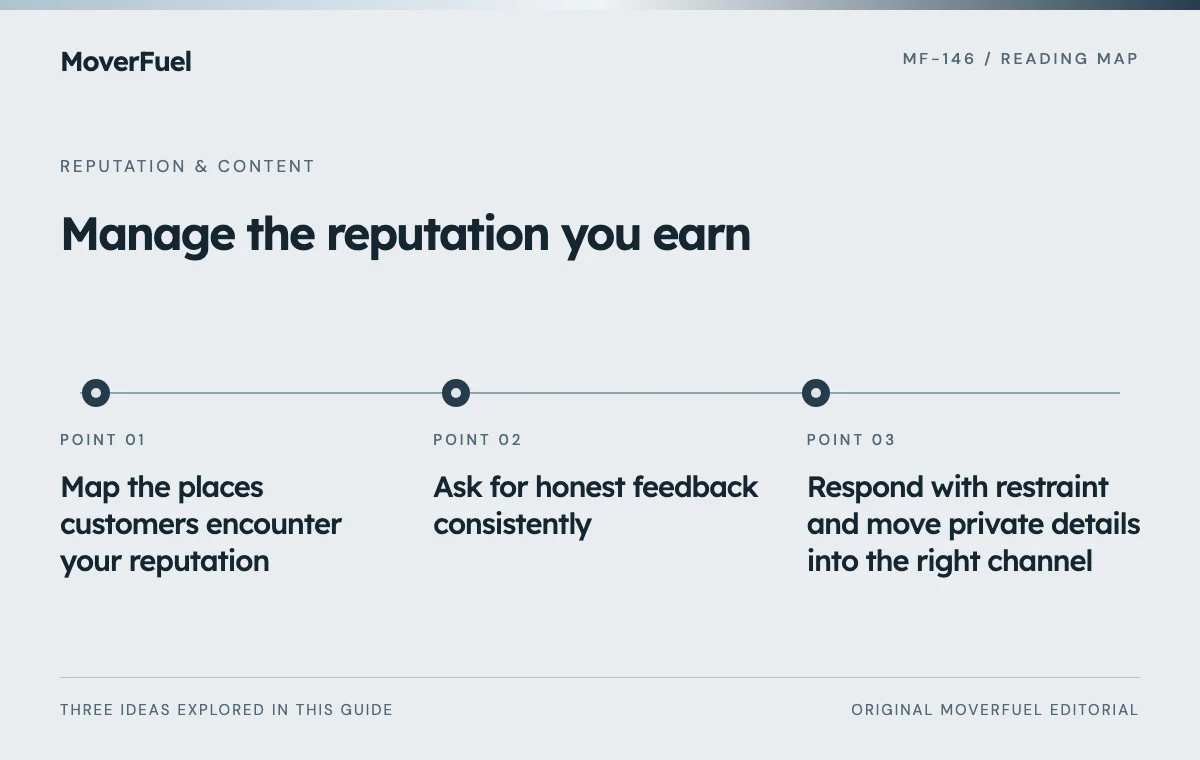
Map the places customers encounter your reputation
List the public profiles, review platforms, website proof and relevant community channels where customers may evaluate the business. Record who controls each profile, how notifications arrive and which branch or service the feedback concerns. Avoid spreading attention across channels the business cannot monitor responsibly.
Scroll the table horizontally to compare all columns.
| Workstream | Owner's responsibility | Evidence of completion |
|---|---|---|
| Monitoring | Review relevant new feedback and alerts | Logged item and assigned next action |
| Public response | Provide an accurate, respectful reply | Approved response where appropriate |
| Private resolution | Investigate the customer's actual issue | Service case and follow-through |
| Review requests | Apply a neutral, permitted process | Request log and suppression controls |
| Operational learning | Fix recurring causes | Assigned improvement and review date |
Define backup coverage for holidays and staff changes. A notification sent to a former employee is not a monitoring process. Keep access secure and tied to business-managed accounts.
Ask for honest feedback consistently
Google Maps policy prohibits incentives and selective solicitation of positive reviews, as well as pressure and certain manipulated review practices. Use a neutral request process rather than directing only satisfied customers to the public review link. [1]
A customer support survey and a public-review request can both be useful, but do not use the survey score as a gate that gives only happy customers the public option. Separate service recovery from the opportunity to share an honest experience.
Explain the request simply and make participation optional. Do not prescribe a star rating, keywords or staff names. Train employees on the actual policy instead of setting incentives that reward the number of positive reviews they extract from customers.
The review-request workflow guide covers the trigger, delivery and deduplication mechanics in detail.
Respond with restraint and move private details into the right channel
Read the feedback and the relevant service record before replying. Acknowledge the concern without exposing addresses, payment information or private conversation details. Offer an appropriate route for investigation and follow through on it.
A practical response pattern
Use a brief acknowledgment, a factual statement within your authority and a clear next step. Avoid arguing about every detail in public or posting a generic apology that promises action nobody owns. If the facts are uncertain, say that the team will review them rather than asserting an unsupported account.
Scroll the table horizontally to compare all columns.
| Feedback type | Appropriate next action |
|---|---|
| Specific service concern | Assign an investigation and customer contact |
| Praise with useful detail | Acknowledge without inventing a broader claim |
| Unclear identity or project | Seek appropriate private clarification |
| Possible policy violation | Review the platform's reporting process |
| Sensitive or legal issue | Escalate to authorized management or advisers |
A negative opinion is not automatically a removable policy violation. Use the platform's actual reporting criteria and preserve the distinction between disagreement and prohibited content. Do not promise that a reputation service can erase unfavorable feedback.
Keep published proof authentic and current
FTC review and testimonial rules address deceptive review practices. Do not fabricate customer identities, purchase false praise or republish invented experiences as social proof. Keep permission and source records for testimonials used in marketing. [2]
Review website excerpts for accurate context and current permission. A quote should not be edited to reverse its meaning or paired with an unsupported result. If the company has no approved testimonials for a service, explain the service using other truthful material rather than filling the gap with fiction.
Turn repeated feedback into operational work
Group themes such as estimate clarity, communication, access preparation, punctuality or handling concerns. Look at the underlying cases before drawing conclusions. A cluster may reflect one branch, one service or a process change rather than the whole business.
Assign a concrete repair: revise a scope explanation, clarify a callback owner or improve the estimator-to-crew handoff. Track whether the work was completed and whether similar issues continue. Review volume alone cannot tell you whether the underlying service improved.
Keep marketing aligned with the repaired process. If customers repeatedly misunderstand an ad's promise, change the promise or the delivery rather than treating the feedback as a review-management problem. Public trust depends on what the business can consistently explain and perform.
Coordinate local search management and conversion optimization with the operating team so profile information, website expectations and customer experience stay consistent.
Common questions
Can a moving company remove every negative review?
No. Use the platform's reporting process for content that violates its rules. A genuine negative opinion is not removable simply because the business disagrees with it.
Should review requests go only to happy customers?
No. Google prohibits selective positive solicitation. Use a neutral, consistent process and keep service recovery separate from access to a public review opportunity.
Your next step
Reputation management needs clear ownership from monitoring through repair. Request honest feedback, respond accurately and use repeated concerns to improve the service customers actually experience.
Sources & editorial notes
Platform claims cite the documents below. Operating frameworks and labeled examples are MoverFuel editorial analysis, not client results or industry benchmarks.
- Google Maps: prohibited and restricted contentGoogle Maps policy prohibits incentives, selective positive solicitation and pressure in review collection. Reviewed .
- FTC: reviews and testimonials rule FAQFTC review/testimonial guidance addresses deceptive reviews and false testimonials. Reviewed .