
Marketing and sales often disagree about lead quality because they are describing different stages of the same inquiry. Marketing sees a genuine request; the estimator sees an incomplete route, an unavailable date or a customer who has not replied. A shared operating agreement should define those states, assign the next action and explain how exceptions return to the people who can improve acquisition.
 View full-size graphic ↗
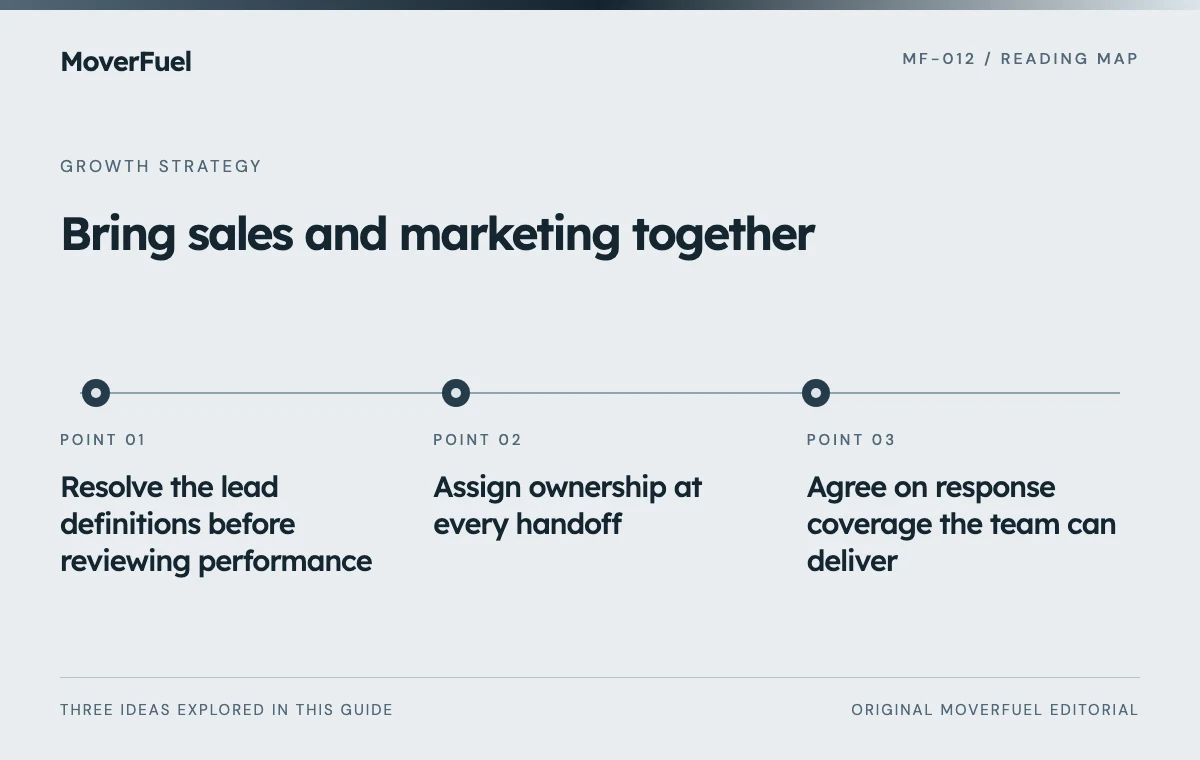
Assign ownership at every handoff
A shared inbox is not an owner. State who receives a new form or call, who checks fit, who prepares the estimate and who follows up. Define the backup when the first person is unavailable. Keep the assignment visible in the business record rather than relying on memory or a private message.
Specify the information that travels with the lead
Agree on a minimal handoff: contact details, requested service, origin and destination information available so far, preferred timing, source context and unresolved questions. The estimator should be able to see what the customer already said without asking them to restart the conversation.
- One responsible owner at each active stage.
- A documented next action and due point.
- A route for exceptions or unusual service requests.
- A clear way to transfer ownership without losing history.
- A closure state that explains why the opportunity stopped progressing.
Agree on response coverage the team can deliver
Define coverage by channel and staffed hours. Explain what happens to a missed call, an after-hours form and an inquiry that arrives during a busy estimate period. Avoid making a response promise the team cannot consistently support.
An automated acknowledgement can confirm receipt and explain the next step, but it should not claim that a person has assessed the move when that has not occurred. If a workflow sends messages, ensure it follows the company's approved contact and data-use process. This operational agreement does not itself establish legal consent for every channel.
Return reasons that marketing can act on
Use a small set of meaningful disposition reasons. Service not offered, route outside coverage, date unavailable, unable to reach and lost after estimate imply different investigations. Avoid a single bad-lead field that mixes them together.
Scroll the table horizontally to compare all columns.
| Recorded reason | What to review | What not to conclude automatically |
|---|---|---|
| Unsupported service | Search intent, ad copy and page descriptions | Every inquiry from the channel is poor |
| Route mismatch | Origin-destination details and targeting | The searcher's device location proves job fit |
| Date unavailable | Scheduling message and capacity | The customer was not serious |
| Unable to reach | Contact data, attempts and coverage | The offer or source was necessarily wrong |
| Lost after estimate | Offer, timing and documented customer feedback | The inquiry was unqualified from the start |
Return patterns with examples and scope. ‘Several sampled requests asked for vehicle transport we do not offer’ gives marketing a testable question. ‘These leads are terrible’ does not. Likewise, marketing should acknowledge genuine service mismatch rather than defend every platform conversion as valuable.
Review disagreements through records, not anecdotes
Set a regular short review of exceptions and stalled opportunities. Inspect a representative set of records with the appropriate permissions. Check the qualification rule, the information available at the time and the action taken. Avoid judging a team member from one isolated note or an incomplete recording.
Tracking systems can support the review, but inspect what they actually capture. CallRail's integration documentation, for example, describes specific conversion paths and prerequisites. A call event does not automatically include a reliable moving-service disposition. The human operating definition still needs to be recorded consistently. [2]
Use the marketing scorecard to connect recurring patterns with an owner and a review date.
Update the agreement when the operation changes
Coverage, staffing, service offers and estimate processes change. Give someone responsibility for updating the shared definitions and communicating the change to campaigns, pages and intake. Preserve the effective date so reports can explain why qualification rates moved.
Keep the agreement short enough to use. A one-page operating summary can link to detailed procedures for exceptional situations. New staff should be able to understand the basic stages and who owns the next step without reading a long strategy deck.
Review whether the agreement reduces unresolved inquiries and improves the usefulness of feedback. The goal is not to prove that either marketing or sales was right. It is to create a reliable path from a suitable customer request to an informed estimate decision.
Common questions
Who should decide whether a lead is qualified?
The business should agree on the definition with operations, sales and marketing. Intake or estimating applies it to records, while marketing uses the resulting evidence to improve acquisition.
Should sales mark every unbooked inquiry as a bad lead?
No. An opportunity can fit the service and still be lost after an estimate. Preserve the stage and reason so the team can distinguish acquisition fit from sales outcomes.
How often should the agreement change?
Update it when material operating facts or processes change, and review recurring exceptions on a regular cadence. Record effective dates rather than silently changing definitions mid-reporting period.
Your next step
Agree on the stages, assign the handoffs and return specific reasons to the people who can act. Use records to resolve disagreements and update the process when the operation changes. Alignment becomes useful when it changes what happens to the next inquiry.
Sources & editorial notes
Platform claims cite the documents below. Operating frameworks and labeled examples are MoverFuel editorial analysis, not client results or industry benchmarks.
- Google: qualified and converted leadsQualified and converted lead-stage concepts. Reviewed .
- CallRail: Google Ads integrationIntegration paths do not themselves establish the moving company's qualification outcome. Reviewed .