
An office relocation inquiry may come from a facilities manager, an owner or an assistant gathering options for several decision-makers. They need to understand whether your company can scope the project and coordinate the move. A commercial landing page should help them start that conversation, not force their project into a residential bedroom-count form.
 View full-size graphic ↗
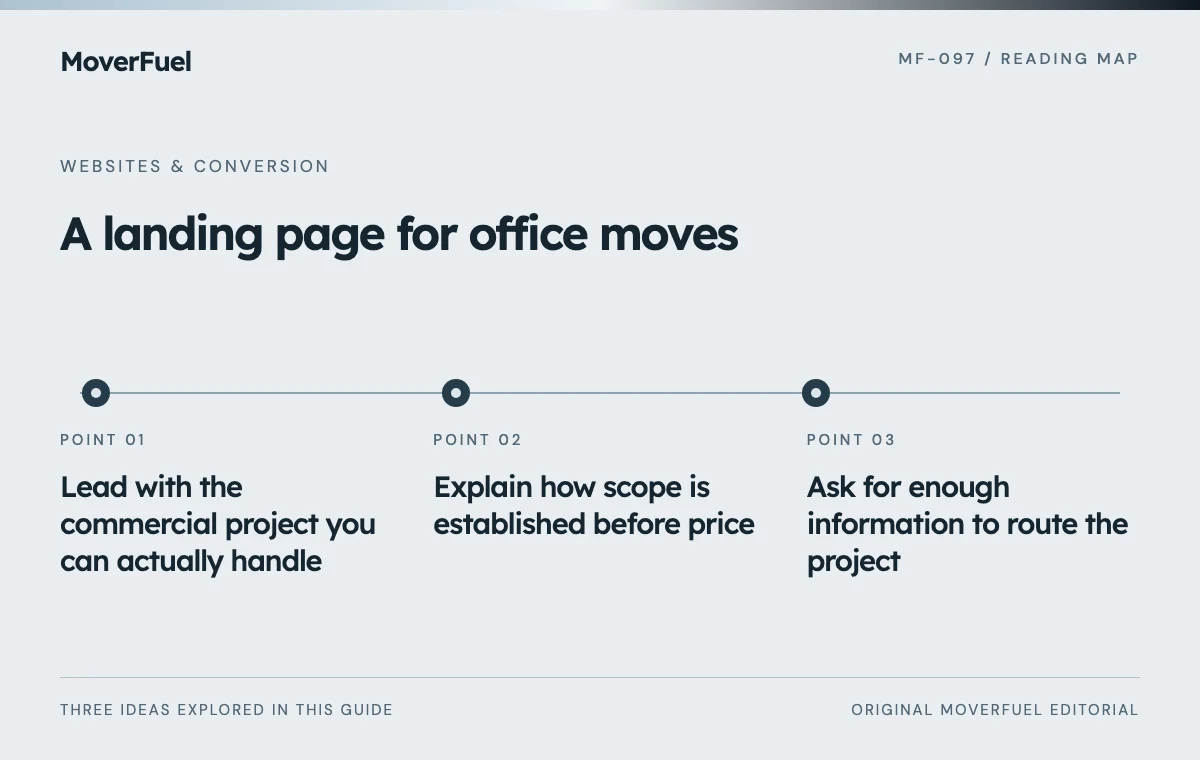
Lead with the commercial project you can actually handle
Name the relevant service and geographic coverage, then explain the next step. If the business offers office relocation planning and site surveys, say so plainly. Do not imply capabilities such as specialist laboratory transport, data-center work or national rollout coordination unless they are real and supported.
The opening should answer three questions: what kind of organization you serve, what work you perform and how a prospect gets a scoped estimate. A broad ‘we move everything’ claim creates uncertainty for buyers who are responsible for downtime, access and coordination.
Scroll the table horizontally to compare all columns.
| Page statement | Business evidence to confirm |
|---|---|
| After-hours availability | Actual scheduling policy and capacity |
| Project coordination | Named role and defined responsibilities |
| Specialist handling | Training, equipment and service limits |
| Packing or furniture work | Included tasks and exclusions |
| Multi-site support | Real operating coverage and delivery model |
Use verified project examples where permission exists. Otherwise explain the process with a clearly labeled illustrative scenario. A fictional office relocation must not become a client case study simply because it makes the page look more established.
Explain how scope is established before price
Commercial scope may include workstations, furniture, storage rooms, access restrictions, elevator reservations, packing responsibilities and move phases. The landing page should make clear which details are gathered initially and which are resolved during a survey or planning discussion.
Define the boundaries between teams
Customers may assume the mover will disconnect technology, manage confidential records or arrange building permissions. Explain only the responsibilities the company accepts and identify where another specialist or the customer's team remains responsible. Clear boundaries reduce surprises during estimation.
For an illustrative two-floor office relocation, the first conversation might establish move windows, origin and destination access, approximate workstation count and the person coordinating approvals. A later survey can resolve inventory and sequencing. Do not publish that example as a universal quoting formula.
Ask for enough information to route the project
The first form should help the team decide who should respond and what conversation is needed. Keep detailed inventory collection for the stage where it becomes useful. Distinguish required fields from optional context and explain unfamiliar questions.
Scroll the table horizontally to compare all columns.
| Field | Reason to collect it | Possible later detail |
|---|---|---|
| Business and contact | Identify the organization and coordinator | Other stakeholders |
| Origin and destination area | Check geographic fit | Full access instructions |
| Target window | Discuss scheduling feasibility | Phased move timetable |
| Project type and scale | Route to the appropriate estimator | Detailed inventory |
| Main constraint | Surface downtime or access concerns | Building documentation |
W3C's forms guidance supports clear labels, instructions and usable structure. Apply those principles to project fields so the form is understandable without placeholder-only labels or unexplained abbreviations. [1]
Do not request confidential files through an unreviewed upload field. If floor plans or inventories are needed later, use an approved exchange process with clear access controls and retention responsibilities. Initial qualification rarely requires collecting every sensitive project document.
Answer the buyer's coordination concerns with specific proof
Describe how the company prepares, communicates and confirms readiness. A process timeline can show inquiry, survey, proposal, planning and move-day coordination. Assigning a real point of contact is more informative than a decorative claim about seamless service.
Use the website proof inventory to check reviews, credentials and photographs before placing them beside the form.
If no approved commercial testimonials exist, use accurate process information rather than unrelated reviews presented as commercial proof. Explain the business's relevant experience only to the extent it can be supported. Buyers can evaluate a clear, honest scope more easily than an exaggerated list of capabilities.
Offer a useful fallback for a coordinator who is still gathering information. A description of the survey process or a preparation checklist can help them involve colleagues without forcing an immediate sales call.
Measure project progression, not just form volume
Assign commercial inquiries to someone who can qualify scope and arrange the next step. Track serviceable projects, surveys scheduled, surveys completed, proposals issued and won work. Keep the original inquiry cohort visible because commercial decisions may mature over a longer period than a simple local move.
Review loss reasons such as unsupported service, unavailable window, project cancellation and proposal fit separately. A landing page that produces fewer but better-scoped projects may be useful even if its raw submission rate falls.
Before launch, test the form, delivery, mobile layout and confirmation message. The confirmation should tell the coordinator what happens next and who will respond, using only response commitments the team can actually meet.
Common questions
Should commercial prospects receive an instant quote?
Only when the business can genuinely provide one for that scope. For complex projects, a clear survey or scoping step is more accurate.
Do we need every inventory detail in the first form?
Usually the first step should establish project fit and route the inquiry. Collect detailed inventory through the appropriate later process.
Your next step
A commercial page should qualify a project and support coordination. Match its promise, proof and form to the real survey and estimating workflow.
Sources & editorial notes
Platform claims cite the documents below. Operating frameworks and labeled examples are MoverFuel editorial analysis, not client results or industry benchmarks.
- W3C: accessible formsAccessible form labels, instructions and structure. Commercial scoping recommendations and illustrative scenario are original, not a pricing or legal standard. Reviewed .