
Dependence becomes a problem when one supplier can change the flow or economics of your work faster than you can respond. Reducing that exposure does not require turning off a productive marketplace overnight. It requires measuring concentration, building credible alternatives and shifting volume only as those alternatives demonstrate useful results.
 View full-size graphic ↗
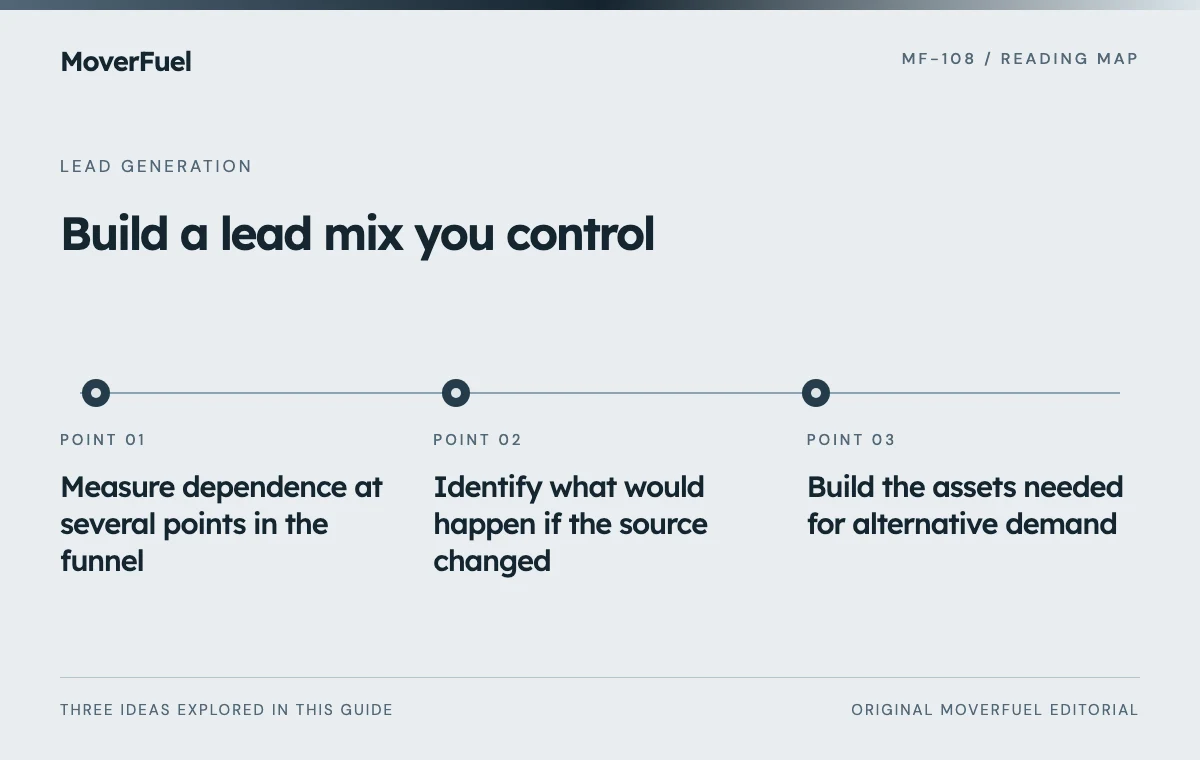
Measure dependence at several points in the funnel
Calculate the share of unique inquiries, completed jobs and contribution associated with each source. A supplier responsible for many low-fit records may dominate lead volume without dominating useful work. Conversely, a small number of valuable projects can create meaningful economic dependence.
Scroll the table horizontally to compare all columns.
| Source | Share of unique inquiries | Share of completed jobs | Decision to investigate |
|---|---|---|---|
| Marketplace A | 60% | 45% | Exposure to supply and price changes |
| Company website and ads | 25% | 30% | Capacity to expand suitable demand |
| Referrals and partners | 15% | 25% | Relationship ownership and repeatability |
These shares are hypothetical and do not prescribe a healthy mix. Add contribution and service-type views using your own records. Keep unknown sources visible and avoid assigning them to the preferred channel simply to complete the chart.
The SBA's marketing-plan guidance connects target customers, sales methods, channel actions, budgets and measurement. Use that planning discipline to make diversification an operating plan rather than a vague wish to own more leads. [1]
Identify what would happen if the source changed
Model a plausible interruption: lower volume, higher fees, different geography or a temporary delivery failure. Estimate which crews, dates or service categories would be affected. This is a scenario exercise, not a prediction that the supplier will fail.
Scroll the table horizontally to compare all columns.
| Exposure | Evidence to collect | Preparation |
|---|---|---|
| Price change | Contract terms and past notices | Defined cost review threshold |
| Volume interruption | Actual dependence by service and week | Alternative demand test |
| Quality drift | Reason-coded qualification records | Supplier review and pause process |
| Account or data access | Ownership and export rights | Independent opportunity records |
| Operational overload | Intake and estimate capacity | Volume caps and routing rules |
Include dependence on a single advertising platform or referral partner in the same review. Moving from one marketplace to one ad account may change control, but it does not remove every concentration risk.
Build the assets needed for alternative demand
Before increasing promotion, make sure the company has a clear service offer, a reliable website inquiry path, accurate local information and outcome tracking. Otherwise new channels can reproduce the same poor qualification or missed-contact problems under a different source label.
Keep business access to the operating assets
Document ownership of domains, advertising accounts, content, tracking numbers and customer records. An agency can manage execution while the business retains appropriate access and export rights. Ownership should be established through real account and contract arrangements, not assumed from branding.
Use the lead-channel comparison to choose alternatives that fit the work you want, rather than copying another mover's channel mix.
Select a small number of alternatives the team can operate well. These might include focused search campaigns, useful service content, local visibility work or transparent professional referral relationships. Each needs a specific audience, owner and next-step experience.
Shift in stages with explicit gates
Scroll the table horizontally to compare all columns.
| Stage | Work | Gate before expanding |
|---|---|---|
| Baseline | Reconcile source and outcome records | Concentration can be explained |
| Foundation | Repair site, intake and account access | Controlled inquiries arrive correctly |
| Pilot | Test one alternative with a bounded budget | Serviceable opportunities appear |
| Mature review | Evaluate estimates and completed work | Economics and capacity are acceptable |
| Reallocation | Shift a limited amount of spend or volume | No unacceptable booking or service disruption |
Do not require an unproven channel to replace the entire supplier immediately. Keep a reserve for learning and for timing differences between inquiry and completed work. A transition that creates a sudden booking gap can harm an otherwise sound long-term strategy.
Review the mix with operational constraints visible
Compare source cohorts at a similar maturity and separate local, long-distance and commercial work. A source that fills a particular schedule gap may be valuable even if its average metrics differ from the rest of the business.
Review contribution, cash timing and handling effort as well as bookings. If an alternative requires substantial estimating work or creates distant service commitments, those costs belong in the decision. Avoid moving spend purely because a dashboard shows a cheaper raw lead.
Maintain the source-risk register and repeat the interruption scenario periodically. The business should know which alternatives are proven, which remain experimental and how quickly it can adjust without damaging customer service.
Common questions
Should we stop buying marketplace leads immediately?
Not simply to reduce dependence. Evaluate current value and build alternatives in stages so the transition does not create an avoidable booking gap.
What is a safe percentage from one source?
There is no universal threshold. Assess the source's economic contribution, contract risk, replaceability and the business's ability to absorb a change.
Your next step
Measure concentration, build alternatives and reallocate through evidence-based gates. Resilience comes from usable options and clear ownership, not just a longer list of channels.
Sources & editorial notes
Platform claims cite the documents below. Operating frameworks and labeled examples are MoverFuel editorial analysis, not client results or industry benchmarks.
- SBA: marketing and salesMarketing planning connects audiences, actions, sales processes, budgets and measurement. Concentration dashboard and transition gates are original strategy tools. Reviewed .