
A large potential office-move invoice can make an expensive lead look attractive. But project revenue is not the amount available to spend on acquisition. You still need to account for fulfillment, the chance of winning, the cost of pursuing the project and the capacity it consumes. Value the opportunity with those assumptions visible.
 View full-size graphic ↗
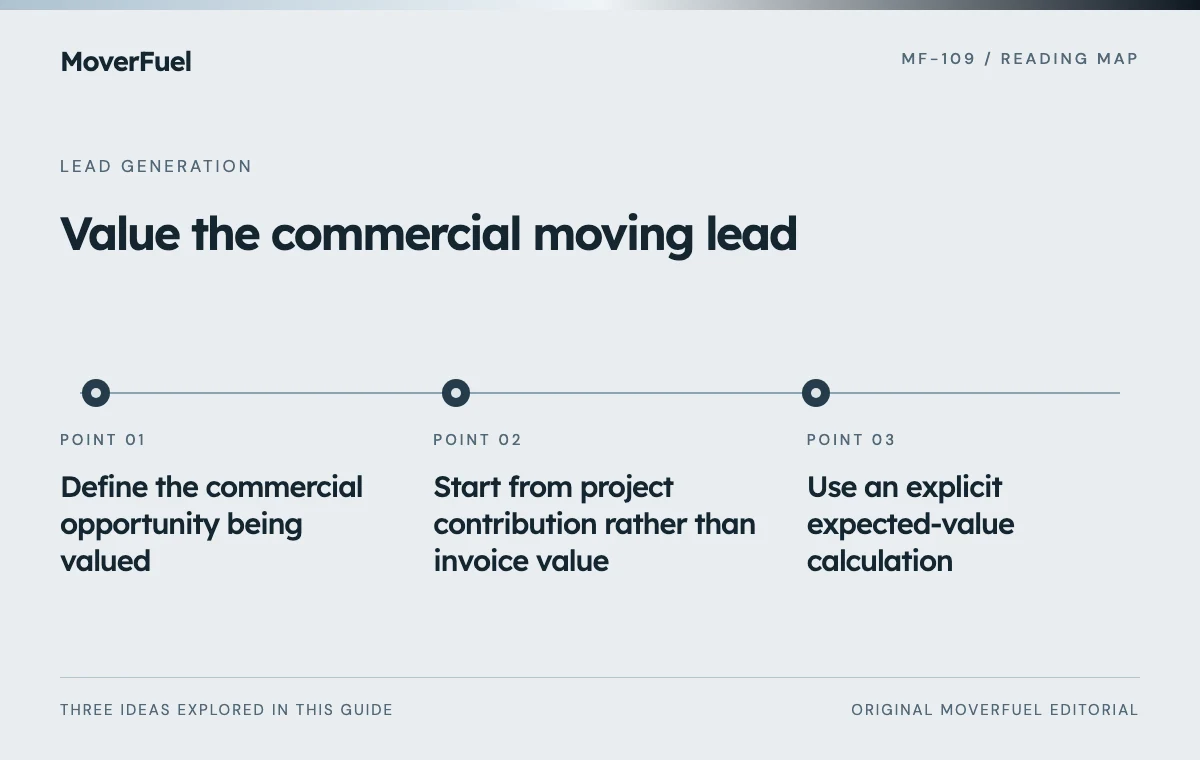
Define the commercial opportunity being valued
Separate an unqualified contact from a scoped project and a proposal-ready opportunity. A facilities inquiry with an unknown destination is not economically equivalent to a surveyed project with confirmed timing and decision-makers. Comparing prices without defining the stage leads to misleading conclusions.
Scroll the table horizontally to compare all columns.
| Dimension | Question to answer |
|---|---|
| Project fit | Is the requested work within real capability? |
| Scope maturity | What is known about inventory, access and phases? |
| Decision process | Who evaluates and approves the proposal? |
| Timing | When might the project be awarded and performed? |
| Pursuit effort | What survey, planning and proposal work is required? |
| Capacity | What other work might this project displace? |
Use the stage and information actually available today. Do not value an early inquiry as though the survey and procurement review have already been completed. Update the estimate as evidence improves.
Start from project contribution rather than invoice value
Contribution margin is revenue less variable costs and contributes toward fixed costs and profit. OpenStax also emphasizes that cost behavior depends on the relevant operating range; costs can change when capacity requirements change. [1]
For a commercial move, identify the fulfillment costs relevant to the project: incremental labor, materials, travel, subcontracted tasks and other costs that change with the work. Have the person responsible for job costing confirm which costs belong in the model.
Include the real capacity consequence
A project that fits unused capacity may have different economics from one requiring additional equipment or displacing an already-profitable job. Do not assume the average margin from local residential work applies to a phased office relocation.
Keep the model consistent about sales effort. If survey and proposal costs are deducted as pursuit costs later, do not also hide the same amounts inside fulfillment costs. Double counting can make a useful source look worse; omitting them can make it look better.
Use an explicit expected-value calculation
A simplified planning formula is: expected project contribution multiplied by the probability of winning and completing the work, minus expected pursuit cost. This is an expected amount before acquisition and any additional reserve for fixed costs, risk and desired profit. It is not a recommended bid or a guaranteed return.
Scroll the table horizontally to compare all columns.
| Input | Assumption |
|---|---|
| Project revenue if completed | $20,000 |
| Variable fulfillment costs | $14,000 |
| Contribution before pursuit and acquisition | $6,000 |
| Probability of winning and completing | 25% |
| Expected pursuit cost per opportunity | $400 |
| Expected amount before acquisition and reserve | $1,100 |
The calculation is $6,000 × 25% − $400 = $1,100. Every number is illustrative. Spending the full $1,100 would leave no expected allowance in this simplified model for additional fixed-cost coverage, risk or desired profit. A business would normally choose a lower ceiling based on its requirements.
Stress-test the assumptions that drive the result
Scroll the table horizontally to compare all columns.
| Completion probability | Expected amount before acquisition and reserve |
|---|---|
| 10% | $200 |
| 25% | $1,100 |
| 40% | $2,000 |
The wide range shows why project size alone is an unreliable lead-pricing guide. Repeat the model with lower contribution, higher pursuit effort and delayed payment. If a small change makes the economics unattractive, use a conservative test rather than a large commitment.
Separate expected value from cash availability. Survey work and acquisition fees may be paid before a project is awarded, and completed work may be invoiced later. A positive expected contribution does not ensure the business can comfortably finance the pursuit and delivery cycle.
Use the commercial landing-page guide to improve the project information available before expensive estimating work begins.
Use the model for bounded decisions and learning
Set an acquisition ceiling and a separate pursuit approval rule. A promising inquiry may justify a discovery conversation without justifying extensive unpaid planning. Decide what information is required before committing additional estimator time.
Track actual pursuit hours, proposal outcomes, completed revenue and fulfillment costs. Compare the realized cohort with the original assumptions after enough projects mature. Keep canceled and lost projects in the record; excluding them would inflate the apparent value of the source.
Revise the model by project type rather than creating false precision for each individual contact. The purpose is to make commercial acquisition decisions explainable, not to produce a confident dollar value from incomplete information.
Common questions
Can we value a commercial lead as a percentage of revenue?
That misses fulfillment, win probability, pursuit costs and capacity. Use contribution-based scenarios and clearly state the assumptions.
Is expected value the amount we should pay?
No. It is a planning input before appropriate reserves and other business requirements. A responsible acquisition ceiling can be materially lower.
Your next step
Value commercial opportunities from realistic contribution and progression evidence. Keep pursuit cost, capacity and cash timing visible before committing acquisition spend.
Sources & editorial notes
Platform claims cite the documents below. Operating frameworks and labeled examples are MoverFuel editorial analysis, not client results or industry benchmarks.
- OpenStax: contribution margin and cost behaviorContribution-margin definition and relevant-range cost behavior. Expected-value formula and numbers are original illustrative planning analysis, not financial forecasts. Reviewed .