
A useful agency evaluation starts with a business brief, not a sales presentation. Tell candidates which services and markets you want to grow, what capacity is available and where the current acquisition process breaks down. Then compare how each agency investigates the problem, defines its work and explains the evidence it will use. A credible proposal should remain understandable when impressive screenshots and broad promises are removed.
 View full-size graphic ↗
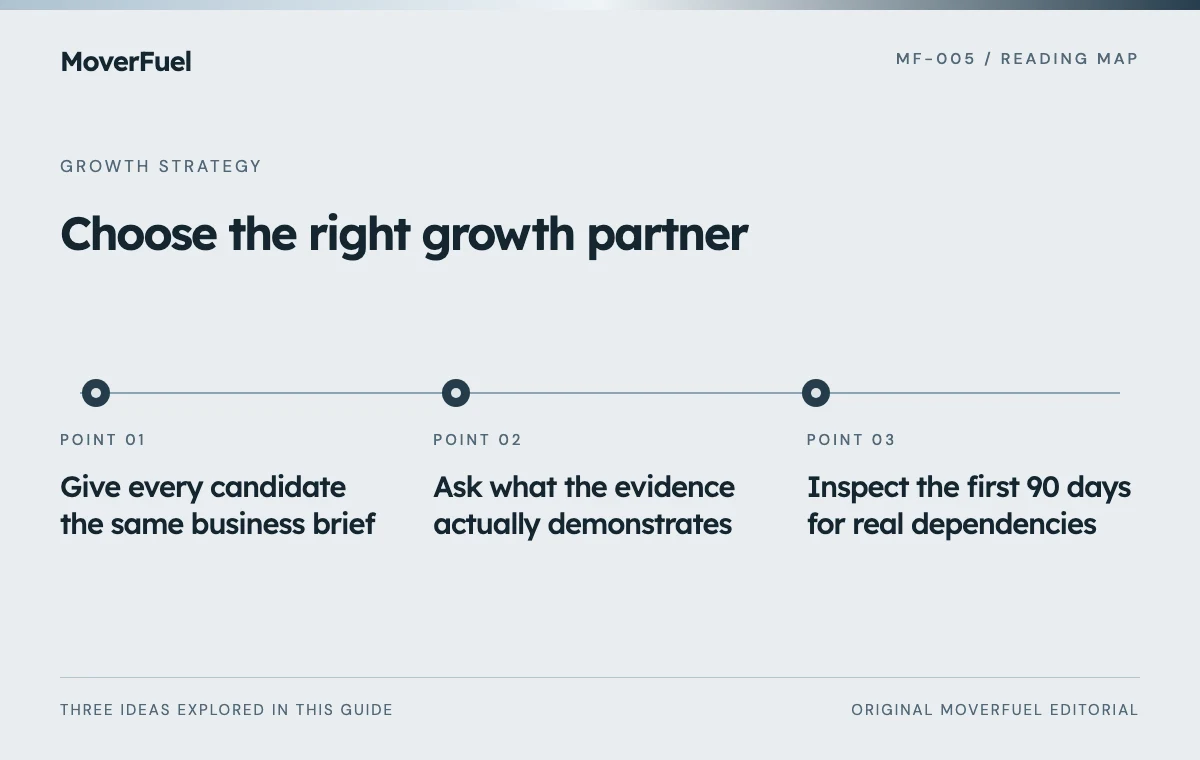
Give every candidate the same business brief
Before signing, use the agency agreement checklist to clarify deliverables, account access and handover questions.
Document your service mix, real coverage, available capacity, marketing assets and main constraint. Include what you know about inquiry volume, qualification, estimates and booked work, with the limitations of those numbers. Candidates cannot produce comparable recommendations if each receives a different version of the business.
Define the decision you need help making. You might need to improve local acquisition, expand a legitimate branch, repair paid-search measurement or increase estimate conversion. A broad request to ‘grow revenue’ gives too much room for a generic channel package.
- Priority services and markets, including exclusions.
- Current operating and intake constraints.
- Available budget ranges with media separated from delivery fees.
- Existing accounts, website and measurement tools.
- Known problems, uncertain assumptions and the first decision to resolve.
If the brief is not yet clear, use the 90-day marketing planning framework to identify the initial constraint and dependencies.
Ask what the evidence actually demonstrates
Request work relevant to your service and problem. A polished website concept demonstrates a design direction, not a verified improvement in booked moves. A screenshot of platform leads does not establish qualified demand or contribution. Ask what was measured, over what period, for which service and with what exclusions.
Read a case study through its definitions
A useful case study explains the starting condition, work performed, operating context and outcome definition. Ask whether the reported customers were unique, whether cancellations were accounted for and whether spending or service coverage changed. Missing context does not automatically make a result false, but it limits what you can infer for your business.
For testimonials, distinguish an authentic attributed statement from a general promotional claim. The FTC's review and testimonial guidance addresses authenticity and deceptive practices. In your evaluation, ask for enough context to understand what the endorsement supports rather than treating every positive quote as proof of commercial results. [1]
Inspect the first 90 days for real dependencies
Ask candidates to explain the sequence from access and research through implementation and review. Which tasks depend on your team? What must be repaired before a campaign launches? How will the company know that a form, phone path or imported outcome works correctly?
Scroll the table horizontally to compare all columns.
| Question | Useful answer should explain |
|---|---|
| What happens before launch? | Access, service brief, destination readiness and measurement checks |
| What do you need from us? | Named approvals, operational facts, assets and sales participation |
| How do you investigate bad leads? | Record samples, qualification criteria and the responsible next action |
| When do we review outcomes? | A cadence that considers the sales cycle and data quality |
| What changes if a dependency is delayed? | A revised sequence rather than spending through a known defect |
Look for a plan specific enough to test but honest about uncertainty. A guaranteed ranking date or a fixed booking promise can conceal assumptions the agency does not control. An implementation milestone should say what will be delivered and verified; a business projection should state its inputs and limits.
Review reporting and account access together
Ask to see the definitions behind the report. Which events count as inquiries, qualified leads and bookings? How are duplicate contacts handled? Can the team reconcile a reported outcome with the underlying business record? Google supports qualified and converted lead stages, but the advertiser's business definition and implementation determine whether those signals are useful. [2]
Confirm how authorized business owners will access advertising accounts, analytics, website assets and reports. Clarify permissions, exports and offboarding before the relationship begins. Do not wait for a disagreement to discover that a critical asset or definition exists only inside a provider's undocumented process.
A branded dashboard may be convenient, but it is not a substitute for explainable records. Ask the agency to walk through one hypothetical lead from source to estimate and booking. The walkthrough should show where data can be missing, where staff input is required and which conclusions would remain uncertain.
Compare scope and exclusions, not only monthly fees
Build a side-by-side scope sheet. Separate media spend, recurring management, one-time implementation, creative production, software and internal workload. Ask whether recommendations are implemented within the fee or require another supplier. A proposal that says ‘CRO included’ may mean analysis, design, development or only a monthly discussion.
Scroll the table horizontally to compare all columns.
| Criterion | Evidence to request | Unresolved question to record |
|---|---|---|
| Moving-industry fit | Service-specific campaign or content reasoning | Does the plan distinguish local, interstate and commercial needs? |
| Measurement | Definitions and reconciliation examples | Who resolves missing or duplicate outcomes? |
| Delivery | Named responsibilities and first-phase outputs | Which tasks are excluded or dependent on another team? |
| Ownership | Access and handoff arrangements | Can the business continue operating after a transition? |
| Commercial fit | Complete cost and scope breakdown | What changes the price or requires additional approval? |
If you use a score, define what the points mean before the interviews. For example, distinguish evidence supplied, explanation only and unresolved. Do not let a precise-looking total conceal a critical unanswered access or delivery question. A single essential gap can matter more than several attractive extras.
Use the same worksheet for specialists. MoverFuel is an agency that works only with movers, and that focus should still show up as service-specific reasoning in the evidence, not just as a label.
Finish with an operating conversation
Bring the person responsible for estimates or sales into the final discussion. Ask how marketing feedback will be reviewed and how the agency handles disagreements about lead quality. A relationship that depends on booking data needs cooperation from the people recording those bookings.
Clarify the communication cadence, change approvals, escalation path and transition arrangements. Put material commitments into the actual scope rather than relying on a verbal description. If contractual terms need interpretation, use the appropriate advisor; a marketing comparison should not pretend to settle legal obligations.
Choose the team whose explanation fits your business and whose work can be verified. You should leave the process knowing the first problem they will investigate, the evidence they need and what your own team must contribute. That is a stronger foundation than confidence created solely by an ambitious sales promise.
Common questions
Should we choose the agency with the lowest management fee?
Compare the complete scope, costs and responsibilities first. A lower fee may exclude implementation or require more internal work. Value depends on whether the arrangement solves the defined business problem.
Are industry case studies essential?
Relevant verified evidence is useful, but its scope matters. Ask what the agency can substantiate and where its experience differs from your situation. Clearly labeled concepts must not be represented as client results.
What should make us pause an agency decision?
Unexplained guarantees, unclear account access, undefined deliverables or an unwillingness to discuss measurement limitations deserve resolution before proceeding. Record the unanswered question rather than relying on a reassuring general statement.
Your next step
Give candidates the same brief, inspect their evidence and compare the real operating plan. Resolve scope, access and measurement questions before selecting a partner. The right choice should make the next business decision clearer and the work easier to verify.
Sources & editorial notes
Platform claims cite the documents below. Operating frameworks and labeled examples are MoverFuel editorial analysis, not client results or industry benchmarks.
- FTC: reviews and testimonials rule FAQAuthenticity and deceptive-practice considerations for reviews and testimonials. Reviewed .
- Google: qualified and converted leadsQualified and converted lead concepts; no platform result is treated as verified booked revenue automatically. Reviewed .