
The right marketing staffing model depends on the decisions and work your moving company needs covered. Hiring one person does not automatically create a complete marketing department; hiring an agency does not remove the operator's responsibility for service promises, capacity and lead feedback. Compare internal, agency and hybrid models against a defined workload before comparing their headline prices.
 View full-size graphic ↗
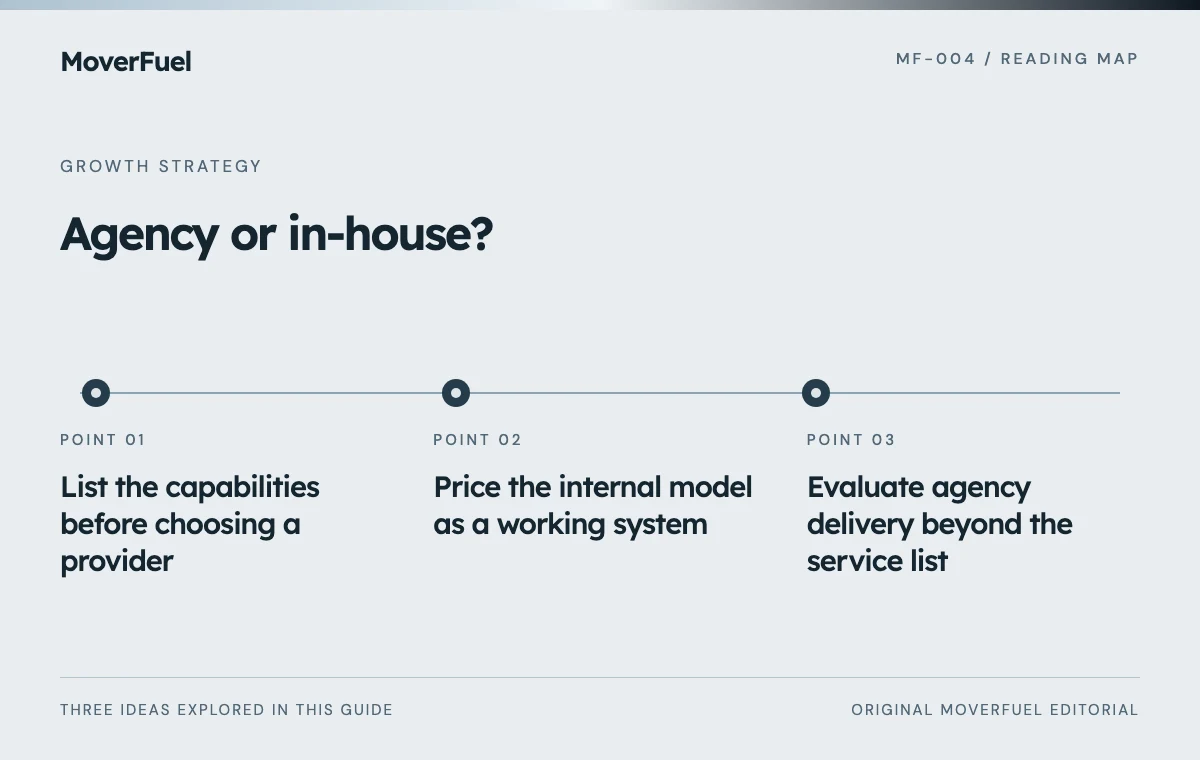
List the capabilities before choosing a provider
Write down the work required over the next planning period: commercial strategy, campaign management, service-page content, design, development, measurement, creative production and coordination with sales. Identify which tasks need ongoing attention and which are occasional projects. The answer may differ across branches or service lines.
Then assign a decision owner. Someone must approve the services being promoted, the markets being targeted, the budget and the definition of a qualified lead. Those decisions need operating knowledge even when an external specialist performs the implementation.
Scroll the table horizontally to compare all columns.
| Work | Business input needed | Delivery skill needed |
|---|---|---|
| Acquisition strategy | Capacity, economics and priority services | Research and channel planning |
| Campaign execution | Approved offer and geographic limits | Platform management and testing |
| Website improvements | Estimate process and service evidence | Content, design and development |
| Measurement | Qualification and booking definitions | Tracking implementation and reconciliation |
| Lead feedback | Actual inquiry and estimate outcomes | A consistent review and correction process |
Price the internal model as a working system
An employee's compensation is only one cost. Include the tools, specialist support, production resources, supervision and coverage needed for the job to succeed. Do not assume that a capable marketing manager is also an experienced developer, media buyer, analyst and videographer.
Decide whether the role manages or produces
A manager may coordinate priorities and providers across several branches. A specialist may spend most of the week operating campaigns or creating content. If the position tries to do both without adequate support, urgent production can crowd out strategy and review. Write the expected work allocation before recruiting.
Internal ownership can be valuable when the business needs frequent coordination, deep service knowledge or rapid access to crews and projects. The practical question is whether the company can give the role enough focused work, authority and support. An under-resourced employee can become the bottleneck the hire was intended to remove.
Evaluate agency delivery beyond the service list
Ask who performs the work, who reviews it and who communicates with your team. A proposal listing SEO, ads and automation does not explain how a landing-page problem gets fixed or how sales feedback reaches the campaign manager. Request a concrete workflow for the first important business problem.
Compare deliverables, dependencies and exclusions. Does website work include development or only recommendations? Does reporting reconcile booked outcomes or simply display platform totals? Who supplies approved photos, service information and access? These boundaries determine whether the engagement can run as promised.
- Identify the accountable strategy contact and delivery owners.
- Clarify what requires the moving company's approval or data.
- Ask how tracking failures and lead-quality disagreements are investigated.
- Confirm how work, decisions and account changes are documented.
- Review access, asset ownership and handoff terms before starting.
An agency can supply several capabilities, but the business still needs a person who can make timely decisions. If every service-page question waits weeks for approval, external production capacity alone will not solve the delay.
Design the handoffs in a hybrid arrangement
A hybrid model works when responsibilities are explicit. The internal lead can own the operating brief, approvals and sales feedback while specialists own implementation within that brief. Avoid assigning both parties general responsibility for ‘marketing performance’ without specifying who changes what.
Scroll the table horizontally to compare all columns.
| Decision or task | Internal owner | External owner |
|---|---|---|
| Services, coverage and capacity | Approves the operating facts | Uses them in campaigns and pages |
| Campaign changes | Approves budget and material offer changes | Executes and documents agreed optimization |
| Lead dispositions | Ensures sales records accurate outcomes | Analyzes patterns and proposes acquisition changes |
| Website implementation | Supplies approved evidence and process | Builds, tests and documents the change |
Use one shared issue list and a decision cadence. If a branch reports unsuitable leads, record examples, check the agreed qualification definition and assign the next investigation. Avoid separate internal and agency reports that count the same events differently and never reconcile.
To fill the External owner column, compare the services an agency can take on with the work your team wants to keep.
Compare models against the same scope
Create a total-cost comparison using actual proposals and compensation estimates available to your business. Include recurring delivery, project work, subscriptions, management time and transition costs. The SBA's budgeting guidance supports recording the complete marketing plan rather than only the most visible expense. [1]
Then test three situations. For a single-market mover with a focused campaign need, a specialist arrangement may cover the immediate gap. For an operator coordinating several markets, internal ownership may become more important. For a major website or tracking project, temporary specialist capacity may be more sensible than hiring permanently for a short-lived workload.
These are comparison prompts, not a ranking of models. Evaluate the quality of the people and process available to you. An inexpensive model with unclear accountability can cost more in delayed work, duplicated tools or unexamined advertising waste.
Use the marketing budget framework to keep media and delivery costs separate while comparing the total investment.
Plan a reversible transition
Before changing the staffing model, inventory accounts, domains, analytics, creative files, source code, reporting definitions and outstanding work. Confirm authorized access and a handoff owner. Keep a record of which campaigns and integrations are active so the transition does not create duplicate tracking or interrupt inquiries.
Set a practical review point based on delivery and evidence: are tasks completed, are operating facts accurate, are inquiries handled and can the team explain results? Avoid judging the entire model solely on a short period of bookings when pricing, capacity or seasonality also changed.
The best arrangement makes the company less dependent on undocumented knowledge. Whether the work is internal or external, the operator should be able to understand its priorities, access its records and continue serving customers when a person or provider changes.
Common questions
Can one internal marketer replace an agency?
Possibly, if the required scope matches that person's skills and available time. Compare actual tasks and specialist needs. A broad title does not establish expertise in every marketing discipline.
Does an agency remove the need for an internal contact?
No. Someone at the moving company still needs to approve operating facts, budget and offers, coordinate access and ensure sales feedback is recorded.
What is the main risk in a hybrid model?
Ambiguous ownership. Define who decides, who implements and who verifies each important task. Shared access to a dashboard is not the same as a shared operating process.
Your next step
Choose the model that covers the real workload with clear accountability. Compare complete costs, define the handoffs and preserve business access to the underlying assets. The label matters less than whether the arrangement helps the team make and execute better decisions.
Sources & editorial notes
Platform claims cite the documents below. Operating frameworks and labeled examples are MoverFuel editorial analysis, not client results or industry benchmarks.
- SBA: marketing and salesComplete marketing-plan budgeting and the relationship between marketing, sales and operations. The responsibility matrices are original editorial frameworks. Reviewed .