An LSA lead price and a Search cost per click cannot tell you which channel acquires moving jobs more efficiently. One describes a contact charged under a platform’s rules; the other describes a visit. Bring both channels to the same business outcome before comparing their costs.
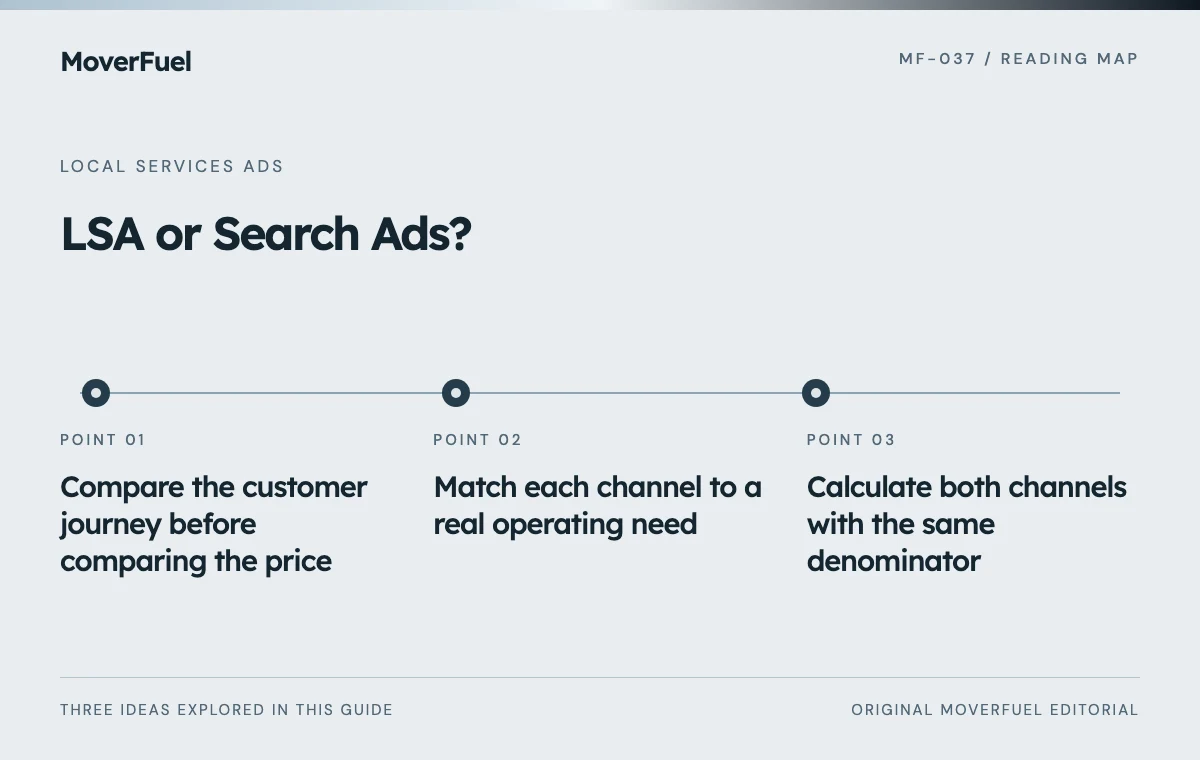 View full-size graphic ↗
Compare the customer journey before comparing the price
Google describes LSA as charging for qualifying lead contacts. A conventional Search campaign uses ads responding to search intent and sends customers into configured destinations or contact paths. The account setup and customer steps differ, so the first reported metric is not an equivalent unit. [1] [2]
Scroll the table horizontally to compare all columns.
| Question | Local Services Ads | Search campaigns |
|---|---|---|
| Where does qualification happen? | Often after a direct contact reaches the team | On the page and during subsequent contact |
| What needs preparation? | Eligible profile, accurate offer and response coverage | Campaign structure, message, destination and measurement |
| What should the business record? | Lead record, fees and sales outcome | Spend, unique inquiry and sales outcome |
| What is the shared comparison? | Retained suitable jobs from a defined cohort | Retained suitable jobs from a defined cohort |
This distinction changes the workload. A direct call may bypass a detailed website explanation, leaving the intake team to clarify scope. A Search destination can explain services before contact, but a poor page can lose an otherwise suitable customer. Neither path removes the need for sales discipline.
Match each channel to a real operating need
Use the services and routes the company actually wants to sell as the starting point. A local residential team may value a direct inquiry path with strong phone coverage. A commercial mover may need a detailed page explaining planning, access coordination and phased relocation before the right person requests a consultation.
Search campaign architecture can separate materially different query themes and destinations. LSA planning starts with the current eligible profile, service selections and coverage controls. Do not assume that changing one channel’s geography changes the other. Keep an approved configuration record for each.
Include the receiving team in the decision
Ask whether the company can answer the additional conversations and deliver the resulting work. A channel that generates calls during understaffed periods may require a routing or scheduling solution before a larger budget. A marketing-only comparison can miss that constraint.
Calculate both channels with the same denominator
Scroll the table horizontally to compare all columns.
| Measure | LSA scenario | Search scenario |
|---|---|---|
| Advertising cost after posted adjustments | $3,000 | $3,000 |
| Unique inquiries | 60 | 50 |
| Qualified opportunities | 36 | 35 |
| Retained bookings | 12 | 14 |
| Cost per unique inquiry | $50 | $60 |
| Cost per retained booking | $250 | $214.29 |
Here Search has a higher inquiry cost and a lower retained-booking cost. That outcome comes from the assumed conversion rates, not a general claim that Search outperforms LSA. Reversing the rates could reverse the result. Replace every input with reconciled account and job data.
Then check service mix. Fourteen short, low-contribution jobs may not be preferable to twelve larger suitable projects. Retained-booking cost is a useful shared metric, but the decision should also consider crew capacity and contribution.
Run a comparison that does not reward reporting artifacts
Use equivalent inquiry periods and allow each group sufficient time to book. Mark unresolved estimates rather than labeling them losses prematurely. Record price changes, staffing changes and unavailable dates that could affect conversion outside the advertising account.
Deduplicate households that contact the business through both channels. Maintain the first known source and later touches rather than assigning two unique bookings to the same move. Use a consistent attribution rule and show multi-touch cases where they are material.
A side-by-side report describes observed performance; it does not automatically prove the outcome would disappear if one channel stopped. When enough volume and operational stability exist, a controlled allocation test can help investigate the marginal effect. State uncertainty when the sample is too small.
Use the LSA booking-cost guide to reconcile the lead ledger before comparing it with other advertising.
Allocate the next increment, not the whole budget by slogan
Start with the channel that is ready to operate responsibly, then fund expansion against evidence. A weak landing page may make Search unready today; incomplete LSA verification may prevent that channel from being available. Repair readiness rather than declaring a permanent winner from a temporary setup problem.
When both work, review where the next increment of budget can produce suitable demand at an acceptable cost. Historical averages are not a guarantee that additional spending behaves the same way. Keep separate limits by service and market where the business economics differ.
Maintain a fallback acquisition plan. Depending entirely on one platform format leaves the company exposed to changes in availability, competition or account status. A diversified plan should still earn its place through results rather than adding channels for appearance.
When both channels earn a place, plan them together so they do not chase the same job twice, and compare both by cost per booked move. That is how we approach managing both channels together, from the Local Services listing to the Search campaigns.
Common questions
Is LSA always cheaper than Google Search Ads?
No. Lead and click prices are different units, and downstream fit and booking rates vary. Compare reconciled cost per retained job and the value of that work.
Can both channels run together?
Yes, when available and appropriate. Coordinate coverage, intake and measurement, and deduplicate customers who use both paths.
Your next step
Choose channels using comparable customer outcomes and operating readiness. A lower price near the top of the funnel is not enough to establish a better acquisition investment.
Sources & editorial notes
Platform claims cite the documents below. Operating frameworks and labeled examples are MoverFuel editorial analysis, not client results or industry benchmarks.
- Google: How leads work in Local Services AdsLSA lead charging model. Reviewed .
- Google: create a Search campaignSearch campaign and destination structure. All comparison figures are original hypothetical examples. Reviewed .