
Google Ads and Meta should support one moving-company acquisition plan. That requires agreement on the work the business wants, the offer customers see and the way inquiries become bookings. Separate platform dashboards can guide delivery, but they should not become competing versions of the company's revenue.
 View full-size graphic ↗
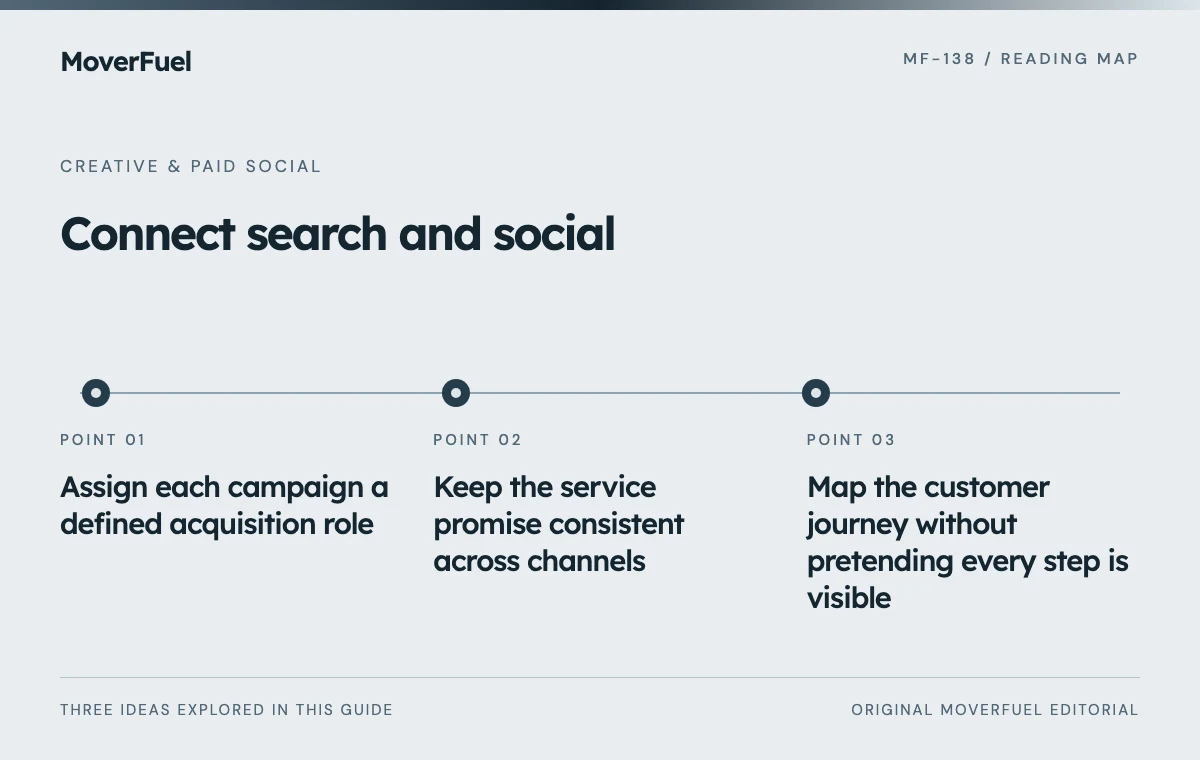
Assign each campaign a defined acquisition role
Scroll the table horizontally to compare all columns.
| Task | Possible campaign role | Shared business requirement |
|---|---|---|
| Respond to explicit service searches | Search campaigns for suitable local intent | Accurate geography and service scope |
| Introduce a useful moving service | Social creative explaining a recognizable need | Truthful offer and qualification |
| Support an undecided visitor | Permitted, relevant re-engagement | Maintained exclusions and current message |
| Explain the estimate process | Reusable page and creative content | Consistent next step and intake ownership |
These roles are planning choices, not claims that every business needs every campaign. A mover with limited intake capacity may benefit more from repairing an existing search path than adding another source of inquiries. A company with strong creative and a distinct service offer may have a different testing opportunity.
Write the expected contribution of each campaign in one sentence. If two campaigns claim the same role, explain why both are needed and how their results will be evaluated without counting the same job twice.
Keep the service promise consistent across channels
A customer may see a packing ad, search the company name and then call from a local moving page. Those touchpoints should agree on service areas, available services and the estimate process. Contradictory offers create intake work and can undermine trust before the first conversation.
Use one offer brief with channel-specific expression
Record the target service, suitable customer, geographic boundaries, actual inclusions, proof assets and next step. Search copy can answer a direct query while social creative explains the situation visually. Both should lead to a compatible destination and a team that understands the offer.
Keep availability and promotions under a single owner. When a service or operating window changes, update the affected ads, pages and intake reference together. Do not let an old social creative keep promising an offer the search landing page has already removed.
Coordinate Google Ads and Facebook Ads through that shared service brief rather than copying identical copy into every placement.
Map the customer journey without pretending every step is visible
A fictional journey might include a social video, a later Google search, a website visit and a phone estimate request. Some of those interactions may be observed and some may not. Preserve the evidence available at inquiry creation and ask a neutral discovery question if useful.
Scroll the table horizontally to compare all columns.
| Record element | Example interpretation |
|---|---|
| Observed inquiry source | Search visit associated with accepted form |
| Other observed interaction | Prior social visit, if validly connected |
| Customer-reported discovery | Customer remembers seeing a video |
| Business outcome | One estimate and one booked job |
| Reporting treatment | One unique job; additional assistance notes are non-additive |
GA4 acquisition data has user, session and event scopes. Keep those distinctions visible when comparing it with platform reporting; a first-user source and an event-attribution source need not match because they answer different questions. [1]
Reconcile company outcomes before evaluating the mix
Start with unique inquiries and jobs in the operating record. Reconcile platform counts to that total using documented identifiers and attribution assumptions. Google and Meta may each claim credit for the same customer; their reported conversions are not automatically additive.
Report combined media spend and a defined acquisition-cost scope against mature outcomes. Then examine channel-specific qualification, estimate progression and contribution with the attribution limits visible. A lower lead cost is not a sufficient reason to move spend when lead fit or completion differs.
Separate new-customer acquisition from brand demand and existing-customer contact where the data supports it. A campaign that captures a return visit can be valuable, but its reported efficiency may not describe how much new demand it created.
Use lead tracking and attribution to maintain the common outcome definitions across both platforms.
Change the mix through a bounded business hypothesis
A useful hypothesis could be that an explanatory social campaign improves the quality of conversations about packing while search continues to capture explicit local moving intent. Specify the affected service, budget boundary, creative, intake questions and observation period.
Avoid changing geography, website, staffing and channel mix at the same time if the goal is to understand the media decision. When simultaneous changes are unavoidable, document them and narrow the conclusion. A before-and-after increase during peak season is not proof of a cross-channel effect.
Review customer quality and capacity alongside cost. If the social campaign generates suitable but later-dated moves, its outcome window may differ from urgent search inquiries. Keep both groups mature enough to compare, then decide whether to continue, revise or stop the test.
Maintain a shared learning log: which service message worked, what intake learned and what changed in the economics. That turns channel coordination into an operating process rather than a recurring argument between two dashboards.
Common questions
Should every local mover advertise on both platforms?
No. Choose channels based on a defined acquisition task, budget, creative capacity and intake readiness. Fix a weak existing path before adding complexity solely to be present everywhere.
Can I add Google and Meta reported conversions together?
Not as a unique company total without reconciliation. The same customer can receive credit in both systems. Use deduplicated business records and show platform attribution separately.
Your next step
Coordinate the offer, customer journey and business outcomes before coordinating budgets. Each platform should have a clear role inside one acquisition plan with one defensible job total.
Sources & editorial notes
Platform claims cite the documents below. Operating frameworks and labeled examples are MoverFuel editorial analysis, not client results or industry benchmarks.
- Google Analytics: scopes of traffic-source dimensionsGA4 user, session and event acquisition scopes answer different questions and must not be treated as interchangeable. Reviewed .