
A route campaign should connect a real origin-destination opportunity with the company's ability to serve it. A list of attractive cities is not a route strategy. Evaluate coverage, timing and delivery economics first, then decide which lane deserves a focused campaign and which should remain outside the offer.
 View full-size graphic ↗
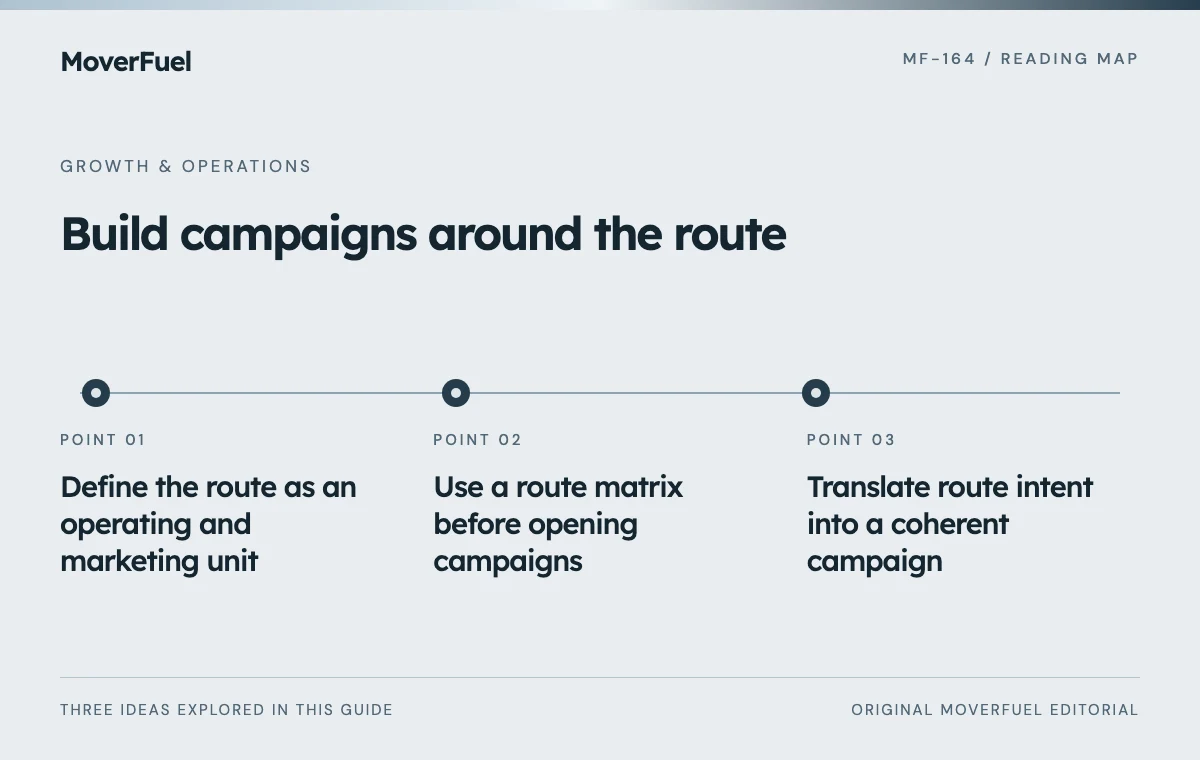
Define the route as an operating and marketing unit
Specify the origin area, destination area, service scope and relevant timing. A campaign for moves from one metro to another is different from a broad long-distance campaign serving many destinations. The route definition should be specific enough to support a decision without implying capabilities the company lacks.
Record who actually provides the transportation and the business's role. FMCSA distinguishes interstate household-goods carriers from brokers. Marketing must accurately represent the company's verified role rather than using carrier language for an arrangement that is actually brokerage. [1]
Scroll the table horizontally to compare all columns.
| Field | What to establish | Why it matters |
|---|---|---|
| Origin and destination | Supported coverage boundaries | Qualification and targeting |
| Service scope | What the company actually offers | Message and estimate accuracy |
| Operating role | Verified carrier or broker arrangement | Truthful representation |
| Timing constraints | Real availability and planning needs | Promise and capacity alignment |
| Cost assumptions | Relevant fulfillment and acquisition costs | Economic evaluation |
Use a route matrix before opening campaigns
Scroll the table horizontally to compare all columns.
| Criterion | Evidence to collect | Possible decision |
|---|---|---|
| Serviceability | Operations confirms the work can be fulfilled | Exclude unsupported lanes |
| Demand evidence | Relevant inquiries and observed search interest | Test cautiously when uncertain |
| Capacity fit | Availability across the full job requirement | Limit exposure where constrained |
| Contribution potential | Expected revenue and relevant variable costs | Review economics before scaling |
| Customer clarity | A useful, accurate offer can be explained | Repair the page or proposition |
Avoid turning unknowns into arbitrary scores that look scientific. A simple supported, uncertain or unsupported assessment can be more honest than a weighted total with invented precision. Note which missing evidence could change the decision.
Prioritize a small set of lanes that the team can assess and serve. Launching every city pair creates operational and reporting complexity before the company knows whether any particular route deserves investment.
Translate route intent into a coherent campaign
Investigate how suitable customers describe the move, including origin, destination and long-distance service needs. Review actual query and inquiry evidence where available. Do not assume every city-pair phrase represents a person ready to hire a mover.
Treat location settings as a hypothesis to verify
Google Ads distinguishes location presence and interest options, and its geographic detection is not perfectly accurate. A person researching a future origin or destination may be located elsewhere. Choose settings deliberately and evaluate the resulting requests, not just the location report. [2]
Keep exclusions tied to documented service limitations and observed mismatches. Avoid excluding a geography solely because it appears outside the origin area when legitimate planners may be researching remotely.
The Google Ads service connects targeting, search intent and landing-page decisions. Route prioritization should inform those choices before spend is distributed.
Build useful route information without doorway pages
A route page should explain the actual service, assessment process and relevant planning considerations. If the only difference from another page is two city names, it may not offer enough distinct value to justify a separate URL.
Do not publish invented travel times, guaranteed delivery windows or unsupported route experience. Explain how timing and scope are confirmed. Use approved evidence where it exists and factual process information where it does not.
Keep the route offer consistent from ad to page to intake. A customer should not discover after submitting the form that the advertised lane is unavailable or handled under a materially different service arrangement.
Capture both ends of the move and the next step
Collect enough origin and destination information to assess fit, along with timing and broad scope. Avoid requesting unnecessary sensitive detail in the first interaction. Route uncertain cases to a person able to clarify the request rather than automatically rejecting every incomplete form.
Track disqualification reasons separately: unsupported origin, unsupported destination, service mismatch, timing or another documented issue. These reasons lead to different campaign corrections. A single bad-lead label hides the pattern.
Use the qualified moving lead guide to make the intake decision consistent across lanes and sales staff.
Review lane outcomes with the full job context
Contribution analysis distinguishes revenue from relevant variable costs. Apply the company's verified cost treatment to route work, then consider acquisition cost and other constraints. A high quoted value does not establish a profitable route. [3]
Include cancellations, changes and completed-job outcomes in the review. A lane with several attractive bookings can look different after the jobs are fulfilled. Keep early booking evidence separate from completed financial outcomes.
Expand only where the route remains serviceable and the evidence supports additional exposure. If one lane is weak, decide whether the issue is demand, targeting, conversion or fulfillment before changing every long-distance campaign.
The long-distance moving solution provides the broader acquisition context; this matrix helps choose where to concentrate the effort.
Common questions
Does every origin-destination pair need its own page?
No. A separate page needs a distinct useful purpose and accurate service information. Near-identical city-pair pages can create maintenance and quality problems without helping customers.
Should route campaigns target only people physically in the origin city?
That depends on the intended audience and observed inquiry quality. Some customers research remotely. Review platform settings and real requests rather than assuming one targeting rule fits every lane.
Your next step
Choose routes from serviceability and evidence, then align the campaign, page and intake process. Evaluate completed work before treating early inquiries as proof of a scalable lane.
Sources & editorial notes
Platform claims cite the documents below. Operating frameworks and labeled examples are MoverFuel editorial analysis, not client results or industry benchmarks.
- FMCSA: movers versus brokersFMCSA distinguishes interstate household-goods carriers and brokers; marketing should reflect the verified operating role. Reviewed .
- Google: advanced location optionsGoogle Ads location options differ and geographic identification is best effort. Reviewed .
- OpenStax: contribution margin and cost behaviorContribution separates revenue from variable costs; the route matrix is an original planning framework. Reviewed .