
An interstate inquiry can look valuable until the estimator discovers that the pickup city, destination or timing does not fit the operation. National reach alone cannot solve this. The campaign needs an operational definition of a sellable route and a way to return that information from sales. Start with a lane matrix, then connect targeting, page promises and reporting to the same route rules.
 View full-size graphic ↗
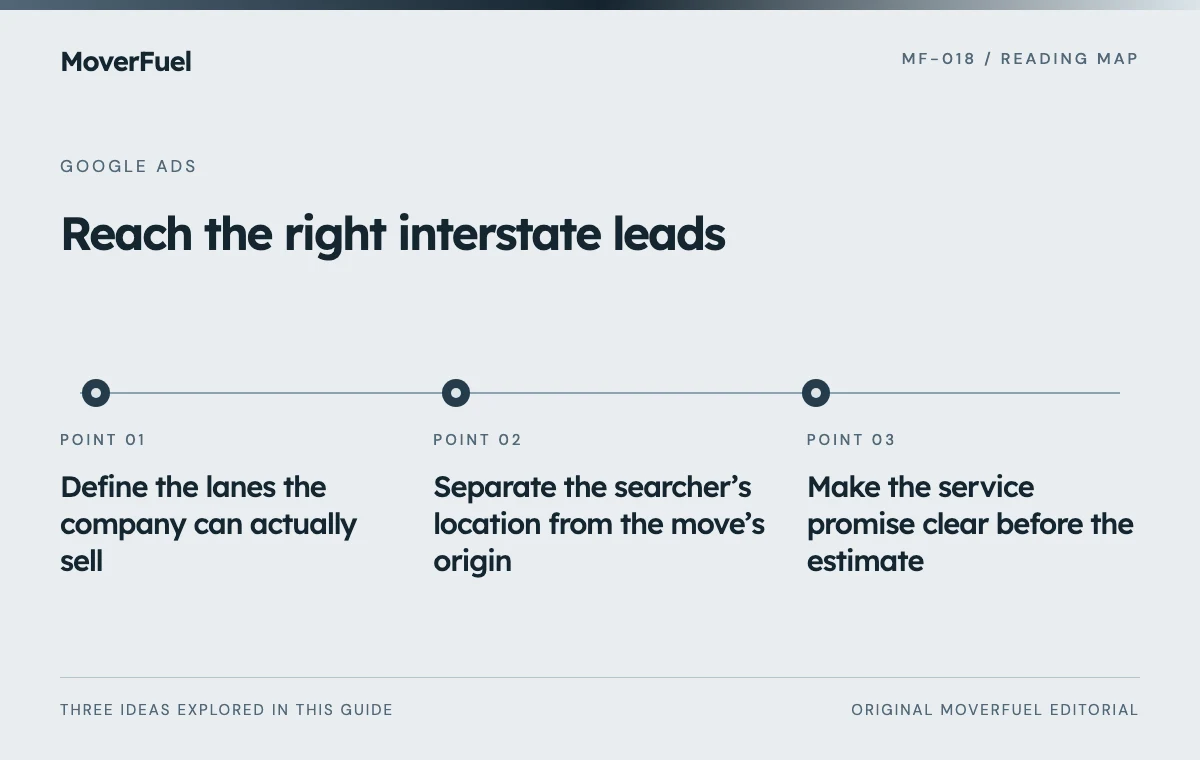
Define the lanes the company can actually sell
A lane is more than two state names. For marketing purposes, document permitted origins, destination coverage, acceptable dates, shipment requirements and service arrangements. Include who approves exceptions. A business may accept a route in principle but lack suitable capacity during the period the customer needs.
Scroll the table horizontally to compare all columns.
| Origin group | Destination group | Qualification issue | Advertising decision |
|---|---|---|---|
| Market A metro | Market B metro | Available departure window | Dedicated test with route-aware page |
| Market A metro | Other approved states | Schedule and shipment fit | Broader service group with detailed qualification |
| Unserved origins | Any destination | Pickup outside coverage | Exclude or decline; do not imply nationwide pickup |
| Approved origin | Temporary capacity restriction | Dates cannot be fulfilled | Adjust claims and spend with operations |
Keep this matrix separate from the advertising location report. One describes what the company can fulfill; the other describes platform targeting and inferred geography. Treating them as interchangeable hides why apparently in-market inquiries are rejected.
Define exceptions before sales improvises
Decide whether a borderline request should be declined, reviewed or served through an approved arrangement. Sales should not change the campaign’s effective service footprint informally. Otherwise the same route may be “qualified” one week and “unqualified” the next, making campaign comparisons unreliable.
Separate the searcher’s location from the move’s origin
Someone in a destination city may be arranging a parent’s move from another state. Someone at the origin may search only for the destination. These are plausible planning situations, not evidence that every out-of-area click is useful. Ask both ends of the route and use the answer to evaluate the targeting choice.
Google’s location options distinguish presence from location interest, and its location signals are not perfectly accurate. Select deliberately for the campaign’s intended customer. Presence can offer a controlled starting boundary; interest can broaden access to people planning a relocation involving the target location. Neither setting guarantees a serviceable shipment. [1]
If testing interest-based reach, create a review plan before expanding. Record where rejected jobs actually begin, the reason they fail and whether useful inquiries are also coming from outside the origin region. Do not infer the entire customer journey from an IP-based location alone.
Make the service promise clear before the estimate
A route-focused page should explain coverage, how an estimate is developed, the information needed and the next contact step. Avoid publishing hundreds of near-identical city-pair pages simply because a spreadsheet can generate them. Build a distinct destination when it answers real questions and represents work the company provides.
Explain who the customer is dealing with. FMCSA distinguishes movers from brokers in its interstate consumer guidance. Advertising and estimate pages should accurately describe the business’s role instead of leaving customers to infer that every advertiser operates the truck. Use verified business information and obtain appropriate review for regulatory statements. [2]
Be precise about timing. A requested pickup date, a planned window and a guaranteed commitment are different statements. Marketing should use the terms operations can support. Avoid a fixed transit promise copied from another route or a generic “available everywhere” headline.
Return route qualification to campaign reporting
Define an eligible opportunity using contactability, both locations, service scope and timing. Keep route mismatch separate from an unanswered call or a customer who chose another provider. Those outcomes point to different corrections.
Google distinguishes qualified and converted leads as later stages than the initial interaction. Apply that distinction to your business definition: the qualified event should represent an actual sales decision, not merely a long call. The booked event should follow the company’s documented booking rule. [3]
Scroll the table horizontally to compare all columns.
| Field | Purpose |
|---|---|
| Origin and destination groups | Compare coverage decisions without exposing full addresses in reports |
| Requested date or window | Understand capacity mismatch |
| Qualification decision and reason | Separate unsuitable work from sales losses |
| Estimate and booking dates | Measure the time needed for an inquiry cohort to mature |
| Expected and revised job value | Track amendments without assuming the first quote is final revenue |
Give the analyst only the information needed for the decision. Aggregated route groups often answer campaign questions without placing customer addresses in shared marketing spreadsheets. Keep the underlying job record in the authorized operational system.
Evaluate lanes after the booking cycle has matured
Compare inquiries acquired during the same period, then allow an appropriate follow-up window. A report of ads purchased this week versus jobs performed this week mixes different populations. It can make a new campaign look unproductive while crediting it with work sold before it launched.
For each lane group, calculate advertising cost per qualified opportunity and per booked move. Then examine expected contribution, cancellations and later changes. A longer-distance job with a larger quoted price is not automatically a better acquisition if fulfillment costs or schedule constraints are substantially different.
Use the definitions in the marketing budget guide to distinguish media-only acquisition cost from wider marketing costs and contribution. Keep the same definitions when comparing routes.
When a lane has little data, report the count beside the rate. One booking from two inquiries is a small observation, not a stable forecast. Group comparable work where operationally sensible and preserve a separate note for unusual projects rather than letting one job drive a national expansion decision.
Expand one route decision at a time
A useful expansion request names a specific change: another origin market, a destination group or additional dates. It includes available capacity, page readiness, response ownership, expected sales delay and a spending boundary. Review whether the new route shares the existing economics before borrowing its acquisition target.
Keep a stop condition for unsuitable demand. If the test attracts unserved origins, examine geography and wording. If routes fit but estimates stall, inspect sales follow-up and the offer. If bookings are strong but cannot be fulfilled reliably, resolve capacity before increasing exposure.
The resulting strategy is a feedback loop between operations and acquisition. Marketing proposes demand, sales records its fit, and operations confirms whether more of that work is desirable. That loop is more useful than treating every state as an equally attractive target.
Common questions
Should an interstate mover target the whole country?
Only when the offer, pickup coverage and capacity justify it. An origin-led or lane-based test often creates clearer qualification and budget decisions. Geographic reach should follow a service model.
Is the person’s current location enough to qualify a move?
No. Ask the actual origin, destination, timing and service scope. Customers can research moves for another household or from a location different from the pickup address.
Your next step
Make route fit measurable. A lane matrix, accurate service explanation and consistent sales dispositions let the company judge which demand deserves more investment.
Sources & editorial notes
Platform claims cite the documents below. Operating frameworks and labeled examples are MoverFuel editorial analysis, not client results or industry benchmarks.
- Google: advanced location optionsPresence, interest and limits of inferred location. Reviewed .
- FMCSA: tips for a successful moveInterstate consumer distinction between movers and brokers; not jurisdiction-specific legal advice. Reviewed .
- Google: qualified and converted leadsQualified and converted lead stages. Reviewed .