
A useful moving-revenue forecast exposes its assumptions. It should show how a defined group of inquiries could become qualified opportunities, estimates and bookings, then distinguish those bookings from completed work and collected cash. A single revenue number without the conversion path is difficult to challenge or improve.
 View full-size graphic ↗
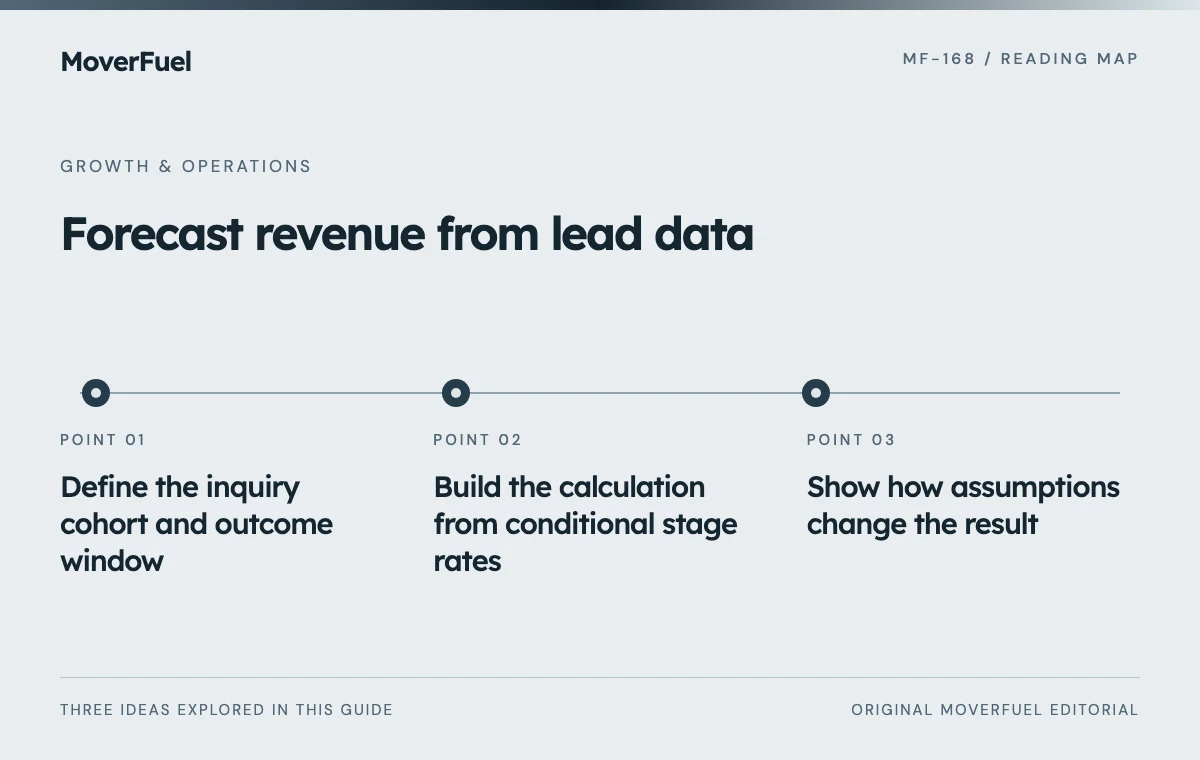
Define the inquiry cohort and outcome window
Start with deduplicated inquiries created in a stated period. Exclude internal tests and identify spam using documented rules. Do not count a callback, form resubmission and CRM import as three new opportunities when they represent one request.
Choose the outcome window and date basis. Bookings created this month are not the same group as jobs scheduled this month. Supermove's milestone documentation distinguishes creation, booking and job-date events, demonstrating why report labels must be checked before combining data. [1]
Scroll the table horizontally to compare all columns.
| Term | Working definition | Common confusion |
|---|---|---|
| Inquiry cohort | Unique eligible requests created in a period | All calls and form events |
| Booked value | Value associated with confirmed bookings under the company's definition | Completed revenue |
| Completed revenue | Revenue from delivered work under the chosen accounting treatment | Quotes still awaiting acceptance |
| Cash collected | Payments actually received | Any of the above by default |
Document who maintains each definition. Marketing, sales and finance may use similar words for different events; the forecast needs one agreed interpretation for each input.
Build the calculation from conditional stage rates
One useful model is: inquiries × qualification rate × estimate rate among qualified inquiries × booking rate among estimates = estimated bookings. Multiply estimated bookings by an assumed average booked value to estimate booked revenue. Each denominator must match its preceding stage.
A labeled arithmetic example
Do not multiply by a lead-to-booking rate and then multiply again by qualification and estimate rates if the overall rate already includes those stages. That would count the same attrition twice.
If a denominator is zero, report the rate as unavailable rather than forcing zero or infinity into the model. The absence of observations is different from evidence that no opportunity can convert.
Show how assumptions change the result
Scroll the table horizontally to compare all columns.
| Scenario | Estimates from the same 200 inquiries | Assumed booking rate | Booked value at $2,000 per job |
|---|---|---|---|
| Lower conversion | 90 | 30%: 27 bookings | $54,000 |
| Middle conversion | 90 | 40%: 36 bookings | $72,000 |
| Higher conversion | 90 | 50%: 45 bookings | $90,000 |
The table changes only the estimate-to-booking assumption so its effect is visible. It does not assign probabilities or claim that the middle case is most likely. Replace the assumptions with defensible company evidence and explain why the range is useful.
Separate service categories when their values and conversion paths differ materially. A blended average can move because the service mix changed, even if performance within each category did not. Avoid presenting that mix effect as a sales improvement.
Respect operating capacity. A mathematically possible booking count may exceed what the company can assess or fulfill. Show the constraint rather than silently accepting an infeasible scenario.
Use mature cohorts and mark incomplete evidence
Recent inquiries often have unresolved outcomes. Comparing them with a fully matured prior period can make conversion appear worse simply because customers have not decided. Use observed decision timing to choose a fair review window.
Keep open, lost and booked opportunities distinct. Do not assign every open estimate an optimistic probability without evidence. If stage-based probabilities are used, explain how they were estimated and how often they are reviewed.
Check whether historical conditions still apply. A new market, price change, service mix shift or intake process can weaken the relevance of old rates. The forecast should state those changes instead of borrowing confidence from a large historical total.
Bridge bookings to completed work separately
Add an explicit cancellation or completion assumption only when the business has reliable evidence for it. Keep job-date timing separate from booking-date timing so the model does not place all booked value into the same month's completed revenue.
Relevant contribution is different again: it considers revenue and variable costs. A booked-revenue forecast does not establish profit, and neither bookings nor profit automatically establishes the timing of cash receipts. [2]
Use the contribution guide for cost treatment and the capacity framework for operating limits.
Compare the scenario with what actually happened
Save the original inputs and forecast date. At the review point, compare predicted and observed inquiries, stage rates, bookings and value. Identify which assumption caused the difference rather than judging only the final total.
Update the model when evidence warrants it, while retaining prior versions. A forecast that is continuously overwritten cannot teach the team whether its assumptions are improving. Use the result to make a decision about acquisition, conversion or capacity.
A reliable tracking and attribution system provides the stage data; it does not remove uncertainty from future customer decisions.
Common questions
Is booked revenue the same as collected revenue?
No. Booked value, completed revenue and cash receipts refer to different events and may occur in different periods. Define and report them separately.
How many scenarios should a moving forecast include?
Use enough to expose the assumptions that matter without inventing precision. A small lower, middle and higher range can be useful if its inputs and limitations are explicit.
Your next step
Forecast from a defined cohort with consistent denominators. Show the assumptions, respect capacity and reconcile the model with actual outcomes instead of presenting a scenario as a promise.
Sources & editorial notes
Platform claims cite the documents below. Operating frameworks and labeled examples are MoverFuel editorial analysis, not client results or industry benchmarks.
- Supermove: Marketing Milestones SummarySupermove milestone reports distinguish creation, booking and job timing; the scenario arithmetic is an original illustration. Reviewed .
- OpenStax: contribution margin and cost behaviorContribution separates revenue and variable costs and should not be confused with bookings or cash receipts. Reviewed .