
A full calendar and a growing business are not the same thing. More inquiries can overwhelm estimates, concentrate jobs on already constrained dates or consume capacity with unsuitable work. Growth planning should identify the next operating constraint and decide whether marketing should increase demand, improve the mix or wait for a capacity change.
 View full-size graphic ↗
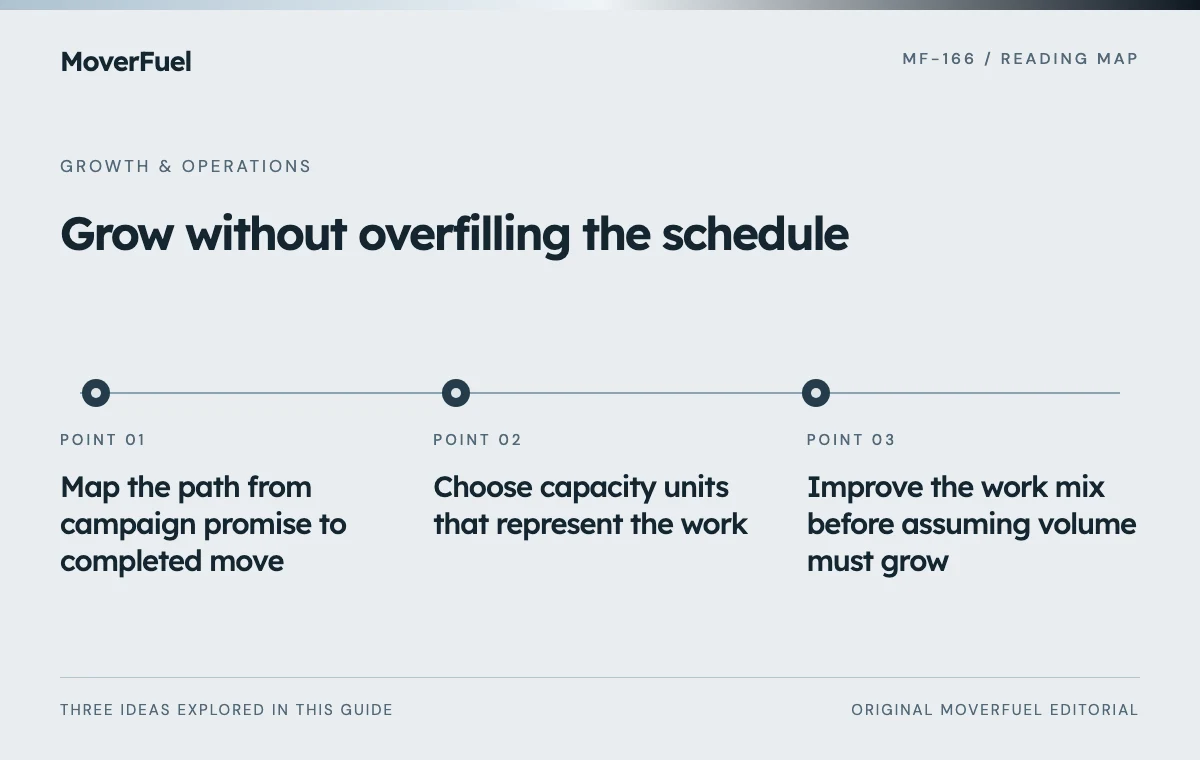
Map the path from campaign promise to completed move
Scroll the table horizontally to compare all columns.
| Stage | Possible constraint | Evidence to inspect |
|---|---|---|
| Inquiry handling | Insufficient coverage or unclear routing | Missed contacts and unassigned records |
| Estimates | Limited assessment slots or slow preparation | Waiting time and incomplete estimates |
| Booking | Availability or scope mismatch | Documented loss reasons |
| Fulfillment | Crew, equipment or scheduling limits | Usable capacity by service and date |
| Quality control | Insufficient supervision or recovery capacity | Rework, complaints and operational feedback |
The first constraint may occur before the crew schedule. Increasing lead volume cannot solve a shortage of estimate capacity. Conversely, better intake may reveal that fulfillment rather than marketing is the limiting factor.
Ask each team to identify the evidence behind its concern. Avoid treating the loudest complaint as the bottleneck. Use a shared view of what happens to suitable inquiries and where work starts waiting or failing.
Choose capacity units that represent the work
A job count can conceal major differences in scope. Operations may need crew-days, equipment availability, assessment hours or another practical unit. Marketing does not need to dispatch the fleet, but it needs a reliable signal about which demand can be served.
Separate theoretical capacity from usable capacity
Allow operations to account for unavailable time, existing commitments and the reserve it considers necessary. Do not assume every theoretical slot is sellable. The working definition should be maintained by the people accountable for delivery.
Review capacity by date and service where that distinction affects decisions. A company can have unused weekday capacity while being unable to accept another weekend move. A monthly total alone may hide the problem.
Improve the work mix before assuming volume must grow
Identify requests that fit the company's capabilities, available dates and economic requirements. Marketing can clarify service scope, reduce unsupported inquiries and highlight genuinely available options. It should not pressure customers into dates or services that do not suit them.
Contribution analysis separates revenue from variable costs. Apply the company's actual cost model when comparing work types, and consider the scarce operating resource as well as the job's headline revenue. [1]
For example, two jobs with similar revenue may require different travel or crew commitments. The useful question is which work supports the business within its real constraints, not which campaign reports the most bookings.
Use the contribution after ad spend guide alongside operational planning; neither a lead count nor gross revenue answers the entire growth question.
Sequence the investment around the limiting step
Scroll the table horizontally to compare all columns.
| Observed limitation | First priority | Then evaluate |
|---|---|---|
| Suitable demand is insufficient | A bounded acquisition test | Capacity required if it works |
| Requests wait for assessment | Estimate workflow or coverage | Whether more demand is useful |
| Bookings exceed supportable dates | Availability and promise controls | Measured capacity expansion |
| Poor-fit jobs consume resources | Qualification and service clarity | A better acquisition mix |
Choose a specific improvement with an owner and a review point. A capacity investment may involve people, equipment or process changes outside marketing's authority. Agree on that responsibility before promising a growth target.
SBA marketing guidance connects plans with goals, actions, budgets and measurement. Use those elements to coordinate acquisition with the operating change instead of treating the campaign budget as an isolated growth lever. [2]
Make availability updates reach the customer-facing team
Define who changes availability information, how quickly it reaches intake and marketing, and how the team verifies that advertised promises remain accurate. A spreadsheet that only dispatch sees cannot reliably guide campaign decisions.
If a service or date range becomes constrained, review relevant ads, pages and follow-up language. Explain alternatives honestly. Avoid a broad claim that the company is fully booked if useful capacity remains elsewhere, and avoid guaranteed availability that no one has checked.
Record the reason for each acquisition adjustment. When capacity returns, the team should know which restrictions can be lifted and which reflect a lasting service limitation.
Judge growth by delivery quality as well as acquisition
Review completed work, cancellations, service issues and customer feedback alongside marketing outcomes. A campaign that produces more bookings but destabilizes delivery may require a different offer or pace, even if its reported acquisition cost looks attractive.
Use a regular cross-functional review to confirm the next constraint. Improvements can move the bottleneck from intake to estimates or from estimates to fulfillment. The growth plan should change when the limiting step changes.
The peak-season planning guide handles weekly control. This broader framework helps sequence acquisition and conversion work around the business's next capacity decision.
Common questions
Should marketing stop when the schedule looks full?
Review usable capacity by service and date first. The business may need a different mix, better qualification or future-period inquiries rather than a complete stop.
Can more leads solve slow revenue growth?
Only when suitable demand is the relevant constraint and the business can convert and fulfill it. Estimate capacity, work mix and delivery limits may need attention first.
Your next step
Identify the constraint, choose a meaningful capacity unit and sequence growth around it. More demand is useful when the business can turn it into well-delivered work.
Sources & editorial notes
Platform claims cite the documents below. Operating frameworks and labeled examples are MoverFuel editorial analysis, not client results or industry benchmarks.
- OpenStax: contribution margin and cost behaviorContribution analysis distinguishes revenue and variable costs; capacity comparisons require the company's own operating data. Reviewed .
- SBA: marketing and salesMarketing plans connect goals, actions, budgets and measures; the constraint map is an original editorial framework. Reviewed .