
During a busy period, more inquiries can create a problem when the team cannot answer, estimate or fulfill them reliably. The marketing decision is not simply whether trucks appear busy. It is which suitable work can still be accepted, on which dates, with enough contribution and customer-service capacity to justify acquiring it.
 View full-size graphic ↗
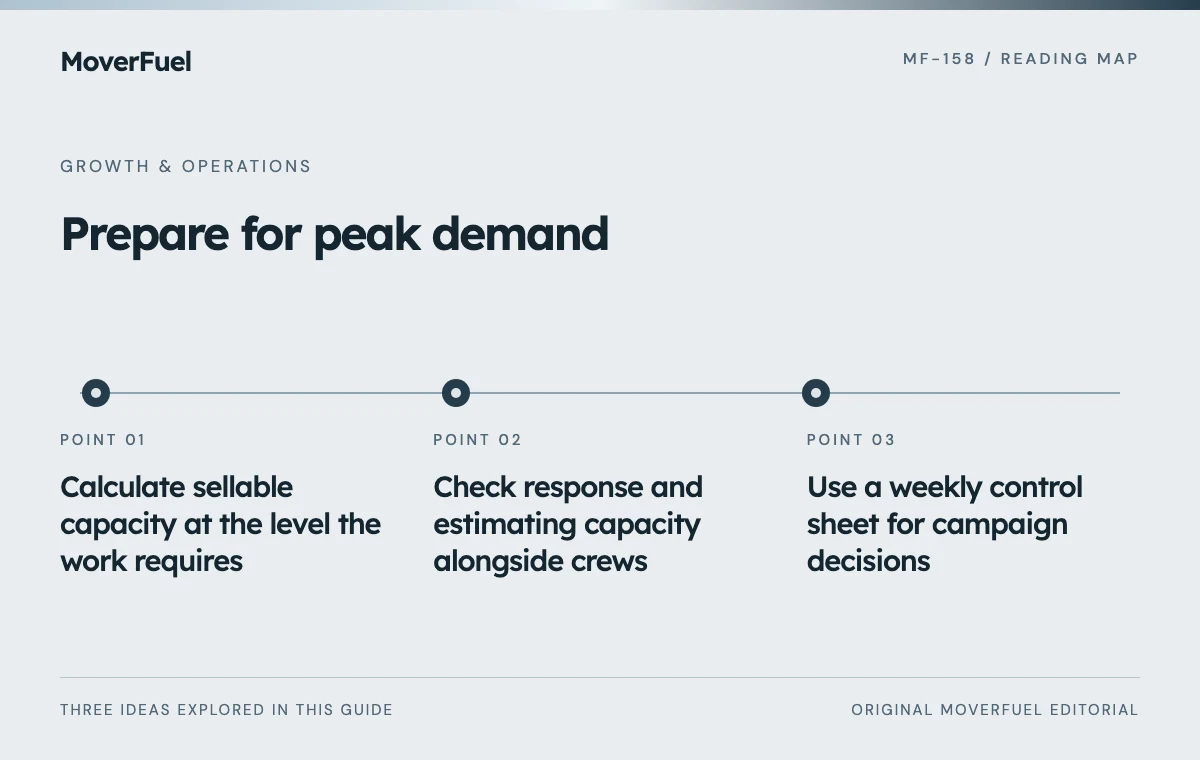
Calculate sellable capacity at the level the work requires
Start with the resources operations actually schedules: qualified crews, vehicle availability, hours, route time and service-specific equipment. Deduct confirmed commitments and realistic operating constraints. Keep a reserve for known uncertainty where the business requires it.
Scroll the table horizontally to compare all columns.
| Item | Illustrative crew-days |
|---|---|
| Nominal available crew-days | 30 |
| Unavailable for training or planned absence | 2 |
| Operating reserve selected by management | 2 |
| Usable planned capacity | 26 |
| Already committed work | 18 |
| Uncommitted planned capacity | 8 |
The example leaves eight crew-day equivalents, not automatically eight jobs. A job may require multiple crews, part of a day or travel that affects another date. The figures are fictional and the reserve is an assumption, not an industry standard.
Maintain service and date detail. Spare capacity on a weekday may not solve a weekend request, and a local crew opening does not establish feasibility for a long-distance route.
Check response and estimating capacity alongside crews
A full operating team still needs enough intake and estimating capacity to handle inquiries accurately. Track first-attempt delays, unresolved questions, survey availability and overdue promises. If those queues expand, additional advertising may amplify a handoff failure.
Assign a daily exception owner
Name who reviews unassigned inquiries, missed calls and estimate requests that cannot be scheduled promptly. Give the team a clear way to escalate unavailable dates or unusual scope. Do not let each representative improvise a different promise to keep the sale alive.
Use the speed-to-lead measurement guide to distinguish fast acknowledgments from meaningful contact.
Use a weekly control sheet for campaign decisions
Scroll the table horizontally to compare all columns.
| Signal | Question for marketing and operations | Possible action |
|---|---|---|
| Forward booked workload | Which dates and services still fit? | Refine the acquisition focus |
| Qualified inquiry flow | Is suitable demand sufficient for the remaining capacity? | Maintain, test or limit spend |
| Estimate backlog | Can the team assess new work responsibly? | Repair coverage or reduce pressure |
| Contribution by service | Is incremental work economically useful? | Prioritize suitable service mix |
| Cancellations | Which openings are real and reusable? | Update availability after verification |
| Customer complaints | Are promises exceeding delivery? | Correct messaging and process immediately |
Agree on thresholds using the company's own operating needs. A campaign manager should not independently decide how much work a branch can accept. Likewise, operations should explain the constraint precisely enough for marketing to act on it.
Contribution is revenue less relevant variable costs before fixed-cost coverage and profit. Use a consistent cost boundary when evaluating additional acquired work; high revenue alone does not establish attractive economics. [1]
Keep availability and scope messages synchronized
Review current ads, landing pages and automated replies for date or service claims. If the company needs to confirm availability after assessment, say so accurately. Do not keep an old promotion live after its operating assumptions no longer apply.
When the schedule tightens, consider the appropriate mix of geographic focus, service emphasis and spending limits under the platform's actual controls. Avoid a blanket shutdown that ignores suitable future-date work, but do not keep spending solely to maintain lead volume.
Manage cancellations and reschedules as real events
Confirm the operational impact before reopening acquisition. A cancellation may free a crew but leave a route or equipment constraint. A reschedule can move pressure to another date rather than create new overall capacity.
Update the job record and any outcome reporting consistently. Do not count a cancelled booking as retained work when evaluating campaign economics. Review whether a surge in cancellations reflects unclear expectations, changed customer circumstances or another cause that needs investigation.
Keep a short change log of capacity decisions and campaign actions. It helps explain why spend changed and prevents the next person on duty from restoring an outdated setting without understanding the constraint.
Plan the exit from the busy period
Watch the forward pipeline before the current schedule empties. The relevant preparation window depends on the service and customer decision time. Coordinate creative, content and estimate coverage for the next phase while keeping present commitments reliable.
After the peak, review missed opportunities, unsuitable inquiries, overtime or rework and customer friction. Use those findings to adjust the next cycle's capacity assumptions and acquisition rules, rather than measuring success only by the busiest week.
Connect Google Ads management with lead tracking so the marketing team can see the operating outcomes behind its lead totals.
Common questions
Should movers stop advertising when the schedule is full?
Review the dates, services and future pipeline first. Limit demand the business cannot serve, while evaluating suitable future work under clear capacity and economic rules.
Does one free crew-day equal one available move?
No. Job duration, crew requirements, route travel, access windows and equipment affect fit. Use the scheduling units operations actually relies on.
Your next step
Peak-period marketing should fill suitable capacity without outrunning intake or delivery. A shared control sheet turns workload, contribution and customer promises into clear campaign decisions.
Sources & editorial notes
Platform claims cite the documents below. Operating frameworks and labeled examples are MoverFuel editorial analysis, not client results or industry benchmarks.
- OpenStax: contribution margin and cost behaviorContribution-margin principles distinguish variable costs, fixed-cost coverage and profit; the capacity example is hypothetical editorial analysis. Reviewed .