
When suitable inquiries are scarce, avoid losing them to preventable friction. The first task is to find where customers struggle: understanding the offer, contacting the team, completing assessment or deciding on an estimate. A focused conversion test can be useful even when the broader market remains slow, but it cannot manufacture demand that is not there.
 View full-size graphic ↗
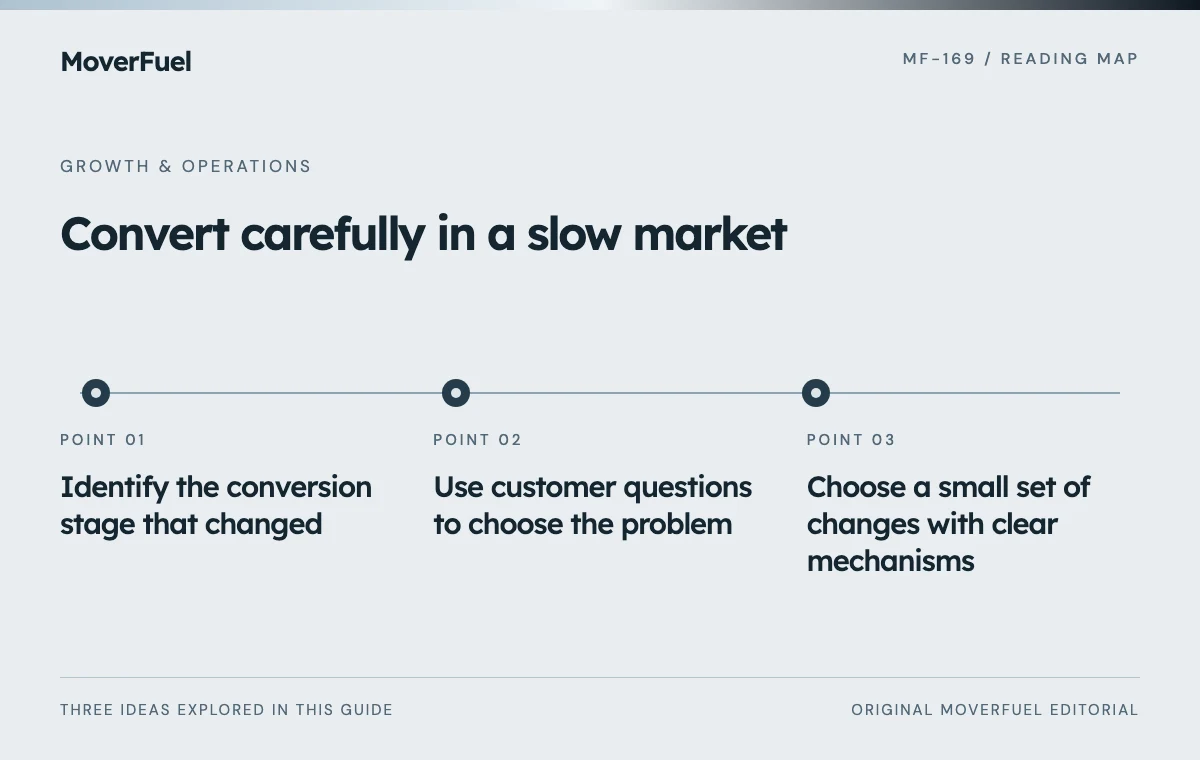
Identify the conversion stage that changed
Scroll the table horizontally to compare all columns.
| Observed pattern | Possible question | Evidence to review |
|---|---|---|
| Traffic without inquiries | Can visitors understand and contact the company? | Page behavior and functional tests |
| Inquiries without contact | Does the team receive and own requests? | Delivery and response records |
| Contact without assessment | Is the next step clear and appropriate? | Conversation notes and scheduling |
| Estimates without bookings | What remains unresolved for suitable customers? | Mature outcomes and loss reasons |
Compare equivalent service and source cohorts. A different mix of customers can change the overall rate even if the experience has not worsened. Do not attribute every movement to the latest page edit or sales script.
Confirm that measurement still works. A tracking failure can make a functioning form look ineffective, while duplicate events can conceal a real decline. Review the underlying inquiry records before making a conversion claim.
Use customer questions to choose the problem
Review representative calls, form errors and estimate discussions through the company's approved access and privacy process. Look for recurring uncertainty about coverage, scope, timing, trust or the next step. Do not collect sensitive material merely because it is available.
Write a specific hypothesis
A useful hypothesis names the observed friction and expected behavior: customers asking whether packing is included may benefit from a clearer scope explanation before requesting an estimate. That is more testable than a general instruction to make the page persuasive.
Separate customer evidence from staff assumptions. Sales may believe every loss is price, while records show unanswered questions or unavailable dates. Both perspectives deserve investigation; neither should be accepted without supporting examples.
Choose a small set of changes with clear mechanisms
Scroll the table horizontally to compare all columns.
| Observed friction | Possible change | Outcome to inspect |
|---|---|---|
| Unclear service coverage | Explain supported locations and move types | Suitable inquiries, not just total submissions |
| Mobile form difficulty | Remove unnecessary fields and clarify errors | Successful valid requests |
| Uncertain assessment process | Explain the next step and required information | Completed assessments |
| Estimate scope questions | Improve the explanation and follow-up handoff | Resolved questions and mature bookings |
Keep required information when it supports safe, accurate service assessment. Shortening a form is not automatically an improvement if it creates unusable records or more work later. Evaluate the entire path, not only the first click.
Test the implementation before exposing it to customers. Confirm keyboard access, error states, phone links and request delivery. A new persuasive message cannot compensate for a broken submission.
Match the test method to the available evidence
Low volume makes small rate changes difficult to interpret. Statistical comparison of proportions depends on assumptions and sample conditions; it does not justify a universal number of leads that proves a winner. NIST discusses both large-sample methods and alternatives for smaller samples. [1]
If a controlled split test is impractical, document a staged change and its limitations. Before-and-after observations can be affected by demand, service mix, seasonality and sales coverage. Present the result as directional evidence rather than a causal certainty.
Set the outcome definition and review window before looking at the result. Avoid stopping a test the first time a favorable number appears. Keep quality and downstream outcomes visible so a higher submission rate does not mask worse fit.
Use conversion optimization with reliable tracking to make the experiment interpretable.
Improve decision support without pressure tactics
Follow up on the customer's unresolved question or agreed timing. Explain scope, availability and the estimate process clearly. Avoid false urgency, unsupported savings or repeated messages after the customer has declined contact.
Review whether intake and estimating staff use the same service definitions as the page. A clear website can still lose trust if the subsequent conversation contradicts it. Fix the handoff rather than adding more promises to the ad.
If price is a genuine issue, examine the offer and economics with the responsible team. A discount may reduce useful contribution and may not address the underlying concern. Do not prescribe a blanket reduction as a conversion strategy.
Keep, revise or remove the change
At the review point, summarize the result, data quality, customer feedback and operational effect. Retain a change when the evidence supports it; revise it when the mechanism is plausible but execution is weak; remove it when it creates confusion or harms fit.
Save what the team learned even when the test is inconclusive. A documented answer about customer uncertainty can improve future pages and intake training. An unexplained percentage change is much harder to reuse.
The slow-market strategy guide addresses broader business choices. This conversion workflow targets preventable losses within the demand already reaching the company.
Common questions
Should a mover discount every estimate in a slow market?
No. Diagnose the objection and review the economics. Scope clarity, availability, trust or follow-up may matter more than price, and a discount does not fix those problems.
Can a small moving company run useful conversion tests?
Yes, but the conclusions must match the evidence. Functional repairs and clear customer feedback can be valuable; small before-and-after samples should not be presented as statistically proven lifts.
Your next step
Find a specific conversion problem, choose a change that addresses it and judge the result with suitable evidence. Protect lead quality and customer clarity throughout the test.
Sources & editorial notes
Platform claims cite the documents below. Operating frameworks and labeled examples are MoverFuel editorial analysis, not client results or industry benchmarks.
- NIST: comparing two proportionsNIST describes assumptions and methods for comparing proportions; small samples do not support a universal conversion-test threshold. Reviewed .