
A list of unbooked quotes is not a ready-made sales campaign. Some moves have already happened, some customers declined and others are waiting for a scope correction. Recovery begins by identifying records with a legitimate unresolved need and an appropriate reason to reconnect, then assigning a useful next action.
 View full-size graphic ↗
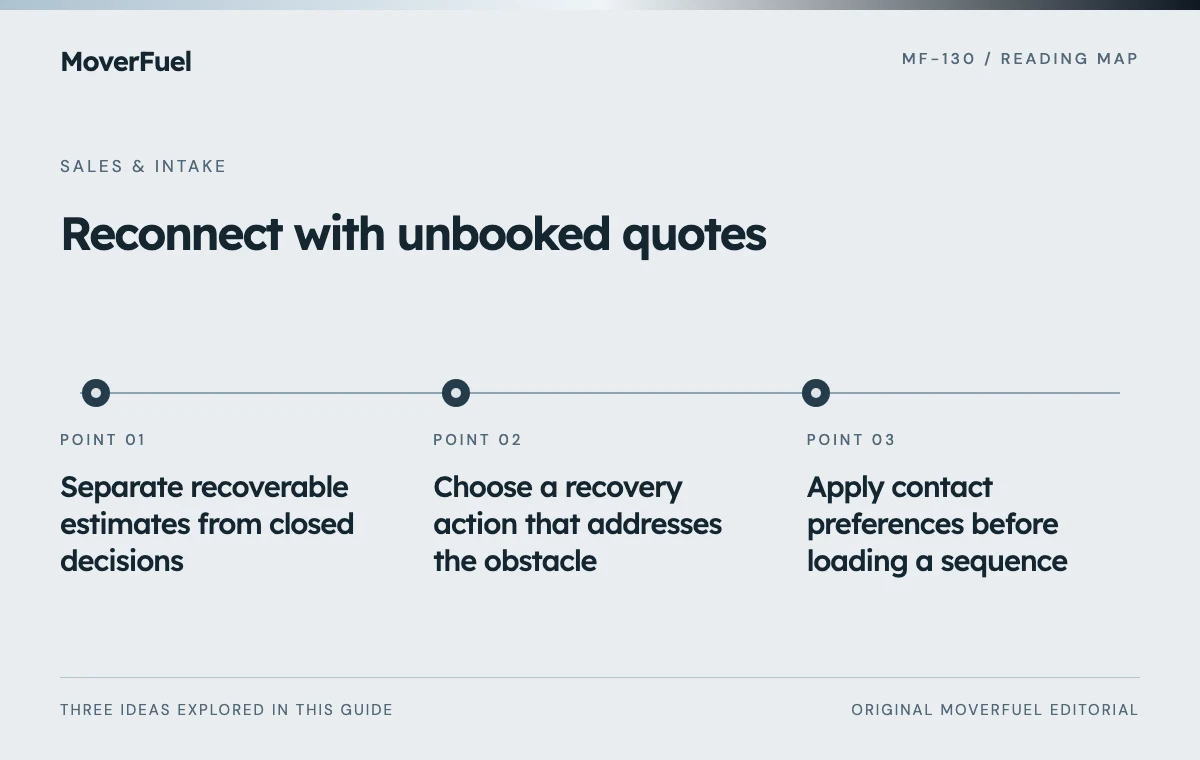
Separate recoverable estimates from closed decisions
Review move date, last contact, latest estimate version, service fit, customer preference and known outcome. A record without a booking can mean open, lost, postponed or simply poorly maintained. Do not infer that every empty booking field represents a customer still shopping.
Scroll the table horizontally to compare all columns.
| Record condition | Treatment | Reason |
|---|---|---|
| Future move; customer requested clarification | Prioritize the promised answer | An unresolved need is documented |
| Future move; timing decision pending | Use the agreed contact point | The project may still be active |
| Move date passed; outcome unknown | Reconcile records before outreach | The original offer may be irrelevant |
| Customer declined or asked to stop | Suppress the applicable sales contact | A clear decision should be respected |
| Scope or route does not fit | Close or route appropriately | Repeated contact cannot repair service fit |
| Already booked under another record | Merge supported duplicates | Avoid a false recovery claim |
HubSpot's documented deal properties separate deal stage from closed-lost reason. Regardless of CRM, preserve that distinction: the workflow state and the reason behind it are different facts. A field's existence does not mean the reason has been verified. [1]
Choose a recovery action that addresses the obstacle
For an unanswered scope question, provide the missing explanation or arrange the appropriate review. For a date change, check actual capacity and whether the estimate needs revision. For a budget mismatch, consider an authorized alternative only if it meets the customer's needs and the company's economics.
An original message for a genuinely unresolved quote
‘When we last spoke, you were confirming the destination access and move date. If the project is still active, I can help review those details and confirm the next step. If your plans have changed, let me know and I will update our record.’ Use this only when it reflects the actual conversation.
Do not tell the customer that a prior estimate or crew reservation remains valid without checking. A recovery message can reopen the conversation, but the business still needs to verify current scope, availability and applicable terms before accepting work.
For active estimates needing ongoing help, see estimate nurturing. Recovery is a separate review of records that have stalled or become uncertain.
Apply contact preferences before loading a sequence
Review how the contact was obtained, what the customer requested and whether the proposed message is operational or promotional. Have the actual channel and jurisdiction requirements checked. An old estimate record is not blanket permission for indefinite email, text or phone marketing.
FTC CAN-SPAM guidance addresses commercial email and opt-out obligations. Before a recovery email campaign, verify its message classification and suppression process. That email guidance alone does not authorize calls or texts. [2]
Keep the sequence finite and assign an owner for replies. If the customer responds with a new need, move the record into the appropriate active process. If the customer declines, stop the recovery effort and record the result without pressuring them for another conversation.
Track actual recovery with an explicit baseline
Scroll the table horizontally to compare all columns.
| Measure | Illustrative count |
|---|---|
| Unbooked records reviewed | 80 |
| Eligible active opportunities after cleanup | 25 |
| Customers meaningfully reconnected | 10 |
| Revised estimates completed | 6 |
| Jobs booked during observation | 3 |
In this fictional example, three bookings followed the recovery effort. That does not prove all three were incremental; some customers may have returned anyway. Report observed recovered bookings and explain the eligibility rules, contact effort and observation period.
Deduct cancellations and follow completed outcomes before evaluating economics. Include staff time, any approved concessions and fulfillment contribution when judging whether the process is worth repeating. Do not call the full value of all 80 old quotes recovered revenue.
If volume permits a fair comparison, evaluate a carefully designed process change against a comparable baseline. Never withhold a promised customer answer merely to create a test group. Record seasonal and capacity differences that limit the comparison.
Use the recovery audit to prevent future stalls
Classify why records needed recovery: no owner, unanswered question, missed callback, incomplete survey, stale availability or missing outcome update. Give each recurring cause a process owner. Fixing a broken handoff may be more valuable than repeatedly contacting the same backlog.
Review the queue on a defined schedule and retire records according to their actual state. Keep an unknown category when the customer outcome cannot be established. A clean pipeline should reflect evidence, not an administrative attempt to make every row look successful.
A lead tracking and automation review can connect estimate tasks, replies and booking updates so fewer legitimate opportunities disappear into an unmanaged list.
Common questions
Should I offer a discount to every unbooked quote?
No. Determine why the estimate stalled first. A missing scope answer, changed date or completed move will not be solved by an automatic discount.
How far back should a recovery campaign go?
Use current relevance, customer preferences, data-retention rules and the actual contact permissions, not an arbitrary age threshold. Review stale records before treating them as active opportunities.
Your next step
Recover the right opportunities with a relevant action. A smaller, accurate queue with clear stop rules is more useful than a large campaign built from every quote that lacks a booking.
Sources & editorial notes
Platform claims cite the documents below. Operating frameworks and labeled examples are MoverFuel editorial analysis, not client results or industry benchmarks.
- HubSpot: default deal propertiesHubSpot deal properties distinguish deal stage from the closed-lost reason field. Reviewed .
- FTC: CAN-SPAM compliance guideFTC guidance covers commercial-email obligations and opt-out handling, not general permission for all outreach channels. Reviewed .