
An accurate moving estimate begins with an accurate description of the work. Missing inventory, uncertain access and unclear packing expectations can create a gap between what the customer expects and what the team must deliver. A disciplined scope review and change process help make that gap visible before move day.
 View full-size graphic ↗
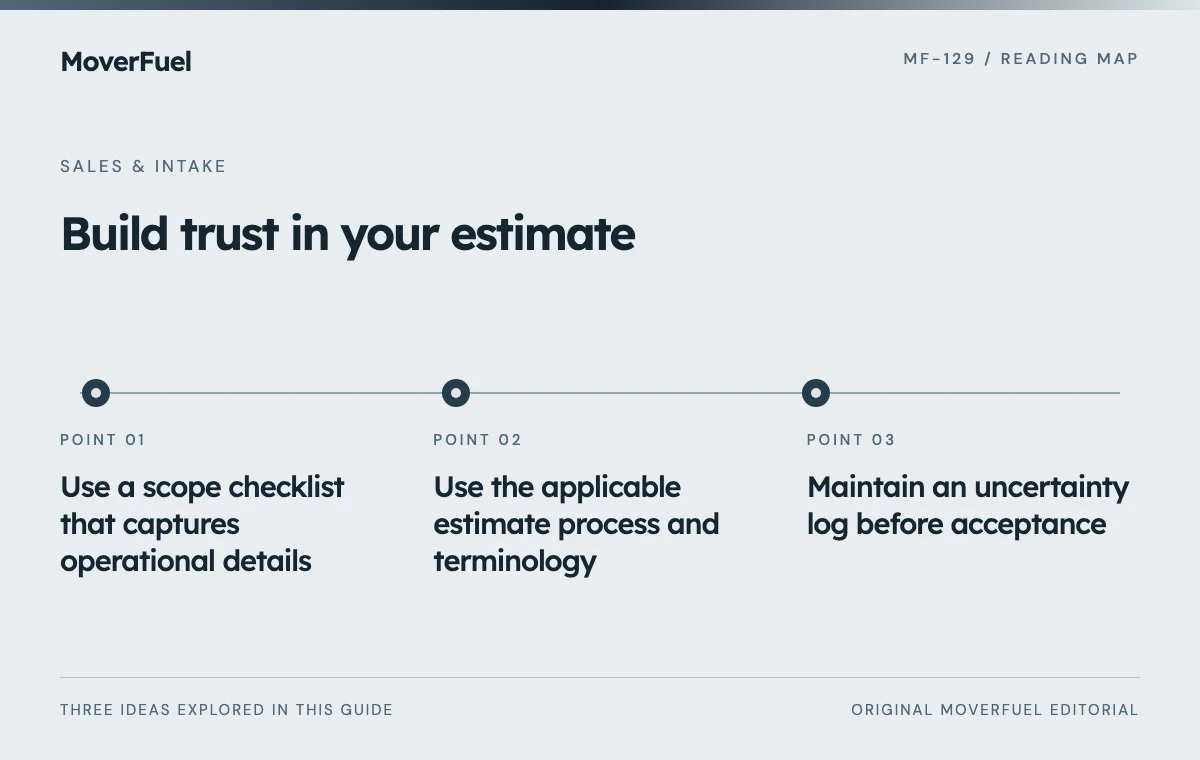
Use a scope checklist that captures operational details
Scroll the table horizontally to compare all columns.
| Area | Questions to resolve | Evidence or follow-up |
|---|---|---|
| Inventory | What moves, stays or requires special handling? | Current inventory review and unresolved items |
| Origin and destination | Are addresses and access conditions confirmed? | Stairs, elevators, parking and building restrictions |
| Packing | Who packs which items and supplies materials? | Written service responsibility |
| Timing | What date and access windows apply? | Verified constraints and flexibility |
| Storage | Is storage required and what transfers are involved? | Confirmed service arrangement |
| Additional work | Are assembly, disassembly or specialty tasks included? | Authorized scope and exclusions |
Use the checklist to identify uncertainty, not to make every customer repeat the same information in several systems. Carry verified details from intake into the estimator's record and ask the estimator to confirm anything that materially affects the work.
A room count can help route an inquiry, but it does not describe every inventory or access requirement. If the customer cannot confirm an important detail, mark it unresolved and assign a way to obtain it. An empty field should not silently mean that no restriction exists.
Use the applicable estimate process and terminology
FMCSA's guidance for interstate household-goods moves describes written estimates and distinguishes them from rate quotes. It also explains the role of inspection and the difference between binding and nonbinding estimates. Apply the current requirements to the actual move type rather than treating an informal phone price as the complete process. [1]
This interstate guidance does not establish the rules for every intrastate move. Confirm the relevant state and service requirements with the appropriate authority or qualified adviser. Keep staff scripts and customer documents aligned with the process the business is authorized to use.
Explain the document in ordinary language
Tell the customer what the estimate covers, what information it relies on and what happens if the inventory or requested service changes. Use the correct approved terminology. Do not promise that a figure can never change when the document or applicable rules require a more specific explanation.
A customer should be able to identify the next step and the person who can answer a scope question. Make the estimate version and date easy for staff to locate so a later conversation does not rely on a superseded quote.
Maintain an uncertainty log before acceptance
Scroll the table horizontally to compare all columns.
| Unresolved item | Potential effect | Owner and resolution |
|---|---|---|
| Destination elevator reservation | Access timing and labor planning | Customer confirms with building |
| Storage decision pending | Service scope and transfers | Estimator reviews options |
| Specialty item dimensions | Handling and equipment needs | Authorized specialist assessment |
| Packing responsibility unclear | Materials and labor scope | Written customer confirmation |
The log is not a license to issue an incomplete estimate. It helps the team identify what must be resolved under its applicable process and what assumptions need explicit treatment. Do not bury a material unknown in an internal note that the customer never sees.
Treat changes as a communication workflow
When the customer adds items, changes access or requests another service, log what changed and when. Route it to the authorized estimator, determine the applicable documentation and explain the effect before relying on the revised plan. Preserve the earlier version for comparison.
An original communication pattern is: ‘The inventory now includes the additional items you described. We need to review how that changes the scope and provide the appropriate updated documentation. Please review that before treating the earlier estimate as current.’ Adapt it to the verified process and facts.
Keep operations informed of the accepted scope. A correct estimate cannot build trust if the crew receives an outdated inventory or a different packing instruction. Confirm that material changes reach both the customer-facing record and the operational handoff.
The phone intake script guide shows how to gather useful scope without making premature commitments.
Review estimate variance by cause
After completion, compare the estimate assumptions with the work performed and the documented customer outcome. Separate added scope, inaccurate inventory, access surprises, operational inefficiency and data-entry mistakes. Do not treat every difference as a salesperson error or every change as customer fault.
Review both overestimation and underestimation. A pattern of conservative estimates that customers cannot understand may hurt conversion; repeated omissions may create disputes. Use the cause analysis to improve questions, surveys, training and handoffs rather than merely demanding a smaller variance.
Connect recurring scope problems to marketing. If an ad or landing page implies that packing is included when the service offer does not, correct the message. Better acquisition starts with an offer the estimator and operating team can consistently explain and deliver.
A conversion and messaging review can identify those expectation gaps before they reach the estimate stage.
Common questions
Is a phone quote the same as a written interstate estimate?
No. FMCSA distinguishes rate quotes from written estimates for interstate household-goods moves. Use the applicable assessment and documentation process, and verify local requirements separately.
How should a mover handle added inventory?
Record the change, obtain authorized review and use the required updated documentation and customer communication. Ensure operations receives the current accepted scope.
Your next step
Estimate accuracy is a chain of clear inputs, appropriate documentation and controlled changes. Review the causes of variance so each completed move improves the next scope assessment.
Sources & editorial notes
Platform claims cite the documents below. Operating frameworks and labeled examples are MoverFuel editorial analysis, not client results or industry benchmarks.
- FMCSA: avoiding unexpected moving costsFMCSA interstate household-goods guidance addresses written estimates, inspection, rate quotes and binding/nonbinding distinctions; it is not universal intrastate guidance. Reviewed .