
An objection often reveals information the customer needs before making a moving decision. The useful response is to identify that concern, answer it accurately and agree on a next step. Trying to defeat every objection can turn a legitimate question about price, timing or trust into an uncomfortable sales conversation.
 View full-size graphic ↗
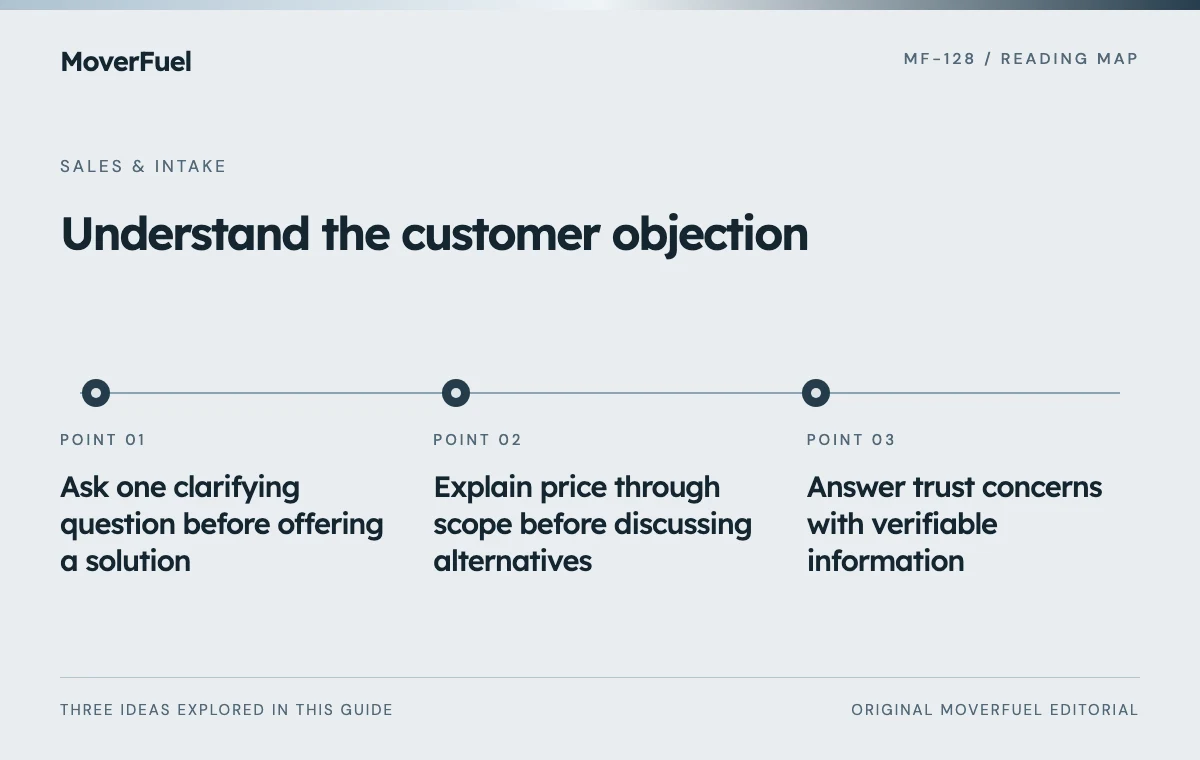
Ask one clarifying question before offering a solution
‘It is expensive’ can mean the total exceeds the budget, the scope is unclear or a competing quote appears lower. ‘I need to think’ can mean the date is uncertain or someone else must approve. Ask a neutral question rather than assigning a reason that makes the sale easier to pursue.
Scroll the table horizontally to compare all columns.
| Customer says | Clarifying question | Possible next step |
|---|---|---|
| The price is high | Is the concern the total budget or how it compares with another scope? | Review scope or an appropriate service alternative |
| I am worried about damage | Which items or handling risks concern you most? | Explain the verified handling and coverage process |
| I need a guaranteed date | Which timing requirements are essential? | Check authorized availability and terms |
| Another mover offers more | Which services are included in that comparison? | Compare like-for-like scope |
| I need to discuss it | What information would help that conversation? | Provide an accurate summary |
Record the answer in the customer's own terms where practical. Avoid turning a tentative question into a firm lost reason. The objective is to understand the decision, not force it into a convenient CRM category.
Explain price through scope before discussing alternatives
Original response: ‘Let us check that we are comparing the same work. Our estimate includes the packing and access requirements we reviewed. Which part would you like to compare or change?’ Use this only when those inclusions are actually documented.
If the budget genuinely does not fit, discuss service alternatives the company offers and can fulfill. Explain what changes, what the customer would handle and how the estimate will be revised. Do not remove necessary work from the quote while leaving the customer expecting the original service.
Make any concession an authorized business decision
A discount is not a substitute for resolving ambiguity. If a manager approves one, document the terms and update the written estimate through the proper process. Do not invent a limited-time promotion or imply that an unapproved reduction is available.
For price-led inquiry qualification, use the moving lead qualification guide alongside the estimate conversation.
Answer trust concerns with verifiable information
A customer worried about damage or reliability may want to understand crew preparation, handling procedures, documentation and the applicable protection options. Route technical coverage questions to an authorized person and the correct documents. Avoid reducing complex terms to ‘everything is covered.’
FTC advertising guidance requires claims to be truthful and supported. Apply the same discipline to sales explanations: do not invent awards, insurance details, reviews or guarantees to overcome hesitation. [1]
For interstate household-goods moves, FMCSA provides consumer information about researching movers and distinguishing movers from brokers. Help the customer verify the business's actual role and applicable credentials instead of treating verification as an objection to evade. [2]
Resolve timing and availability without pressure
Original response: ‘You need the move completed around a building access window. I will confirm what we can support before describing it as available. Are there any dates that cannot change?’ This distinguishes a constraint from a preference and prevents an estimate conversation from becoming an accidental reservation.
If the requested timing cannot be supported, explain the limitation promptly. Offer a genuine alternative only if it exists. Do not keep a poor-fit inquiry active by suggesting that operations will somehow find capacity after the customer accepts.
When another person must approve, offer a clear scope summary or a joint conversation if useful. Respect the customer's decision process. A demand for an immediate deposit may increase resistance when the real obstacle is missing information or authority.
End with a decision, an action or a respectful close
After answering the concern, ask whether it resolves the question and what the customer wants to do next. A next step might be a revised inventory review, a written clarification or a decision date chosen by the customer. It does not always have to be a booking.
If the customer declines, record what is known and stop the relevant sales sequence. Do not argue with a service mismatch or an explicit request for no further contact. If the reason is unclear, mark it unknown rather than defaulting to price.
Use team roleplay to practice listening and accurate explanations. Review whether staff clarified the concern, stayed within authority and completed the promised follow-up. A scorecard that rewards only closing pressure can encourage behavior that harms both customer trust and estimate accuracy.
Connect those observations to lost-booking reason training and the broader lead tracking process.
Common questions
Should a mover always match a competitor's price?
No. First establish whether the scope is comparable and whether the proposed work can be delivered at an acceptable contribution. Any concession should be authorized and reflected accurately in the estimate.
What if a customer still says no after the concern is answered?
Respect the decision, document any known reason and stop inappropriate follow-up. A clear decline is a useful outcome even when it does not produce a booking.
Your next step
Good objection handling makes the decision clearer. Use questions, documented scope and verified facts to help the customer choose without inventing urgency or promises.
Sources & editorial notes
Platform claims cite the documents below. Operating frameworks and labeled examples are MoverFuel editorial analysis, not client results or industry benchmarks.
- FTC: advertising and marketingFTC business guidance requires truthful, substantiated advertising claims. Reviewed .
- FMCSA: tips for a successful moveFMCSA consumer guidance supports researching interstate movers and their role and credentials. Reviewed .