An estimate follow-up is useful when it removes a real obstacle to the customer's decision. A missing inventory detail, unclear packing allowance or unanswered access question gives you a reason to contact them. Repeated messages asking whether they are ready to book add little when the underlying uncertainty remains unresolved.
 View full-size graphic ↗
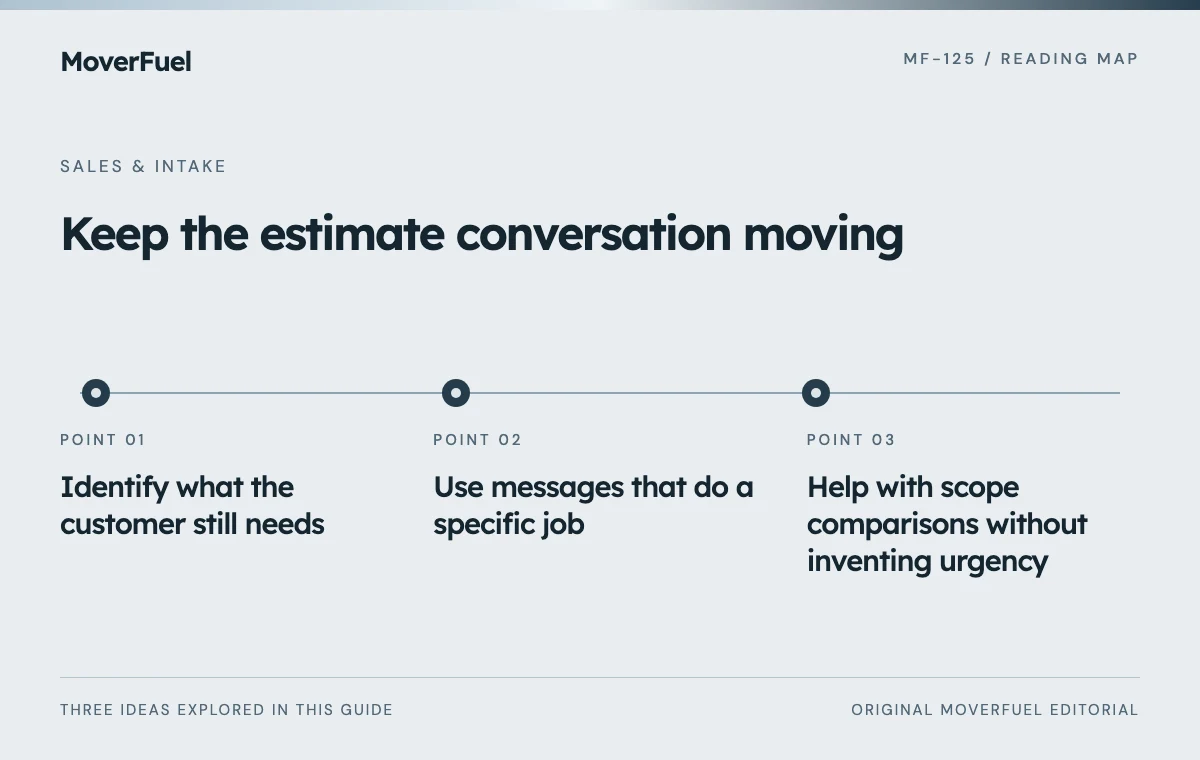
Identify what the customer still needs
Before sending a message, read the most recent conversation and estimate version. Establish whether the customer is waiting for a survey, reviewing the quote, comparing scope or postponing the move. The next message should match that state, not the number of days since the record was created.
Scroll the table horizontally to compare all columns.
| Stage | Useful purpose | Avoid |
|---|---|---|
| Survey pending | Confirm preparation and appointment details | Acting as though the price is final |
| Estimate delivered | Explain inclusions and outstanding assumptions | A generic booking demand |
| Scope comparison | Help compare packing, access and services | Disparaging another mover |
| Decision delayed | Agree on a useful future contact point | Repeated artificial deadlines |
| No longer interested | Close the loop and respect preferences | Restarting the same sequence |
Ask the salesperson to name the unanswered question in the record. If there is none, a brief invitation to ask questions may be appropriate; that does not justify indefinite contact. Silence can reflect a changed plan, a busy customer or a choice of another provider.
Use messages that do a specific job
Before the survey
Original example: ‘Ahead of our inventory review, please note any items that will stay behind and any access restrictions at either address. If the move date or packing needs have changed, let me know so the review reflects the current plan.’ This helps the customer prepare without implying that an estimate or reservation already exists.
After the written estimate
Original example: ‘I wanted to check that the estimate is clear. It includes the packing services we discussed and uses the access information from our review. Is there an item, service or timing requirement you would like us to clarify before you compare options?’ Replace every detail with the actual approved scope.
When the decision is delayed
Original example: ‘You mentioned that the destination date is still being confirmed. Would a follow-up after that decision be useful, or would you prefer to contact us when you are ready?’ Save the answer and use it to change the task schedule.
Messages should come from the person or team that can answer the likely reply. Sending a helpful question from an unmonitored address creates a new service failure. Route replies to the inquiry owner and stop any conflicting automation.
Help with scope comparisons without inventing urgency
When a customer says another quote is lower, offer to compare the stated work rather than immediately reducing the price. Ask whether inventory, packing, travel, access and any storage are equivalent. Explain your own inclusions and assumptions; do not guess what a competitor will charge later.
Use actual availability information when timing matters. ‘The current schedule needs to be checked before booking’ is different from an unsupported claim that only one slot remains. Have staff verify any availability or expiry statement before including it in a message.
For a deeper comparison conversation, see handling moving customer objections. The purpose of nurturing is to resolve the decision, not win an argument.
Respect channel preferences and contact limits
Record the customer's requested contact method and any request to stop. Separate operational messages about a requested estimate from broader promotional campaigns, and review the actual message purpose and applicable rules before automating contact.
The FTC's CAN-SPAM guidance explains requirements for commercial email, including truthful identification and a working opt-out. A CRM sequence is not exempt simply because it is sent by a salesperson. Email rules do not settle separate calling, texting or jurisdiction-specific requirements. [1]
Build suppression into the workflow. A reply declining the service, a booked job, a complaint or a stop request should pause the applicable sequence and create the appropriate human task. Do not assume that an unsubscribe in one tool automatically reaches every connected system.
Evaluate helpful progress rather than message volume
Track meaningful responses: a clarified inventory, completed survey, revised scope, explicit decision or confirmed booking. Count unwanted-contact complaints and missed follow-up commitments too. More sent emails are an activity measure, not evidence of a better customer experience.
Review a small sample of open estimates with the team. Identify the unresolved issue, the last useful message and the next agreed action. Close stale records according to a defined policy while keeping the distinction between a known rejection and an unknown outcome.
If you test a new message, keep its purpose clear and compare similar estimate stages. A message sent to customers awaiting a survey should not be judged against one sent to customers already reviewing a final scope. Track changes over a sufficient decision window.
Connect these tasks through marketing automation and lead tracking while keeping a person responsible for exceptions and substantive replies.
Common questions
How many times should a mover follow up on an estimate?
There is no universal count. Use the customer's stage, preferences and agreed next action, with finite contact limits and explicit stop conditions. A useful answer matters more than a long sequence.
What should I say when the customer does not reply?
Offer one clear way to resolve the outstanding question or confirm that the move is no longer active. Avoid assuming that silence means price resistance, and respect any request to end contact.
Your next step
Nurture the decision by clarifying scope, keeping promises and respecting preferences. Each follow-up should have a customer-relevant purpose and a clear condition for stopping.
Sources & editorial notes
Platform claims cite the documents below. Operating frameworks and labeled examples are MoverFuel editorial analysis, not client results or industry benchmarks.
- FTC: CAN-SPAM compliance guideFTC guidance describes commercial-email identification and opt-out obligations; it does not determine all phone/text rules. Reviewed .