
A multi-location mover needs consistency without pretending every branch has the same demand, capacity or economics. Centralize the definitions and systems that must agree. Give local teams responsibility for the facts only they can verify. The resulting framework should make ownership clear when a campaign, inquiry or job crosses branch boundaries.
 View full-size graphic ↗
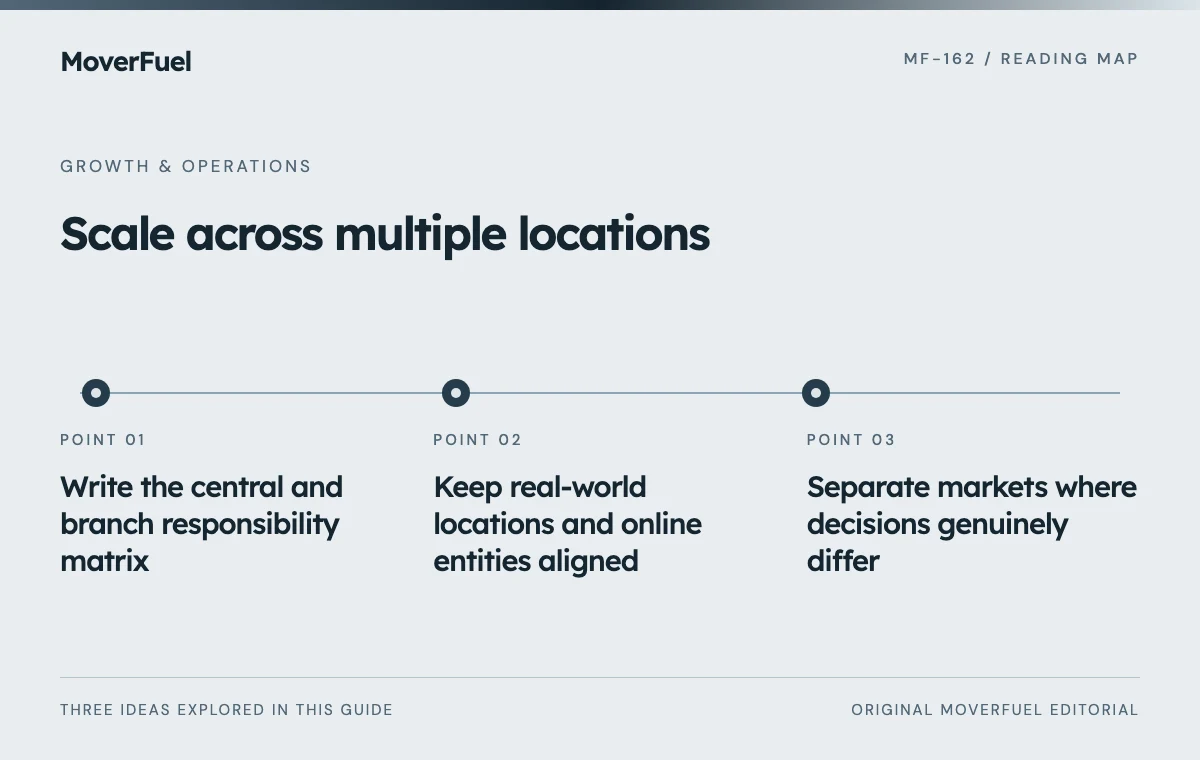
Write the central and branch responsibility matrix
Scroll the table horizontally to compare all columns.
| Activity | Central responsibility | Branch responsibility |
|---|---|---|
| Brand and service standards | Shared claims, templates and approval rules | Confirm local accuracy |
| Campaign strategy | Account structure, measurement and budget governance | Supply capacity and market context |
| Business Profiles | Access standards and policy checks | Maintain real hours and operating details |
| Intake | Shared stage definitions and routing design | Own response and record outcomes |
| Performance review | Comparable definitions and consolidated reporting | Explain local exceptions and corrective actions |
Assign named owners in the company's working document. A shared responsibility with no final decision-maker becomes a delay when a branch needs to pause a service or correct an advertised promise.
Define escalation paths for conflicting priorities. If central marketing wants more inquiries while a branch lacks estimate coverage, the issue should reach someone able to reconcile demand generation and service delivery.
This matrix is a proposed operating model, not a claim that every moving company needs a headquarters department. Smaller operators can assign several responsibilities to one person while preserving the distinctions.
Keep real-world locations and online entities aligned
Google Business Profile guidelines require accurate representation of eligible businesses. Do not create duplicate or fictional locations to fill a geographic coverage map. Each profile needs a real basis under the applicable eligibility rules. [1]
Service-area settings communicate where a business works. They should not be used to imply that the company maintains an office in every named place. Keep branch addresses, phone routing, service coverage and website descriptions consistent with operations. [2]
Give every location page a factual owner
A branch page should answer useful local questions: which services are available, how estimates work, what coverage is supported and how to contact the correct team. A city-name substitution template is not a substitute for those facts.
Maintain a change log for relocations, hours, phone numbers and service changes. The same correction may need to reach the profile, website, intake scripts and campaigns. One person should confirm that the set is complete.
Separate markets where decisions genuinely differ
Choose campaign and reporting boundaries according to budget ownership, service mix and operational control. Separate markets when the team needs distinct decisions; avoid splitting so finely that each segment has too little useful evidence.
When territories overlap, define how inquiries are assigned. A customer should not receive conflicting offers from two branches or disappear while each assumes the other owns the request. Keep the original source and record any branch transfer separately.
Use tracking and automation to connect ownership changes with the same underlying inquiry and job records.
Create a reliable path for local capacity changes
Define how branches report unavailable dates, service restrictions and temporary intake limitations. The central team needs an effective date, owner and expected review point, not an informal message that may never reach campaign management.
Check that customer-facing availability statements remain accurate after changes. Marketing may adjust acquisition priorities, but it should not promise an exact slot until the operating process can confirm it.
Give the local team a clear way to report mismatched inquiries with reasons. Unsupported geography, service type and timing need different responses. A vague complaint that leads are bad does not identify the necessary change.
Compare branches using equivalent definitions
Scroll the table horizontally to compare all columns.
| Measure | Keep consistent | Explain local variation |
|---|---|---|
| Qualified inquiries | Qualification criteria and deduplication | Service coverage and mix |
| Booking rate | Cohort and decision maturity | Availability and estimate process |
| Cost per completed job | Cost inclusion and cancellation handling | Market prices and operating requirements |
| Contribution | Relevant cost treatment | Travel, labor and service mix |
A branch with a higher cost per lead is not automatically less effective. Review whether its jobs, margins and sales cycle differ. Use the comparison to investigate decisions rather than rank teams from a single number.
Reporting tools can also use different date bases. Supermove's Marketing Milestones documentation distinguishes project creation, job timing and booking milestones, and explains that a project can produce multiple milestone rows. Match the report's definition before aggregating branch totals. [3]
Do not average branch percentages without considering the underlying counts. A small branch and a large branch should not contribute equally to a company-wide conversion rate merely because each occupies one spreadsheet row.
Use one review cadence with market-specific decisions
Prepare a shared review showing data quality, acquisition outcomes, operational constraints and the decision needed for each market. Separate company-wide fixes from local experiments so a branch problem does not automatically trigger a global change.
Record who approves budget movements and what evidence will be reviewed afterward. Keep branch leaders informed about changes that affect their workload. Shared accountability is easier when the decision and its assumptions are visible.
The multi-location solution overview connects local visibility, paid acquisition and reporting. Pair it with the new-market launch guide when adding another territory.
Common questions
Should every moving branch have identical marketing budgets?
No. Use common decision rules while accounting for market opportunity, service mix, capacity and mature outcomes. Equal budgets can ignore meaningful operating differences.
Can one central team manage all branch profiles and campaigns?
Yes, if access and responsibilities are appropriate, but local facts still need accountable owners. Central management should not create fictional locations or override accurate branch information.
Your next step
Standardize definitions, ownership and quality controls. Let real market and operating differences shape local decisions instead of forcing every branch into the same campaign plan.
Sources & editorial notes
Platform claims cite the documents below. Operating frameworks and labeled examples are MoverFuel editorial analysis, not client results or industry benchmarks.
- Google: representing your businessBusiness Profiles must accurately represent eligible real-world businesses and locations. Reviewed .
- Google: service areasService-area settings describe coverage rather than creating additional offices. Reviewed .
- Supermove: Marketing Milestones SummarySupermove milestone reporting distinguishes date and event bases and can include several milestone rows for one project. Reviewed .