
A quiet schedule does not identify the marketing problem by itself. The company may have fewer suitable inquiries, a weak estimate conversion process or availability that does not match the requests arriving. Diagnose the gap first, then divide the off-season plan between bounded demand tests and work that improves future acquisition.
 View full-size graphic ↗
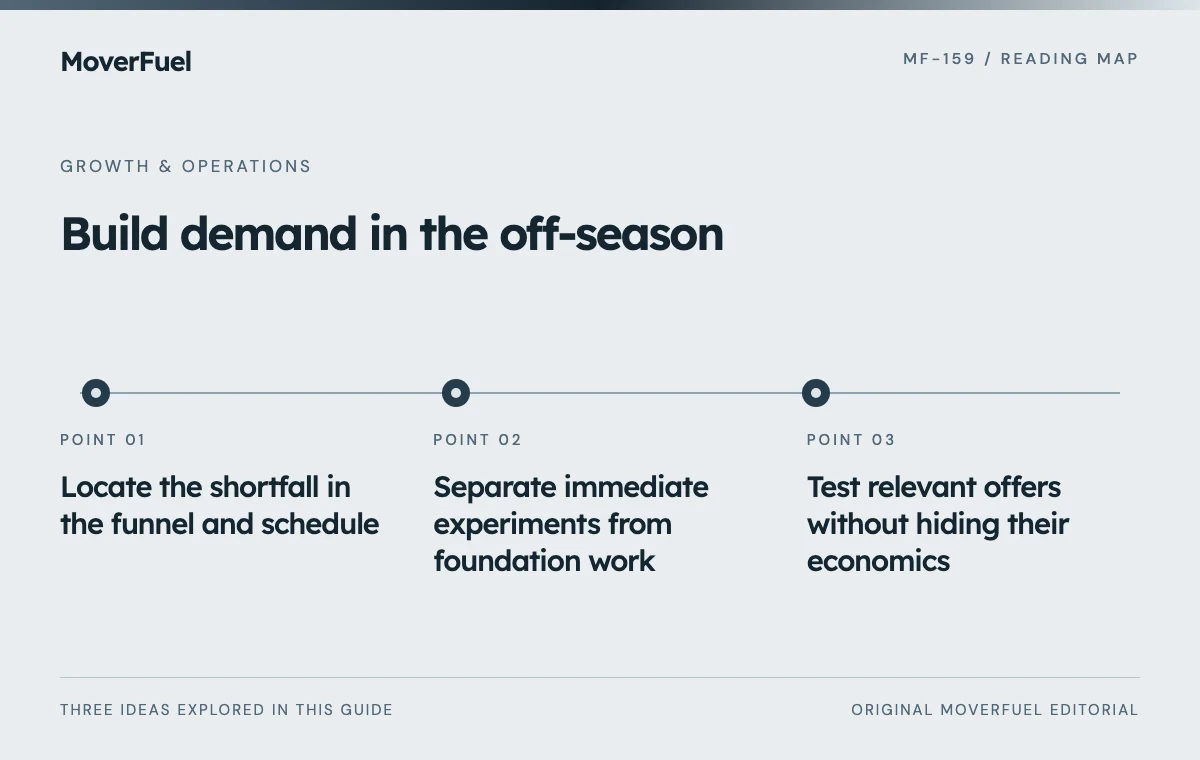
Locate the shortfall in the funnel and schedule
Scroll the table horizontally to compare all columns.
| Observed condition | What to inspect | Avoid assuming |
|---|---|---|
| Fewer inquiries | Search demand, visibility, campaign delivery and tracking | Every decline means the market disappeared |
| Stable inquiries, fewer qualified | Routes, services, timing and offer clarity | More spend will fix fit |
| Qualified inquiries, fewer estimates | Contact coverage and assessment process | The leads must be poor |
| Estimates, fewer bookings | Scope, price, availability and decision timing | Every loss is price |
| Bookings that do not fill usable capacity | Date and service distribution | Total bookings equal a balanced schedule |
Compare equivalent periods and note changes in service mix, geography and measurement. A quiet month after a peak should not automatically be treated as a year-over-year decline. Use the business's history and current evidence rather than a generic seasonal label.
Ask operations which work can be fulfilled well now. The acquisition plan needs a real service opportunity, not simply an instruction to keep crews busy at any cost.
Separate immediate experiments from foundation work
Scroll the table horizontally to compare all columns.
| Work type | Example | Evaluation window |
|---|---|---|
| Demand test | A bounded campaign for an actually available service | Enough time for its inquiry-to-outcome cycle |
| Conversion repair | Fix a broken form or unclear estimate handoff | Verify the repair, then observe relevant outcomes |
| Owned acquisition improvement | Improve useful service content and local information | Review over an appropriate longer period |
| Measurement repair | Connect inquiry records to jobs | Test accuracy before using new reports |
| Creative preparation | Build approved assets for future campaigns | Assess readiness and later campaign learning |
SBA marketing guidance supports setting goals, actions, budgets and measures. Apply that discipline separately to each work type. A technical repair and a new acquisition campaign should not be judged by the same immediate revenue expectation. [1]
Assign an owner and a review point to each action. An off-season list can become an unfunded backlog unless the team agrees what will actually be completed and what evidence will determine the next step.
Test relevant offers without hiding their economics
An offer might emphasize a service the company already provides and has capacity to deliver, such as packing or an appropriate commercial assessment. Validate demand and service fit before assuming an adjacent audience will compensate for a slowdown in local home moves.
Review the contribution effect of a promotion
A discount can increase bookings while reducing the contribution available to support the business. Calculate the effect using actual relevant costs and a realistic outcome range. Do not prescribe a universal percentage reduction or claim that a promotion will pay for itself.
Explain the offer's scope, eligibility and timing accurately. Avoid false scarcity, hidden exclusions or an advertised price that the customer cannot reasonably obtain under the stated conditions. Keep intake and operations informed before the campaign launches.
Use the contribution after ad spend guide to keep revenue and useful contribution separate.
Use available time to repair recurring acquisition problems
Review service pages for missing scope explanations, mobile forms for avoidable errors and Business Profile information for inaccuracies. Improve the pages that answer real customer questions rather than creating a large batch of interchangeable city pages.
Build or refresh approved creative assets, document the intake script and resolve source-to-job tracking gaps. These improvements may support future demand even when they do not generate an immediate booking. Record the expected purpose and how readiness will be checked.
Revisit legitimate opportunities respectfully
Review open estimates with a current need and an appropriate contact basis. Resolve unanswered questions or use the customer's agreed follow-up point. Do not blast old records whose move dates have passed or whose customers declined contact.
Keep customer referral and partner activity transparent and permission-based. The goal is useful introductions, not undisclosed recommendations or pressure for positive reviews. Track the resulting inquiry quality and completed work with the same definitions used for paid channels.
The unbooked quote recovery guide distinguishes recoverable opportunities from stale or closed records.
Reassess the portfolio against cash, capacity and evidence
Review the actual spend, work completed, suitable inquiries and mature outcomes. Stop tests that cannot meet the agreed service or economic criteria, and preserve useful learning from inconclusive ones. Avoid increasing spend only because the schedule still feels uncomfortable.
Coordinate material financial choices with the people responsible for the company's cash and operations. A marketing plan should show assumptions and alternatives, not pretend to determine the business's financial capacity from a dashboard alone.
Carry the completed foundation work into the next demand cycle. Document which pages, assets and processes are now ready, and what still needs verification. The off-season should leave a clearer acquisition system as well as any suitable work generated during the period.
Coordinate SEO, Google Ads and conversion optimization around the diagnosed bottleneck.
Common questions
Should a mover cut all marketing during a slow period?
Review cash needs, service capacity and the evidence for each activity. Some spend may need to stop, while a bounded test or an important conversion repair may still be justified. There is no universal rule.
Are discounts the best off-season strategy?
Not automatically. Confirm the reason for the shortfall and the contribution effect. A discount will not fix an unsuitable route, missed callback or unclear service scope.
Your next step
Diagnose the slow-period gap and choose a balanced set of useful actions. Keep immediate demand tests, conversion repairs and longer-term preparation distinct in both budget and expectations.
Sources & editorial notes
Platform claims cite the documents below. Operating frameworks and labeled examples are MoverFuel editorial analysis, not client results or industry benchmarks.
- SBA: marketing and salesSBA marketing guidance connects goals, actions, budgets and measurement; specific off-season choices are conditional editorial recommendations. Reviewed .