
Packing and storage offers work best when they resolve a real planning problem. A customer may need help preparing belongings, managing a gap between properties or coordinating a more complex move. Explain what the service includes and how it changes the plan rather than treating every inquiry as an opportunity to push a larger package.
 View full-size graphic ↗
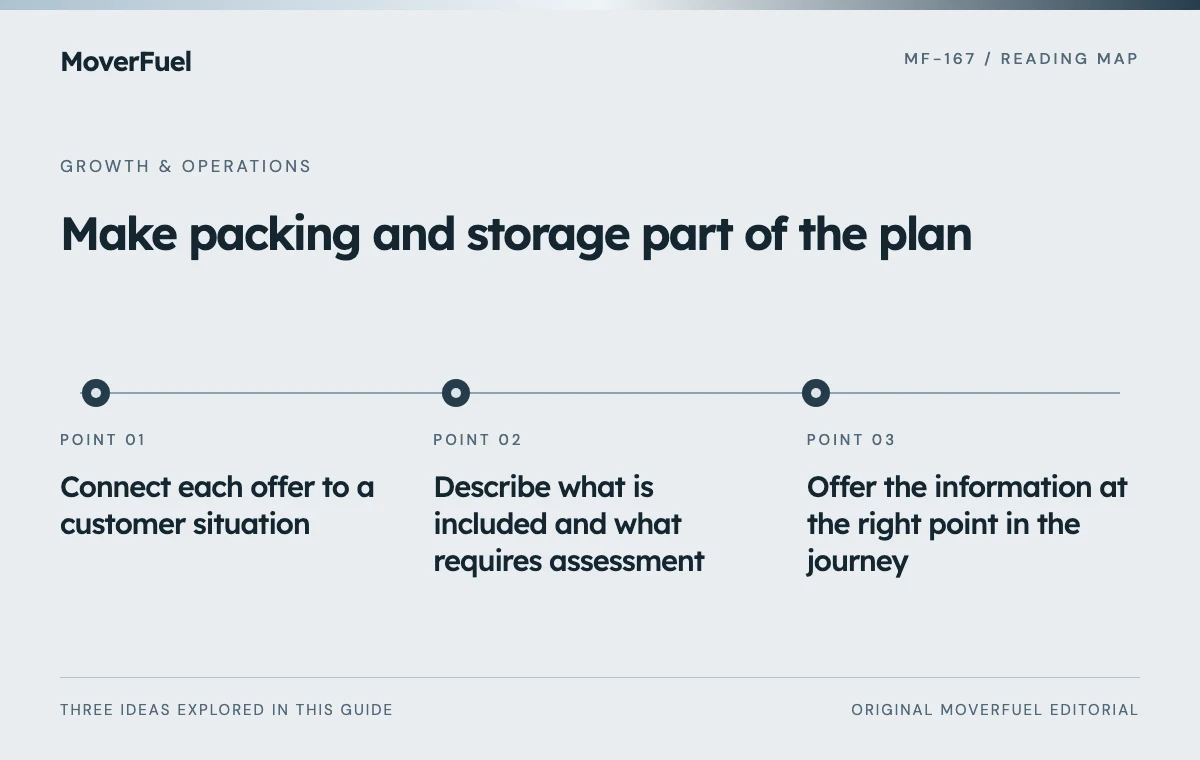
Connect each offer to a customer situation
Scroll the table horizontally to compare all columns.
| Customer situation | Possible service discussion | Clarify before recommending |
|---|---|---|
| Limited preparation time | Appropriate packing assistance | Scope, schedule and what the customer handles |
| Gap between locations | Available storage arrangement | Duration, access and transition logistics |
| Specific items need assessment | Relevant packing or handling options | Actual capability and any exclusions |
| Customer wants partial help | A defined partial-service offer | Responsibilities at each handoff |
These are discussion prompts, not automatic recommendations. Confirm that the company actually provides the service and that the customer's needs fit it. A useful question can reveal that the add-on is unnecessary.
Keep the offer language understandable. Full packing, partial packing and storage can mean different things across providers. Explain the company's own scope instead of assuming the label communicates all responsibilities.
Describe what is included and what requires assessment
For packing, explain the assessment process, materials where relevant, scheduling and the division of responsibility. Identify exclusions accurately without burying them in vague fine print. Do not promise specialist handling that has not been verified.
Make the storage arrangement clear
Explain who provides the storage, how access is arranged, how timing affects the plan and what the customer must confirm. Avoid implying that a third-party facility is owned by the mover or that availability is guaranteed before it is checked.
FTC advertising guidance requires truthful, supported claims. Apply that standard to service descriptions, promotional prices and implied promises about protection, access or convenience. Attractive copy does not remove the need to substantiate what customers are led to expect. [1]
Offer the information at the right point in the journey
Use dedicated service information for customers actively researching packing or storage. On moving pages, provide a concise explanation and a relevant next step. Avoid adding a long sales interruption before the customer can request the core move estimate.
An intake question can ask whether the customer would like to discuss packing or a storage need. Make optional fields clearly optional and avoid preselecting paid services. The team should confirm the need during assessment rather than assume interest equals acceptance.
Follow-up should answer the customer's unresolved planning question. A useful explanation of timing and responsibilities may matter more than a repeated promotion. Stop offering the service when the customer has declined it or it is not available.
Coordinate the experience with moving and storage marketing and website conversion design so the offer remains clear on mobile.
Explain pricing inputs without false precision
Tell customers which details affect the assessment and when they will receive an appropriate estimate. If the final cost depends on scope, duration or logistics, a universal instant price can mislead. State any promotional conditions where customers can understand them.
For interstate household-goods moves, FMCSA distinguishes a written estimate from a rate quote and explains related estimate requirements. Use the correct process for the actual service and jurisdiction; do not treat a website add-on calculator as a substitute for required documentation. [2]
Compare offers on the same scope. A low advertised starting figure is not a useful comparison if it excludes work that the customer reasonably expects. Train intake staff to explain the difference clearly rather than rely on a disclaimer after the sale.
Carry the accepted scope into operations
Scroll the table horizontally to compare all columns.
| Record | Why it matters | Owner to confirm |
|---|---|---|
| Requested service | Preserves the original customer need | Intake |
| Assessed scope | Defines the proposed work | Estimator |
| Accepted terms | Distinguishes interest from agreement | Sales |
| Scheduling and dependencies | Coordinates packing, move and storage steps | Operations |
| Changes and final outcome | Supports accurate follow-through and reporting | Assigned job owner |
Test the process with a representative scenario before promoting the offer. Confirm that the right team sees the requested service and that changes do not disappear between systems. A marketing checkbox is useful only if the fulfillment workflow can act on it.
Keep relevant customer information in controlled systems. Do not pass detailed inventories or personal circumstances through campaign URLs or ordinary analytics events merely to make the report richer.
Measure useful service adoption and contribution
Track requests, assessed opportunities, accepted services and completed work separately. An increase in checkbox selections is not the same as an increase in delivered add-on revenue. Review complaints or scope confusion alongside conversion.
Use actual relevant costs when evaluating contribution. Revenue minus variable costs is a different measure from revenue alone, and additional work can consume scarce time or resources. Agree on the company's cost treatment before declaring the offer profitable. [3]
Connect lead tracking with the accepted service and completed job. Use the capacity planning guide when an offer changes the fulfillment workload.
Common questions
Should packing and storage be preselected on a quote form?
No. Let customers indicate a real need and confirm the scope through the appropriate sales process. Preselection can create confusion about what they requested or agreed to buy.
How should a mover judge an add-on campaign?
Review suitable requests, accepted scope, completed work and relevant contribution, plus customer clarity and fulfillment issues. Interest alone is not a completed sale.
Your next step
Market add-on services as clear solutions to specific needs. Accurate scope, a reliable handoff and completed-job measurement matter more than maximizing form selections.
Sources & editorial notes
Platform claims cite the documents below. Operating frameworks and labeled examples are MoverFuel editorial analysis, not client results or industry benchmarks.
- FTC: advertising and marketingService advertising must be truthful and supported, including material implied claims. Reviewed .
- FMCSA: avoiding unexpected moving costsFMCSA estimate guidance concerns interstate household-goods moves; website preferences do not replace required estimates. Reviewed .
- OpenStax: contribution margin and cost behaviorContribution uses revenue less variable costs, rather than treating all additional revenue as profit. Reviewed .