An assistant can influence a customer who later searches the company name or calls a saved number. Another customer may click a source link that produces an identifiable referral. A useful AI traffic report captures the second path without pretending it measures every version of the first.
 View full-size graphic ↗
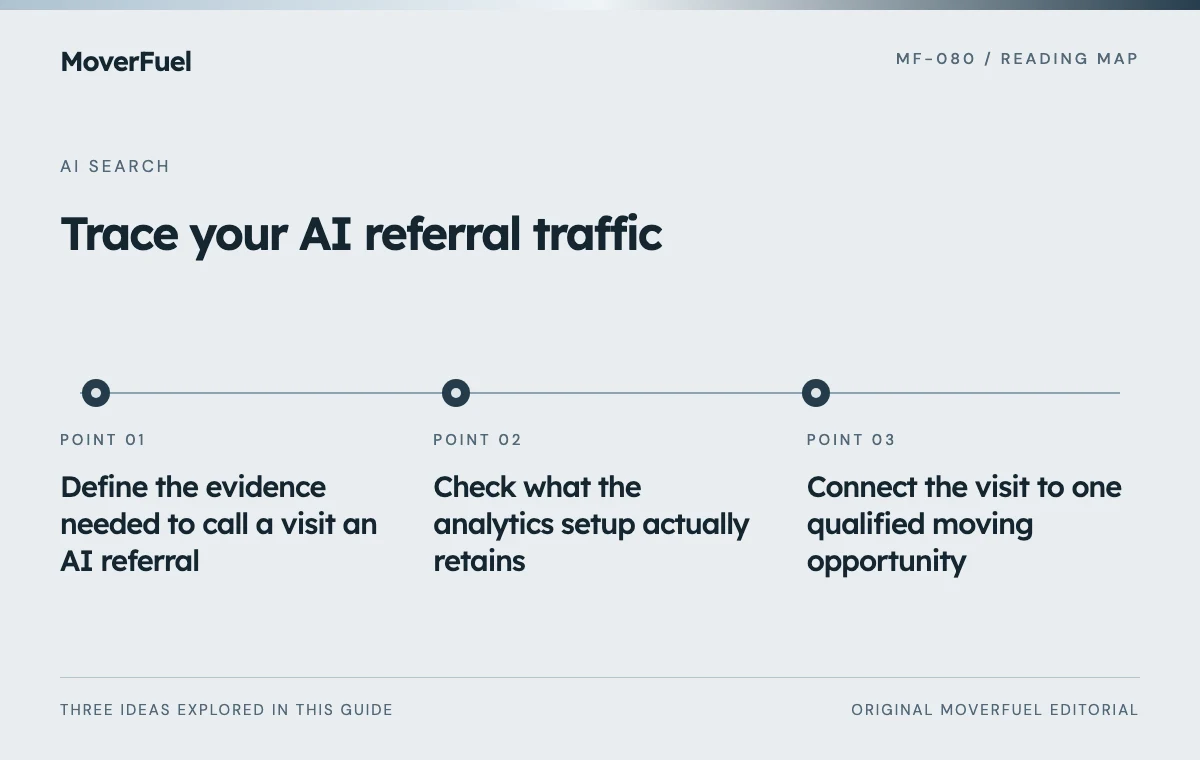
Define the evidence needed to call a visit an AI referral
Start with observed source information in your analytics implementation. Keep the raw source value alongside any reporting group you create. A manually maintained ‘AI’ category should have documented inclusion rules and a review date so new or ambiguous sources are not silently misclassified.
Google Analytics distinguishes source, medium and campaign information, with data that can come from tagging and integrations. Those dimensions describe collected acquisition context; they do not establish that a channel caused incremental revenue. [1]
Scroll the table horizontally to compare all columns.
| Evidence | Report label | Limit |
|---|---|---|
| Identifiable incoming assistant referral | Observed referral | Only the traceable visit is established |
| Customer says an assistant helped | Self-reported assistance | May not identify the final visit source |
| Direct visit after an AI mention was observed | Unknown unless further evidence exists | Timing alone does not prove the journey |
| Company cited in a sampled answer | Visibility observation | No visit or inquiry established |
Check what the analytics setup actually retains
Review source and landing-page reports with the person responsible for analytics. Inspect redirects, consent behavior, cross-domain paths and form handoffs. A source can be lost between the first page and the inquiry record even when the initial visit is measured correctly.
Trace a permitted test journey end to end
Use a controlled test that does not contaminate production lead handling. Record the entry URL, observed source, landing page and expected inquiry fields. If testing a live system is necessary, coordinate with its owner and clearly identify the test so it is excluded from sales reporting.
Do not relabel all unexplained direct traffic as AI traffic. Browser behavior, privacy controls, saved links and many other journeys can leave incomplete source information. Keep an unknown category and report its size rather than filling it with a convenient hypothesis.
Connect the visit to one qualified moving opportunity
Pass appropriate source context into the inquiry system while limiting personal data collection to what the business needs. Join follow-up contacts to the same opportunity when they concern the same move. Keep the first observed source and later assists as separate fields.
Scroll the table horizontally to compare all columns.
| Field | Decision supported |
|---|---|
| Observed source and landing page | Which content receives traceable visits? |
| Opportunity ID | Which contacts belong to one move? |
| Requested service and geography | Does the demand fit? |
| Qualification and estimate status | Did the visit lead to useful sales work? |
| Booking and completion | What outcome matured from the opportunity? |
| Self-reported discovery | Was another channel involved? |
For a mover, qualification should include the actual service, route and timing constraints. A referral asking for work the company cannot perform is still a valid visit, but it should not be counted as a qualified opportunity merely because the channel is new.
Separate attribution from incremental impact
Attribution assigns credit under a rule. Incrementality asks whether the outcome would have happened without the activity. A customer who already intended to hire the company may use an assistant to find the phone number; a recorded referral does not resolve that counterfactual.
Small samples should be reported with counts and context rather than dramatic percentage changes alone. One additional booking can transform a rate when the denominator is tiny. Note open opportunities and cancellations so the report does not compare immature and mature cohorts.
Build a report that exposes gaps instead of hiding them
Include identifiable visits, landing pages, unique opportunities, qualified requests and booked outcomes. Add the number of self-reported AI-assisted discoveries and the share of inquiries with unknown source. Keep sampled mentions in a separate visibility section.
Use the AI visibility report rubric to evaluate mention metrics, and lead tracking and automation to repair gaps in the sales handoff.
Choose actions from the evidence: clarify a landing page that attracts unsuitable work, repair a lost source field or improve the follow-up path. Do not scale a channel solely because a referral label appears in analytics. The operating question is whether the observable demand is useful and how confidently it can be measured.
Common questions
Can analytics measure every AI-assisted customer journey?
No. Some journeys end in brand searches, direct visits or offline contact without a clear assistant referrer. Preserve those limitations in the report.
Should self-reported AI discovery overwrite the tracked source?
Keep both. They describe different evidence and may reflect different stages of the same journey.
Your next step
Measure identifiable referrals carefully, join them to qualified opportunities and leave unknown journeys unknown. The credibility of the report depends on preserving uncertainty as well as outcomes.
Sources & editorial notes
Platform claims cite the documents below. Operating frameworks and labeled examples are MoverFuel editorial analysis, not client results or industry benchmarks.
- Google Analytics: traffic-source dimensions and taggingAnalytics source/medium and tagging concepts. Confidence categories, cohort example and attribution distinctions are original analytical guidance. Reviewed .