
A customer may watch a moving video, return through search and book by phone. Social may have contributed to that decision, but the evidence rarely supports treating every observed interaction as a separate booking. Measure assistance with an explicit definition and reconcile it to unique jobs before assigning commercial value.
 View full-size graphic ↗
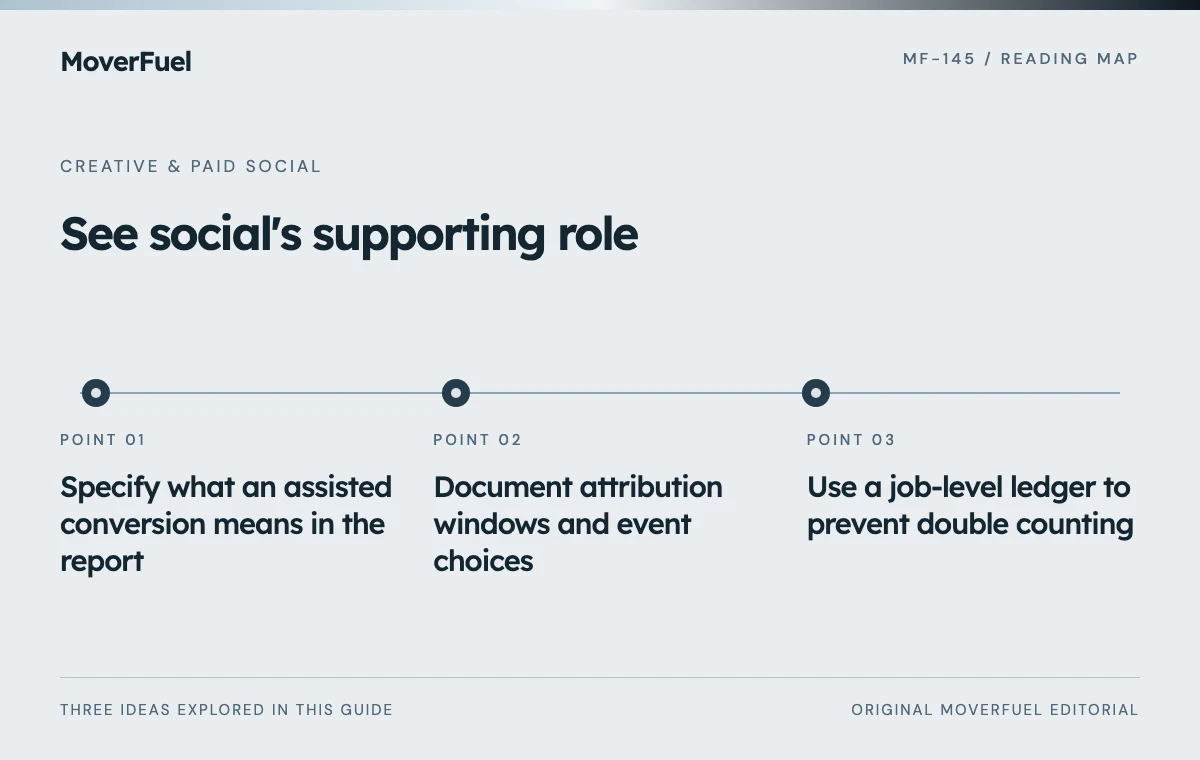
Specify what an assisted conversion means in the report
An observed social assist can mean a recorded social interaction before an inquiry or booking attributed primarily elsewhere. A platform-reported view-through conversion is a different kind of claim, based on that platform's measurement rules. Customer-reported discovery is another source of evidence. Keep these labels separate.
Google Analytics describes attribution as assigning credit to touchpoints using a model. That credit allocation does not by itself establish how many additional jobs advertising caused. Use the model name and scope when presenting results. [1]
Scroll the table horizontally to compare all columns.
| Category | What is known | What is not established |
|---|---|---|
| Observed social visit | A validly recorded visit occurred | The visit caused the eventual booking |
| Joined assisted path | A supported connection links touchpoints to one inquiry | Every earlier influence is visible |
| Platform-reported credit | The platform's rules assign an outcome | It is a unique incremental company job |
| Customer reported | Customer recalls a social interaction | Technical timing and complete path are verified |
Write the definition next to the chart. Otherwise two people can use the same term while one means a website click and the other means an ad impression recorded only inside a platform.
Document attribution windows and event choices
Record which event each system counts, its attribution window, any view-based credit and the date basis. Verify the current settings in the actual account rather than assuming a default from an old screenshot. A form submission and a completed moving job should not share an unlabeled ‘conversion’ column.
Compare like-for-like outcomes where possible
Choose a common reporting period and explain late-arriving outcomes. A booking this month can belong to an inquiry created earlier. If one report uses interaction date and another uses booking date, their monthly totals may differ without either system having a technical defect.
Retain an as-of date and the share of records that can be joined. Privacy choices, device changes and offline conversations can leave gaps. Do not fill them with a model that appears precise but has no documented basis.
Use a job-level ledger to prevent double counting
Scroll the table horizontally to compare all columns.
| Job | Recorded path | Primary inquiry view | Assistance note |
|---|---|---|---|
| J-201 | Social visit, later search form, booking | Search inquiry | Observed social assist |
| J-202 | Social form, estimate, booking | Social inquiry | No additional observed source |
| J-203 | Direct call, booking | Unknown technical discovery | Customer recalled a social video |
The example contains three unique bookings. It does not contain two social bookings plus one search booking plus another direct booking plus an extra assisted booking. Assistance notes can overlap with primary-source categories and therefore must be marked non-additive.
Keep the inquiry ID, project ID and the evidence supporting any join. Do not match records casually because names look similar. A household can request more than one move, and different people can share a surname or business address.
The first-touch and last-touch guide explains why alternative credit views can coexist without changing the underlying number of jobs.
Report value without giving every channel the full revenue total
Show unique completed revenue and contribution in the business ledger, then show attribution views separately. If a model allocates fractions of credit, explain the rule. If a report lists assisted revenue as the value of jobs with an observed assist, label it as overlapping associated value, not additional revenue.
Retain cancellations and revisions consistently. A platform that received the original booking event may not automatically reflect a later operational change. Reconcile the current business outcome before using attributed revenue to justify more spend.
Use a separate design to investigate additional bookings
A controlled experiment, where feasible and appropriately designed, can address whether an intervention changes outcomes relative to a comparison. That is a different question from which touchpoint receives credit. Available platform tests, market comparisons and business volume determine what can be evaluated credibly.
Avoid claiming incrementality from a simple rise after adding social ads when seasonality, pricing or search spend also changed. If the available evidence is observational, say so and use it to form the next hypothesis. Small moving companies may need to combine cautious quantitative analysis with customer and intake research.
A useful monthly conclusion states what was observed, how much coverage the measurement had, what remains uncertain and what decision follows. For example, the team may continue a bounded test because social-assisted inquiries fit the service, while withholding a claim of proven incremental return.
Connect Facebook Ads reporting with lead tracking so platform credit and actual moving outcomes remain distinguishable.
Common questions
Can assisted conversions be added to last-click conversions?
Usually not as unique jobs. The categories can overlap. Reconcile them to a deduplicated business ledger and label assisted views as non-additive where appropriate.
Does a social touchpoint prove the ad caused a booking?
No. It supports an observed association under the recorded evidence. Causal or incremental claims require a suitable comparison design and enough reliable data.
Your next step
Use assistance reporting to describe observed paths, not multiply bookings. Keep definitions, windows and uncertainty visible, and investigate incrementality as a separate question.
Sources & editorial notes
Platform claims cite the documents below. Operating frameworks and labeled examples are MoverFuel editorial analysis, not client results or industry benchmarks.
- Google Analytics: get started with attributionGoogle Analytics describes attribution as model-based credit assignment to touchpoints, distinct from a causal experiment. Reviewed .