
An organic visit and a booked move may appear in different systems weeks apart. Tracking them requires a durable inquiry-to-job connection and an honest account of what is known about the customer's path. The useful output is a booking report with source evidence and confidence levels, rather than a precise-looking total built from guesses.
 View full-size graphic ↗
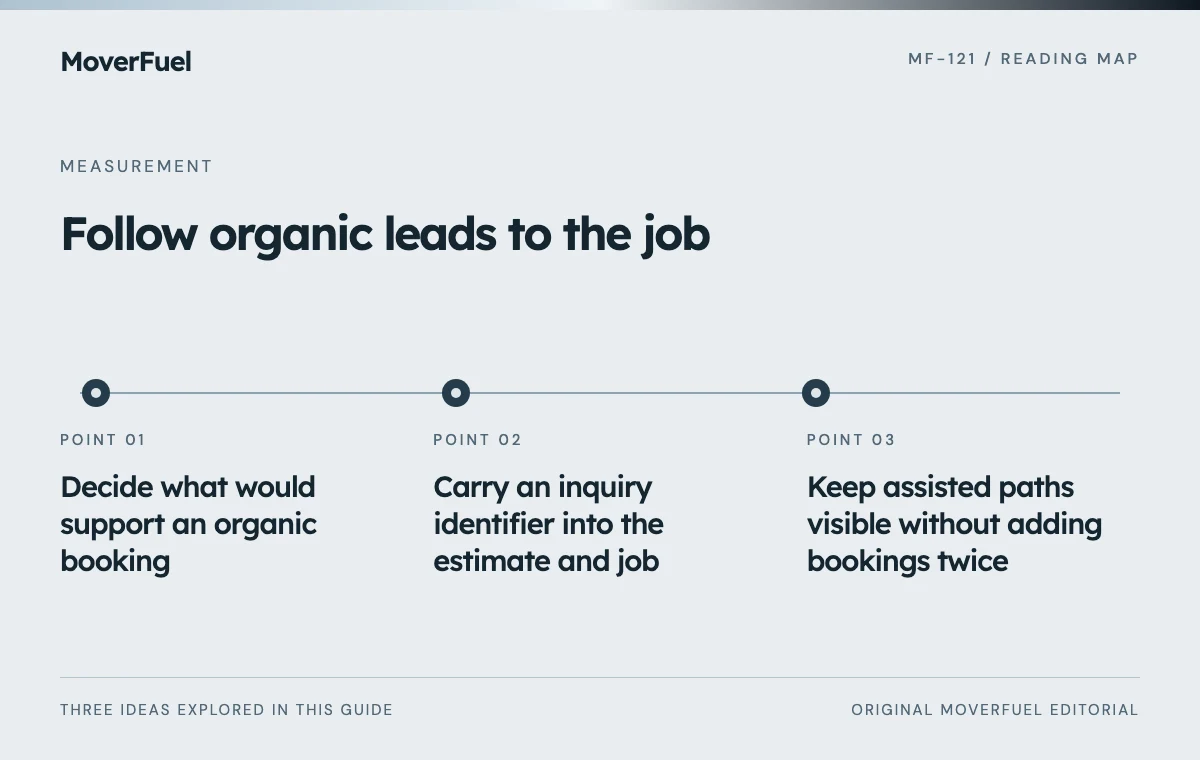
Decide what would support an organic booking
Search Console reports search impressions and clicks; those are not customer identities or booked jobs. GA4 also distinguishes user, session and event acquisition scopes. A first-user organic source and a later session source answer different questions. [1] [2]
Choose the reporting statement before selecting fields. ‘This inquiry arrived during an observed organic session’ is narrower than ‘SEO caused this job.’ A record may support the first statement while leaving the customer's earlier research, referrals and later calls unknown.
Scroll the table horizontally to compare all columns.
| Level | Evidence retained | Permitted description |
|---|---|---|
| Observed and joined | Organic session context attached to an inquiry that maps to a job | Observed organic inquiry with a booked outcome |
| Customer reported | Customer says they found the company through search | Self-reported search discovery |
| Assisted path | Observed organic interaction before another recorded inquiry source | Organic-assisted observed path |
| Unresolved | Missing source or conflicting records | Unattributed pending review |
These labels are an editorial reporting framework, not a universal analytics standard. Keep the evidence fields alongside the label so an analyst can explain why a booking was included. Do not silently promote self-reported discovery into a technically observed session.
Carry an inquiry identifier into the estimate and job
Assign a durable internal inquiry ID when a valid contact enters the intake system. Link it to the estimate and eventual project ID through your actual CRM process. The linkage should survive a rescheduled survey, a revised quote and a change of salesperson.
Treat forms and calls as separate collection paths
For a form, retain the permitted acquisition context with the submission record. For a call, establish what the phone system can actually associate with the visit. A static number on every page does not by itself identify the caller's channel. Document the limitation instead of assigning all website calls to organic.
Merge repeat contacts only when the business has evidence that they concern the same move. A customer can call, submit a form and request an updated estimate without creating three opportunities. Conversely, a repeat customer with a new relocation may represent a distinct job.
Define the underlying identifiers and outcomes with lead tracking and automation before trying to reconcile revenue by channel.
Keep assisted paths visible without adding bookings twice
Consider a fictional customer who reads a packing guide from search, later visits through a paid ad and books after a phone conversation. The observed path contains an organic interaction, but a primary-source report might assign the inquiry to paid search. Preserve both views with different labels.
Scroll the table horizontally to compare all columns.
| Job | Primary inquiry evidence | Additional path note | Unique bookings |
|---|---|---|---|
| A-101 | Observed organic form | Returned directly before accepting | 1 |
| A-102 | Observed paid inquiry | Earlier organic guide visit observed | 1 |
| A-103 | Unknown technical source | Customer reported Google search | 1 |
This ledger has three bookings, not five channel wins. An assisted-booking column can overlap with primary-source columns, so mark it as non-additive. Do not sum it into the company total. Show how many records have enough path evidence to be assessed at all.
Follow inquiry cohorts until their outcomes mature
An inquiry created this month may book next month and complete later. Report the original inquiry cohort's eventual outcomes separately from bookings created during the current reporting period. Write the date basis directly above the table.
Include the as-of date, open estimates, booked jobs, cancellations and completed work. A recent organic cohort with many undecided estimates should not be compared as though it had the same observation time as an older cohort. Revisit it at a consistent age.
When revenue is included, distinguish quoted value, booked value and completed recognized revenue. Keep cancellations and material corrections attached to the original job record. Avoid changing the source label merely because the customer returned through a different channel to pay or reschedule.
Audit uncertain joins before making an SEO budget decision
Each review, sample bookings from all four evidence levels. Check the original contact, source capture, duplicate handling and estimate-to-job join. Record the cause of each mismatch: absent call context, overwritten source, unlinked project or conflicting customer report.
Prioritize repairs that recover reliable evidence without unnecessary personal data collection. Then compare organic landing-page groups by qualified inquiries and mature outcomes. A page that attracts research traffic and assists later decisions may need a different evaluation from a direct estimate-request page.
For the acquisition strategy behind those pages, see SEO for Moving Companies. This tracking method measures observed contribution; it does not establish incremental causation by itself.
Common questions
Can Search Console tell me which searcher booked?
No. Use it to understand search visibility and clicks. Connect inquiries to jobs through your own permitted intake records, and retain the limitations of the source evidence.
Should an organic-assisted booking count as an organic booking?
It can appear in a clearly labeled assisted view. Keep it separate from the mutually exclusive primary-source total so the same job is not added twice.
Your next step
Build the report around a stable inquiry-to-job join, an explicit date basis and a visible source-confidence label. That makes organic booking evidence useful without claiming certainty the data cannot support.
Sources & editorial notes
Platform claims cite the documents below. Operating frameworks and labeled examples are MoverFuel editorial analysis, not client results or industry benchmarks.
- Google: Search Console performance overviewSearch Console search clicks and impressions are search-performance measures, not customer/job identities. Reviewed .
- Google Analytics: scopes of traffic-source dimensionsGA4 user, session and event acquisition scopes represent different attribution contexts. Reviewed .