
A fleet count is not an acquisition target. The capacity a moving company can sell depends on crews, job duration, travel, maintenance, dates and service requirements. Marketing should work from the same saleable calendar as dispatch. Otherwise, a successful campaign can generate demand for work the operation cannot accept while leaving other dates underfilled.
 View full-size graphic ↗
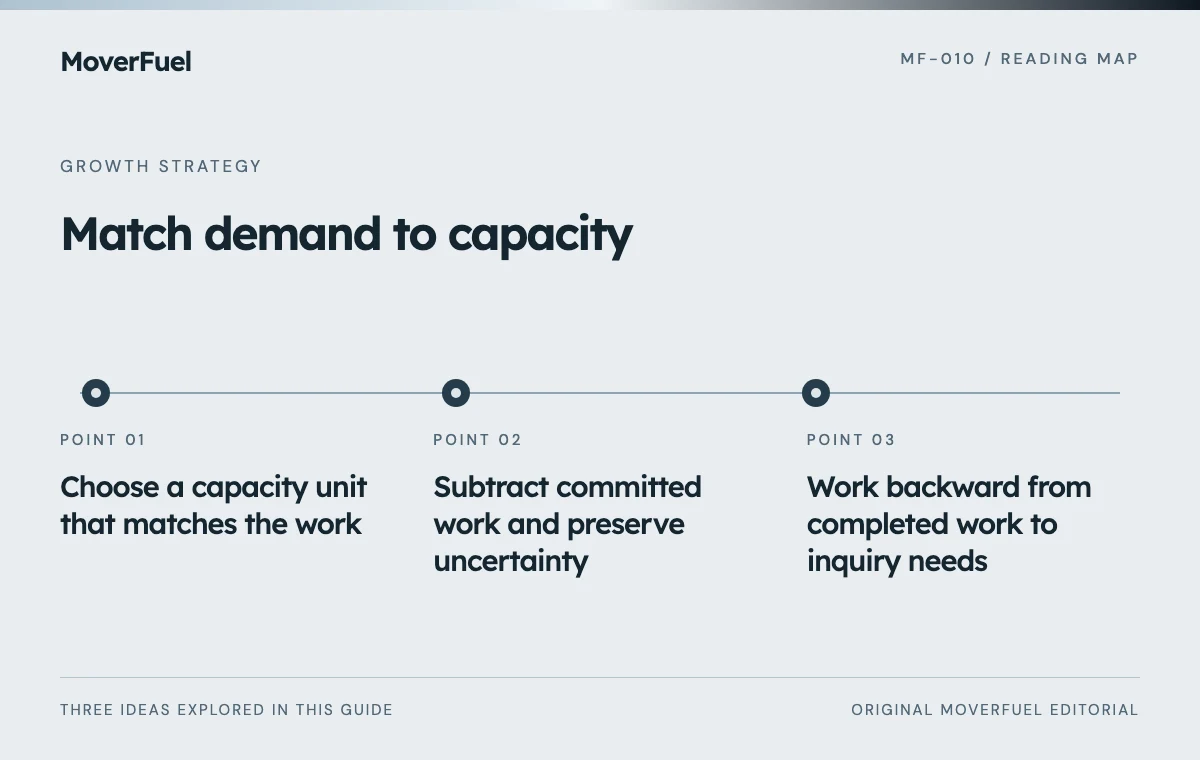
Choose a capacity unit that matches the work
Use crew-hours, crew-days or another unit the operator can estimate consistently. A truck-day may be useful for one service but misleading when crew skill or travel is the constraint. Define the unit and its assumptions before translating it into a number of jobs.
Ask dispatch to distinguish theoretical availability from saleable time. Maintenance, training, travel and operational buffers can make a vehicle or crew unavailable even when the calendar looks open. Different services may also require different crew sizes, equipment or experience.
Scroll the table horizontally to compare all columns.
| Input | Why it matters |
|---|---|
| Crew availability and skills | Not every team can perform every service |
| Job duration and travel | A nominally short move can consume a larger operating window |
| Vehicle and equipment availability | A crew may be available while the required resources are not |
| Date and route constraints | Open time in one slot cannot always serve another customer's request |
| Operational reserve | A fully allocated plan can leave no room for variability |
Subtract committed work and preserve uncertainty
Start with a calendar of confirmed commitments, then identify tentative holds and the rules for releasing them. Do not count the same capacity as available to several campaigns. A commercial project under discussion may require a different reservation decision from a small local inquiry.
Use a transparent planning example
If the intended jobs average one crew-day within this model, four completed jobs would use the remaining capacity. If the jobs need two crews or span several days, the same calendar supports a different number. Keep those assumptions beside the calculation so marketing does not turn a rough capacity estimate into a guaranteed availability claim.
Work backward from completed work to inquiry needs
Use the operation's own qualification, booking and completion rates when available. For a simplified scenario, required inquiries equal desired completed jobs divided by the product of those rates. The result is a planning estimate, not a promise that a campaign can buy that many suitable inquiries at a given price.
Scroll the table horizontally to compare all columns.
| Assumption | Value |
|---|---|
| Desired additional completed jobs | 4 |
| Qualified share of unique inquiries | 50% |
| Booking rate among qualified inquiries | 40% |
| Completion rate among bookings | 80% |
| Expected completion rate per inquiry | 0.50 × 0.40 × 0.80 = 16% |
| Estimated inquiries required | 4 ÷ 0.16 = 25 |
The fractional probabilities describe uncertainty, not permission to overbook. Dispatch still controls actual commitments. Model a range and update it with observed outcomes. If a rate is unknown, identify the data gap rather than presenting a precise inquiry target as established demand.
Use the marketing budget guide to connect these funnel assumptions with acquisition costs and job contribution.
Shift the offer only where customer flexibility exists
Open Tuesdays do not automatically solve excess Saturday demand. Some customers have flexibility; others are constrained by leases, access reservations or project schedules. Explain genuine options without implying that every request can be moved to a convenient date.
Align campaign and page messaging with the service windows the business wants to discuss. If the offer changes, make sure intake understands it and confirms availability before commitment. A special scheduling message should not remain active after the relevant capacity is sold.
- Identify the dates or services with saleable capacity.
- Confirm whether the business has a legitimate offer for those slots.
- Brief the estimator on how to discuss flexibility.
- Monitor whether the resulting inquiries actually fit the target window.
- Update the offer when dispatch changes the availability picture.
Give dispatch and marketing a shared change process
Assign someone to communicate material capacity changes and someone to act on them in campaigns and pages. Specify which changes require immediate attention, such as a service becoming unavailable, and which belong in the next scheduled review. Keep a record of when the operating fact changed and when the marketing response occurred.
The SBA notes that operations influence marketing and the customer experience. In a moving business, the connection is direct: a service promise depends on people and equipment being able to deliver it. A shared change process keeps the acquisition message tied to that reality. [1]
Avoid a system where every routine calendar adjustment causes an unplanned campaign overhaul. Use agreed thresholds and service-level decisions. Marketing needs enough stability to evaluate a test, while dispatch needs a way to prevent promises the operation cannot fulfill.
Recognize when more demand requires a different business decision
When existing capacity is consistently filled, the next question may be pricing, service mix, additional resources or the quality of demand. Increasing advertising alone does not create another trained crew. Estimate the cost and lead time of expansion before treating higher inquiry volume as the objective.
Capacity also has an economic dimension. Open time is not necessarily worth filling with any job at any price. Evaluate the contribution of the work, the effect on surrounding commitments and the risk of rushed delivery. A low-value job can consume the slot needed for work that better fits the business.
Review the planning model after the period closes. Compare expected and actual job duration, cancellations, route fit and unused time. Use the difference to improve the next forecast. The value of the model is its ability to expose assumptions and guide coordination, not its appearance of precision.
Common questions
Can truck count determine how many leads we need?
Not by itself. Crew availability, job duration, routes, equipment and timing affect what the business can sell. Translate operational capacity into jobs before estimating inquiry needs.
Should we advertise more when the calendar has gaps?
First establish which gaps are saleable and whether the existing inquiry process can fill them. A targeting or scheduling adjustment may be appropriate, but unanswered suitable inquiries may require an intake fix instead.
Should cancellation assumptions justify accepting extra bookings?
No automatic rule follows from a planning average. Dispatch must manage actual commitments and service obligations. Use cancellation data to understand uncertainty, not to promise capacity that has not been confirmed.
Your next step
Start with saleable operating time, subtract real commitments and translate the remaining work into a range of inquiry needs. Keep the assumptions visible and give dispatch a direct role in acquisition decisions. Marketing should help fill the capacity the business can deliver well.
Sources & editorial notes
Platform claims cite the documents below. Operating frameworks and labeled examples are MoverFuel editorial analysis, not client results or industry benchmarks.
- SBA: marketing and salesThe relationship between operations, marketing and customer experience. All capacity and funnel arithmetic is explicitly hypothetical original analysis. Reviewed .