
Established movers rarely need a longer list of marketing tactics. They need a defensible way to decide which work deserves investment. A company with a strong local reputation, spare weekday capacity and weak inquiry handling has a different growth problem from a well-booked operator opening another market. Build the strategy as a portfolio of service-market decisions, then give each channel a specific role in that portfolio.
 View full-size graphic ↗
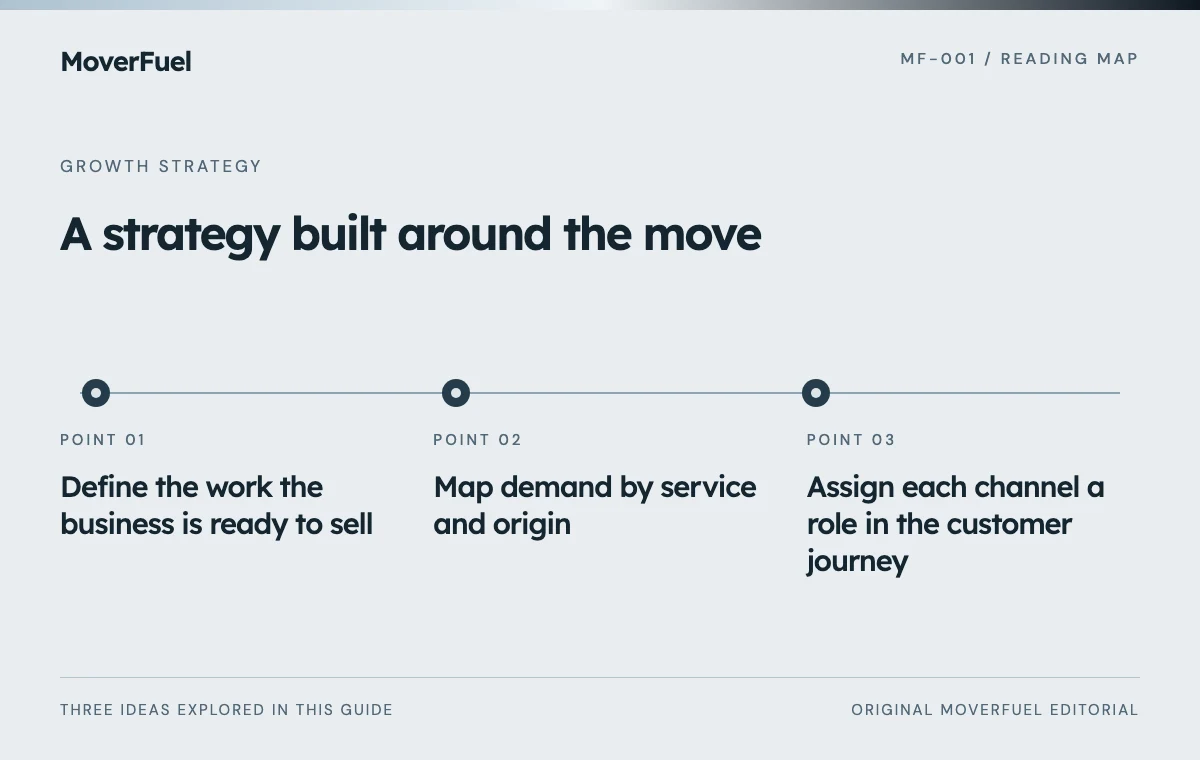
Define the work the business is ready to sell
Start with services, origins, destinations and timing. Review the jobs the company can deliver reliably and the constraints that limit additional work. Those constraints may include trained crews, trucks, storage space, estimator coverage, route availability or management capacity. Marketing should make those constraints visible rather than assume that every extra inquiry is useful.
Next, distinguish growth objectives. Filling existing capacity, improving the value of the service mix and entering a new market are not interchangeable. Each needs a different offer, investment horizon and risk limit. Write the objective in terms of completed work the operation wants to serve, not a percentage increase in website traffic.
Scroll the table horizontally to compare all columns.
| Operating situation | Priority question | First investment to evaluate |
|---|---|---|
| Open local weekday capacity | Can existing demand be directed to suitable dates? | Service messaging, intake coverage and focused demand capture |
| Healthy volume but weak contribution | Which jobs and acquisition costs leave enough value? | Service-mix analysis, qualification and conversion improvements |
| A real new branch is ready | Can this market generate suitable work at a sustainable cost? | Local information, market-specific pages and a bounded acquisition test |
These are planning scenarios, not universal prescriptions. The correct first investment depends on what the company's records show. A campaign may be the next step in one market and an expensive distraction in another.
Map demand by service and origin
Use a matrix with services in rows and real operating markets in columns. Mark where the company has demand, fulfillment capacity, trustworthy tracking and a credible customer proposition. A blank cell is a research question, not automatic permission to launch a new page or campaign.
Follow the customer's job, not just their current location
Local customers often need confidence that the company serves their neighborhood and date. Long-distance requests need origin-destination qualification. Office moves can involve multiple stakeholders and a site-survey process. The website and intake path should reflect those differences before channel budgets are compared.
The local versus long-distance marketing guide explores how route, trust and measurement change between those services.
Do not infer demand solely from a competitor's visible advertising or from a large keyword estimate. Competitor activity does not reveal margins, cancellations or sales effectiveness. Combine available market research with your own inquiry records and a clearly bounded test when uncertainty remains.
Assign each channel a role in the customer journey
The SBA's marketing-planning guidance connects target customers, competitive advantage, sales methods, actions and budget. Apply that relationship when evaluating channels: the question is what each channel helps a suitable customer do, not whether the channel is fashionable. [1]
Scroll the table horizontally to compare all columns.
| Role | Channels to evaluate | Business question |
|---|---|---|
| Capture expressed demand | Relevant Search campaigns, eligible LSA and organic service discovery | Are suitable customers reaching an estimate? |
| Establish local confidence | Business Profile, useful local content and authentic customer evidence | Can customers verify that the business serves their need? |
| Explain a considered purchase | Service guides, project examples and permitted follow-up | Does the prospect have enough information to take the next step? |
| Maintain relationships | Referrals, partnerships and appropriate customer communication | Does existing trust produce relevant introductions or repeat needs? |
Several channels can contribute to the same booking. A customer might see the business locally, inspect the website, return through an ad and then call. Plan for that journey without claiming you can attribute every influence perfectly. Avoid adding channel-level conversion totals together when they may describe the same people.
Keep eligibility and operational requirements separate from strategy. For example, Local Services Ads availability and screening depend on the service and location. Verify those requirements before allocating a launch budget, rather than treating every proposed channel as immediately available. [2]
Fund the measurement and conversion foundation
Before buying more demand, trace an inquiry from its entry point to its final recorded outcome. Confirm that calls reach the right team, forms arrive once, source information survives the handoff and staff use consistent dispositions. A polished report cannot repair an unrecorded estimate or a duplicated lead.
- Define a unique inquiry and how duplicate contacts are linked.
- Define qualification from the service the business can provide.
- Record estimates, bookings, cancellations and completed work as distinct events.
- Retain the dates needed to compare mature inquiry cohorts.
- Assign responsibility for investigating missing or contradictory records.
A website also needs to explain the offer and make the next step workable on a phone. Fix broken submission handling, misleading availability claims and unclear service boundaries before expanding traffic. These improvements support multiple channels at once, which is why they belong in the shared foundation budget.
Use the lead qualification framework to keep a serviceable opportunity separate from a completed sale.
Choose a base plan and an expansion option
Create a base plan the business can sustain without optimistic assumptions. It should maintain essential information, the estimate journey, measurement and a manageable acquisition program. Then define an expansion option that receives funding only when a stated condition is met. This prevents every attractive idea from becoming an immediate recurring commitment.
Evaluate additional spending using the additional work it can reasonably support. A channel's historic average may not describe the next market or the next increment of budget. Consider job contribution, sales effort, cancellations and the cost of new capacity. Revenue alone does not show how much value remains after delivery and acquisition costs.
Keep one-time implementation costs visible instead of burying them in a recurring media line. Likewise, budget for the internal time needed to approve content, review lead outcomes and coordinate dispatch. A plan can fail because the operator lacks execution capacity even when the advertising account has sufficient funds.
Review the portfolio through decisions, not channel rankings
At the review, compare the original objective with qualified work, completed outcomes and current operational constraints. Ask what you learned, which assumption changed and where the next investment would remove the most important bottleneck. A low-cost inquiry channel is not automatically the best place for more budget if the jobs are unsuitable or the sales team is saturated.
Scroll the table horizontally to compare all columns.
| Finding | Decision to consider | Evidence still needed |
|---|---|---|
| Demand fits, but estimates stall | Improve the intake and estimate process | Reasons for the handoff loss |
| A service books, but contribution is weak | Revisit pricing, service mix or acquisition cost | Consistent job-level costs and cancellations |
| A market has suitable demand and spare capacity | Test a measured increase | Marginal results from the additional spend |
| A new channel remains ambiguous | Extend, redesign or stop the test | Whether the question was measurable and the cohort mature |
Translate the chosen decisions into a short operating plan. Preserve the distinction between annual direction and weekly execution: the strategy sets the work worth pursuing; the action plan names the people, tasks and evidence required to pursue it.
Build that execution layer with the 90-day moving-company marketing plan.
Common questions
What is the best marketing channel for an established moving company?
The answer depends on the service-market objective, operating capacity and measured outcomes. Compare the job each channel performs and the quality of the resulting work instead of choosing from a universal ranking.
Should marketing focus on more leads or more booked moves?
Track both, but define their relationship. Leads are an early signal. Suitable bookings and completed contribution are closer to the business objective, while sales capacity and fulfillment determine what growth the company can absorb.
When should a mover add another market?
When the operation can genuinely serve it and the business has a clear offer, responsible team and bounded acquisition plan. A new location page or wider targeting does not create operational readiness.
Your next step
Build the strategy around serviceable work, give each channel a role and fund the handoffs that make demand useful. Keep expansion conditional on evidence and capacity. The result should be a series of defensible investment decisions rather than a collection of disconnected tactics.
Sources & editorial notes
Platform claims cite the documents below. Operating frameworks and labeled examples are MoverFuel editorial analysis, not client results or industry benchmarks.
- SBA: marketing and salesRelationships among target market, sales plan, marketing actions, budget and review. Reviewed .
- Google: Local Services verificationLocal Services Ads screening varies by service and geography; no eligibility is assumed. Reviewed .